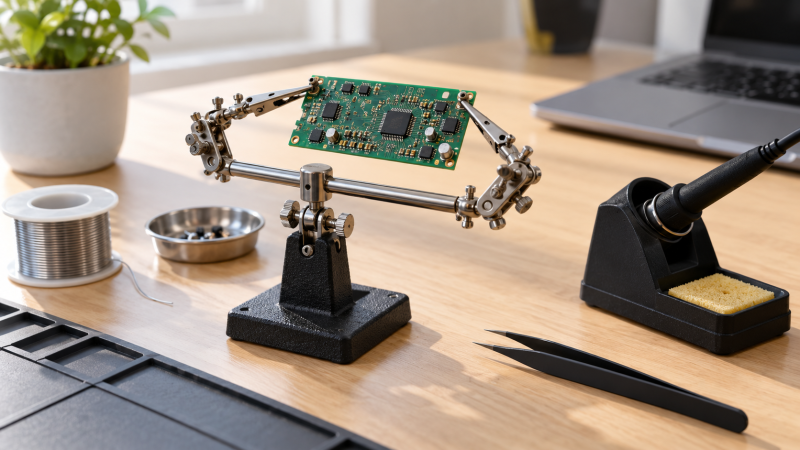
Helping hands earn their bench space when a repair needs one object held steady while both of your hands stay on the work. A good station can keep a wire against a terminal, suspend a connector for tinning, hold a small switch during inspection, or position a light component while adhesive sets. It should do that without drifting, scratching the part, or crowding the iron and tools.
Arm count is only part of the choice. Clip reach, base size, joint type, magnification, lighting controls, and protective covers decide whether a station fits the job. The XYK XYK-141 is our best overall pick because it combines four clip arms, a 3X lighted magnifier, six brightness levels, and a seven-inch steel base. The NEIKO 1902 and AORAEM 2.5X are simpler two-clip stands, while the NZQXJXZ, NOEVSBIG, and Drdefi models use magnetic positioning on steel bases.
Helping hands are not interchangeable with a dedicated board fixture. A clip can hold a wire, connector, or light component, but a purpose-built PCB holder supports a board across defined jaws. For the loose screws surrounding a repair, a magnetic parts tray is a separate tool for that.
| Image | Product | Details | Check Price |
|---|---|---|---|
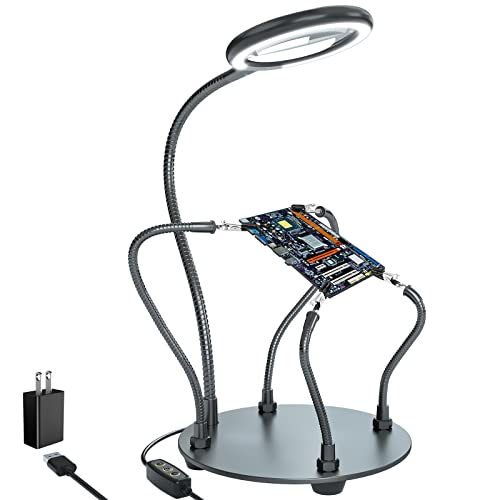 | XYK XYK-141 | Best fit: All-around illuminated helping hands Clip arms: 4; two 7.5-inch and two 5-inch Magnifier: 3X; lighted Lighting: 28 LEDs; 500 lumens; 6 levels Base: 7-inch steel; 4 rubber pads | Check Price on Amazon |
 | NEIKO 1902 | Best fit: Simple two-clip cast-iron stand Clip arms: 2 Magnifier: 2X Adjustment: Ball joints Base: Cast iron | Check Price on Amazon |
 | Kaisiking PCB Holder Station | Best fit: Four arms on a rectangular base Clip arms: 4; 8.34 inches each Magnifier: 2.5X Clip rotation: 360 degrees Base: 7.87 x 5.51-inch steel; 5 pads | Check Price on Amazon |
 | NZQXJZ NZV55H0413FDJ23 | Best fit: Magnetic modular repair station Clip arms: 4 magnetic arms Magnifier: 3X; lighted Lighting: 10 brightness levels; 3 colors Extras: 4 magnetic towers; removable tray | Check Price on Amazon |
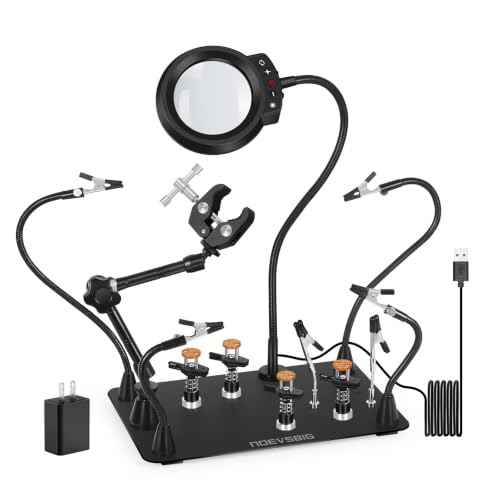 | NOEVSBIG Helping Hands | Best fit: Clamp and thread compatibility Clip arms: 4 magnetic arms Magnifier: 5X; LED Super clamp: 2.16-inch opening; 360 degrees Threads: 1/4-inch and 3/8-inch compatible | Check Price on Amazon |
 | Drdefi Large Helping Hands | Best fit: High-magnification close work Magnifier: 12X; 4.3-inch glass Lighting: Stepless dimming; 3 colors Arm mounting: Magnetic Clip protection: Removable rubber covers | Check Price on Amazon |
 | KUVRS 10X-GJTP-YS | Best fit: Integrated organized repair area Work area: 13.7 x 8.5 inches Clip arms: 4; 360-degree clips Magnifier: 10X; lighted Organization: 100 screw positions; 8 driver slots; 14 parts areas | Check Price on Amazon |
 | AORAEM 2.5X | Best fit: Basic two-clip magnifier Clip arms: 2; four-way swivels Magnifier: 2.5X; 63 mm glass Lens rotation: 360 degrees Base: Cast iron | Check Price on Amazon |
How to read these recommendations
All eight products have a New offer and list electronics repair, circuit-board work, soldering, inspection, or another close-detail task among their uses. The comparisons below use the figures each seller states, including magnification, lighting controls, clip count, base construction, adjustment method, and listed accessories.
Seller descriptions of stability, grip, light quality, and surface protection are claims, not measured results. Base weights, arm loads, color temperatures, and clamp-force figures are not stated. The gap is easiest to see when two products look similar but publish different levels of detail.
1. XYK XYK-141 — Best Overall Helping Hands Station
Our take: The XYK XYK-141 suits a bench that needs four flexible clip arms, a lighted 3X magnifier, multiple brightness levels, protected jaws, and a broad steel base in one station. It is more complete than a basic two-clip stand, and it does not expand into the integrated silicone work area of the KUVRS station.
XYK specifies two 7.5-inch and two 5-inch metal gooseneck arms. Each alligator clip can rotate through 360 degrees and comes with a rubber sleeve intended to avoid scratches and short circuits. The different arm lengths let the station approach a part from more than one height, although the listing does not state a supported load per arm.
The magnifier uses 3X glass, 28 lamp beads, a stated 500-lumen output, and six brightness levels. A round powder-coated steel base measures seven inches across and has four rubber pads. That footprint gives the arms room to spread, so plan a dedicated clear area beside the soldering iron and other tools.
Pros
- Four clip arms include two 7.5-inch and two 5-inch goosenecks.
- The 3X lamp lists 28 LEDs, 500 lumens, and six brightness levels.
- Rubber clip sleeves are intended to reduce scratches and short circuits.
- A seven-inch steel base uses four rubber pads for bench contact.
Cons
- The seven-inch round base consumes more space than a compact two-clip stand.
- No maximum supported load is stated for the flexible arms.
2. NEIKO 1902 — Best Simple Cast-Iron Stand
Our take: The NEIKO 1902 is the straightforward choice for buyers who need two clips, moderate magnification, and a conventional weighted base. It does not add lighting, magnetic modules, or four separate hands. Instead, it keeps the familiar two-clip layout on adjustable arms with what NEIKO specifies as a 2X magnifying glass.
NEIKO mounts the mirror and clamps on adjustable ball joints so each can be positioned at different angles. The dual alligator spring clamps are intended for components, workpieces, small electronics, and appliances. Ball joints offer quick directional changes, though the listing does not give arm lengths or a rotation range in degrees.
The cast-iron base is described as heavy duty and intended to keep the unit upright during fine work. The listing gives 5 x 3 x 2.68 inches overall but does not identify base-only dimensions or weight, so it cannot be compared numerically with XYK’s steel platform (rated at seven inches) or Kaisiking’s rectangular base. Choose it for a small number of held parts and uncomplicated adjustment.
Pros
- Two alligator clips provide a simple setup for a wire and component.
- Adjustable ball joints position both the 2X lens and clamp arms.
- A cast-iron base is intended to keep the stand upright during close work.
Cons
- The station provides no built-in lighting for the 2X magnifier.
- Two clips offer fewer simultaneous holding points than four-arm stations.
- Base-only dimensions, arm lengths, and total weight are not stated.
3. Kaisiking PCB Holder Station — Best Wide Rectangular Base
Our take: Kaisiking’s station is a strong fit when a wide rectangular base is easier to place against the back of a bench than a circular platform. Kaisiking specifies a painted steel base measuring 7.87 x 5.51 inches with five anti-slip rubber pads, so you know the footprint before you commit desk space.
The manufacturer provides four 8.34-inch metal gooseneck arms carrying alligator clips with rubber boots. Kaisiking says the clips rotate 360 degrees and lock in position. The listing also gives a specific adjustment note. Turning a rotating arm counterclockwise, opposite the screw-tightening direction, is intended to keep it secure rather than loosen the base connection.
The kit includes a 2.5X magnifying glass to support close inspection without the lighting controls found on XYK, NZQXJXZ, or Drdefi. The listing identifies five flexible metal arms but four clip arms, with the remaining support used for the magnifier. Plan on four held objects, not five alligator clips.
Pros
- Four 8.34-inch gooseneck arms provide equal reach around the work.
- The 7.87 x 5.51-inch steel base has a clearly stated rectangular footprint.
- Five anti-slip pads are included for grip and work-surface protection.
- Rubber-booted clips rotate through a stated 360 degrees.
Cons
- The 2.5X magnifier has no integrated light in the supplied description.
- Four long arms plus the magnifier require clearance above the rectangular base.
4. NZQXJXZ NZV55H0413FDJ23 — Best Magnetic Modular Station
Our take: The NZQXJXZ station suits buyers who rearrange their bench between tasks. Four adjustable clip arms and four small magnetic towers can be placed on the steel base, and a removable tray gives loose parts a defined area within the station.
Its lighted 3X real-glass magnifier provides ten brightness levels and three light colors. Those controls give it more lighting combinations than XYK’s six-level lamp, although the listing does not state lumens or exact color-temperature values. The clip jaws are insulated, and the four tower pieces are described as circuit-board holders.
The powder-coated steel base uses four rubber pads and is presented as foldable or portable after setup. Its overall dimensions are not provided, while Amazon lists the product weight as about 3.46 lb. Choose the magnetic layout when quick repositioning is more useful than the fixed repeatability of arms bolted into one location.
Pros
- Four magnetic clip arms can be repositioned across the steel base.
- Four small magnetic towers add another way to support a circuit board.
- The 3X LED magnifier offers ten brightness levels and three light colors.
- A removable tray keeps small parts within the station’s work area.
Cons
- Base dimensions and lighting output in lumens or color temperature are not stated.
- Magnetic modules need deliberate placement to avoid crowding each other.
5. NOEVSBIG Helping Hands — Best Clamp and Thread Compatibility
Our take: NOEVSBIG’s station suits buyers who want to mount a tool or component through common threaded connections. The separate super clamp has a listed 2.16-inch jaw opening, two 1/4-inch mounting screws, and compatibility with 1/4-inch and 3/8-inch threads. The clamp makes it the most adaptable pick here for that job.
The package includes four flexible arms with alligator clips, a 360-degree rotating clamp, magnetic holders, and a heavy-duty steel base. NOEVSBIG also describes parallel clamps that apply pressure across a board rather than relying only on traditional alligator jaws. The listing does not give a maximum PCB size or a load limit for the super clamp.
A 5X glass magnifier uses LED illumination and includes a 5V/2A power adapter. No brightness-step count, lumen figure, or lens diameter is stated. Choose it for the clamp hardware and the 5X viewing level, not for precisely documented lighting controls.
Pros
- The super clamp opens 2.16 inches and rotates through 360 degrees.
- Dual 1/4-inch mounts support both 1/4-inch and 3/8-inch thread compatibility.
- Four magnetic helping-hand arms can be repositioned on the steel base.
Cons
- The 5X LED magnifier has no stated brightness levels or lumen output, and the listing gives no maximum board size, clamp load, or thread adapters beyond the listed hardware.
6. Drdefi Large Helping Hands — Best for 12X Magnification
Our take: Drdefi is the high-magnification option. It pairs a 12X real-glass lens with a 4.3-inch diameter, a combination aimed at detailed examination and close repair tasks. Magnification this high narrows the comfortable working view for some users, so choose it for tiny details rather than assuming it is better for every soldering job.
The light offers stepless brightness adjustment and three color options described as warm, cool, and neutral. A control on the lamp head keeps adjustment near the lens. Drdefi does not publish lumen output, color-temperature values, or working distance, so buyers cannot directly compare the illumination with XYK’s stated 500 lumens.
Flexible magnetic arms attach to a large base and use thickened alligator clips with removable rubber covers. Drdefi says the covers protect the circuit board and the gooseneck arms hold their set angle. The number of included helping hands is not stated in the feature bullets, so the 12X lens and magnetic positioning are the safer reasons to select it.
Pros
- A 12X real-glass lens provides the highest stated magnification in this group.
- The 4.3-inch lens gives the magnified field a disclosed physical size.
- Stepless dimming and three light colors support different viewing preferences.
- Magnetic arms permit quick repositioning across the base.
Cons
- The feature bullets do not state how many clip arms are included, and no lumen output, working distance, or color-temperature figures are provided.
- The high magnification narrows the comfortable working view for some users.
7. KUVRS 10X-GJTP-YS — Best Integrated Repair Work Area
Our take: KUVRS suits a bench that needs holding and organization together. It combines helping hands with a structured repair surface rather than a plain base. The 13.7 x 8.5-inch work area includes a silicone mat, a zero-to-ten-inch ruler, 100 screw positions, eight screwdriver slots, and 14 parts areas. It is the fullest single-station option here.
The listing rates the silicone mat to 932 degrees Fahrenheit, or 500 degrees Celsius. That figure describes the mat, not every arm, clip, light, or accessory on the station. Four adjustable gooseneck arms end in 360-degree rotating alligator clips with widened contact areas and removable rubber covers.
The 10X real-glass magnifier uses separate knobs for brightness and color temperature, plus a memory function for the previous mode. A flexible swing arm carries the lens, and a metal clamp with a non-slip rubber pad secures it without tools. The broad work area has many functions but takes more room than a compact cast-iron stand.
Pros
- The 13.7 x 8.5-inch area combines a silicone mat with organized storage zones.
- Four gooseneck arms use 360-degree clips and removable rubber covers.
- The 10X glass lens has separate brightness and color-temperature knobs.
Cons
- The large integrated work area needs substantially more desk space.
- The 932°F rating applies to the silicone mat, not the complete station.
- One hundred screw positions may be unnecessary for simple wire-holding jobs.
8. AORAEM 2.5X — Best Basic Two-Clip Magnifier
Our take: AORAEM’s stand is the basic alternative for occasional electronics, craft, or inspection work. It provides two alligator clips on four-way swivels, a 2.5X glass lens, and a cast-iron base. There is no integrated lamp, multi-arm magnetic system, or organized work mat to set up.
AORAEM specifies the lens measures 63 mm across and can rotate through 360 degrees. AORAEM says the adjustable magnifier and clips can accommodate medium-to-small items, but it gives no opening width or weight limit for the jaws. The metal-chromed lens frame and cast-iron base make it a conventional compact stand.
The title notes that no battery is included, while the feature bullets do not describe a powered light. Treat it as a naturally lit magnifier station. Choose it when two held points are enough and the work area already has suitable task lighting.
Pros
- The 63 mm glass lens provides a rated 2.5X magnification and 360-degree rotation.
- Two clips on four-way swivels support simple positioning tasks.
- A cast-iron base is intended to resist movement during light work.
Cons
- The station does not list built-in illumination for the magnifier.
- Two clips cannot hold as many separate parts as four-arm stations.
- Clip reach, jaw opening, and supported load are not stated.
Buying Guide: Choosing Helping Hands for Electronics Repair
Decide how many independent parts must be held
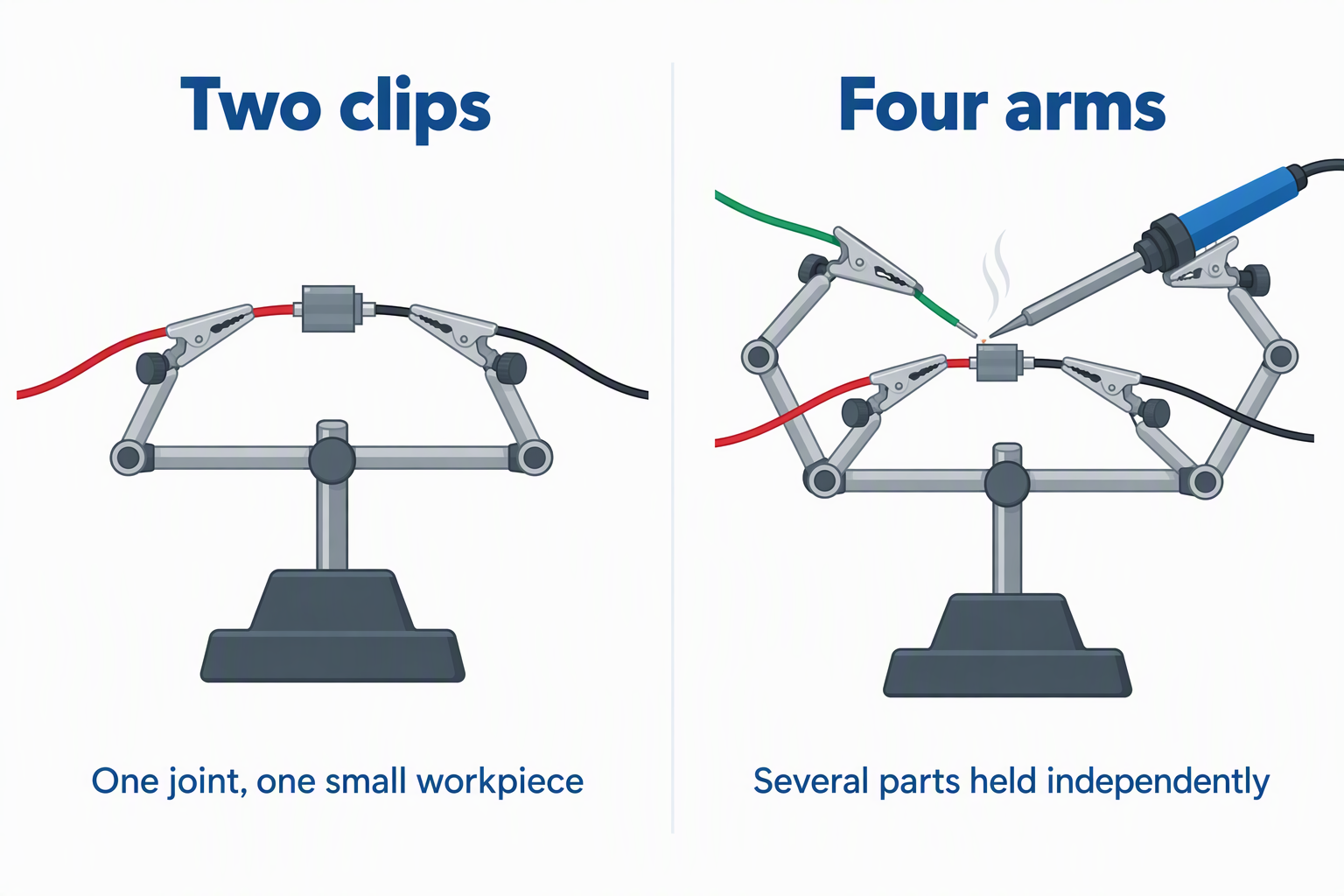
Two clips are enough for a wire-to-connector joint or a single small workpiece. NEIKO and AORAEM use conventional dual-clip layouts that reduce setup complexity and leave more open space around the task. They suit occasional soldering, inspection, gluing, or craft work where extra arms would remain unused.
Four arms make sense when several leads or tools need independent positions. XYK, Kaisiking, NZQXJZ, NOEVSBIG, and KUVRS all provide four primary helping-hand arms. More arms do not guarantee more capacity because load limits are not supplied, but they allow several light items to approach the same work. Keep a USB-C electric screwdriver outside the arm sweep so its cable or body does not disturb the setup.
Match the joints to the adjustment style
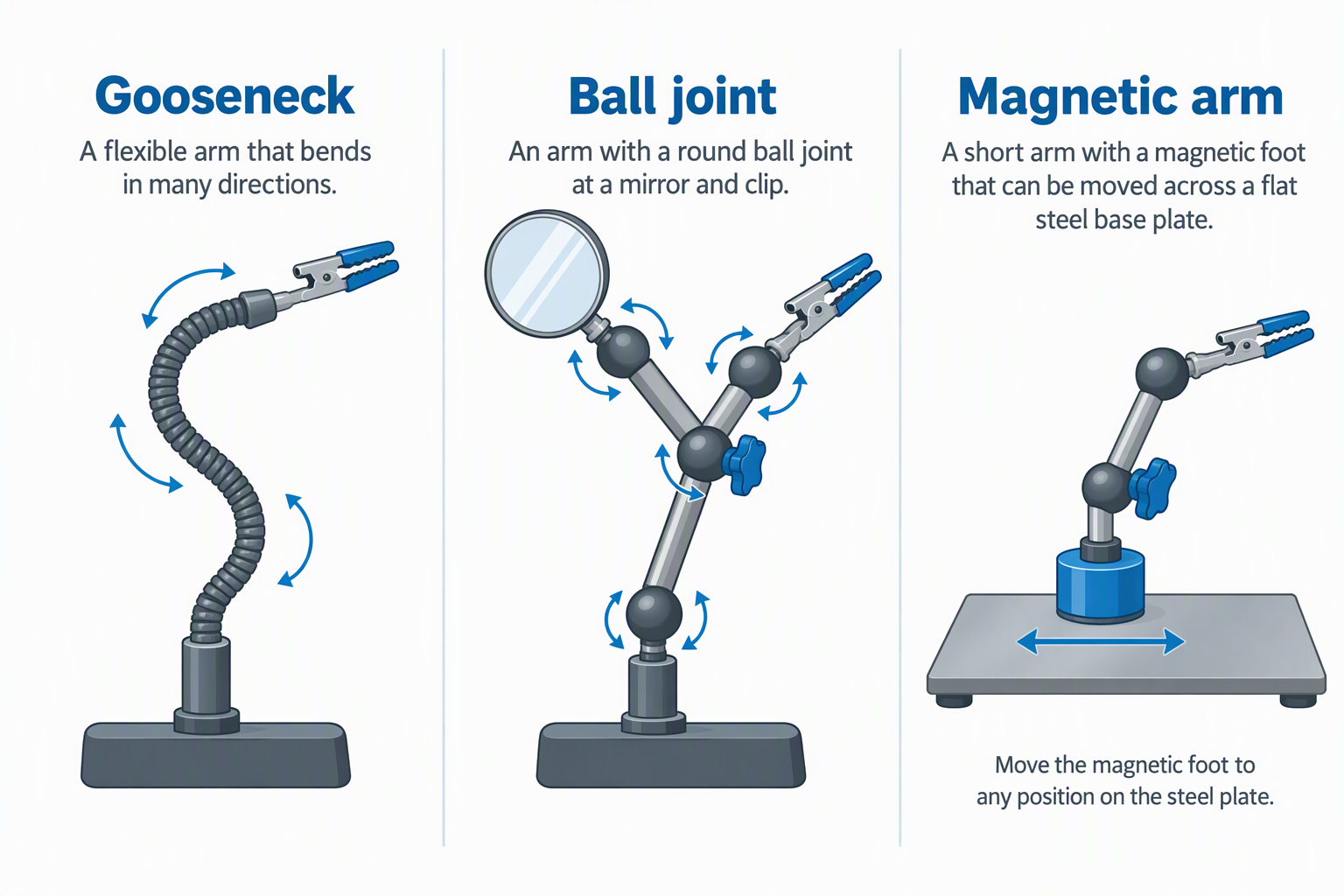
Goosenecks favor quick curves and repeatable reach. XYK publishes two 7.5-inch and two 5-inch arms, while Kaisiking provides four equal 8.34-inch arms. NZQXJXZ, Drdefi, and KUVRS also use flexible arms. Their clips can approach a part from many directions, but no listing supplies a weight-versus-sag chart.
Ball joints and magnetic bases solve different positioning needs. NEIKO uses adjustable ball joints for its mirror and clips. NZQXJXZ, NOEVSBIG, and Drdefi let users reposition magnetic arms across a steel base. Magnetic modules can reset a layout quickly, while arms fixed in one place give each position a dedicated attachment point.
Pick magnification for the working distance
Moderate magnification preserves a broader working view. NEIKO uses 2X, Kaisiking and AORAEM use 2.5X, and XYK and NZQXJXZ use 3X. These levels are natural starting points when the user needs to see the entire joint and nearby tool tip rather than isolate the smallest detail.
Higher magnification is a specialized choice. NOEVSBIG lists 5X, KUVRS lists 10X, and Drdefi lists 12X through a 4.3-inch lens. Their listings do not state focal or working distances, so the number alone cannot show how comfortable the lens is to use. Buyers who alternate bench work with computer inspection should keep data devices such as USB-C drive docks and M.2 SATA enclosures beyond the close-work zone.
Compare lighting controls rather than lens power alone
A built-in lamp can reduce shadows from hands and tools. XYK lists 500 lumens, 28 lamp beads, and six brightness levels. NZQXJZ offers ten brightness levels and three colors. Drdefi uses stepless dimming with three colors, while KUVRS separates brightness and color-temperature controls and remembers the previous setting.
Not every magnifier includes lighting. NEIKO and Kaisiking list magnifying glasses without lamp specifications, and AORAEM’s supplied features describe no powered light. Those stands can still work under an existing bench lamp. Avoid routing lamp leads through the same space as USB4 cables or other test connections that may pull on the clipped work.
Reserve enough base and arm clearance
Published base dimensions let you check the fit before you buy. XYK uses a seven-inch round base, Kaisiking uses a 7.87 x 5.51-inch rectangle, and KUVRS expands into a 13.7 x 8.5-inch work area. These stations need additional room above the base for arms, clips, and the lens.
A compact stand can coexist more easily with test hardware. NEIKO and AORAEM are simpler two-clip systems, though their base dimensions are not stated. On a multipurpose desk, keep a compact Thunderbolt 5 dock or desktop drive enclosure outside the soldering area rather than using it as a support or magnetic mounting surface.
Frequently Asked Questions
Are helping hands suitable for holding an entire PCB?
They can hold a light board, but clips and a PCB vise do different jobs. XYK, Kaisiking, NZQXJZ, NOEVSBIG, Drdefi, KUVRS, and AORAEM all identify boards or electronics among their uses. Alligator clips usually contact isolated edges or points rather than supporting the board across purpose-built jaws.
Use a dedicated holder when board width, thickness, flatness, or two-sided rotation is the core requirement. Helping hands are the better choice for wires, connectors, switches, and light parts surrounding the board. NOEVSBIG’s parallel clamp and NZQXJZ’s magnetic towers provide additional board-support options, but their listings do not state full board-capacity ranges.
Do rubber clip covers prevent short circuits?
Several listings describe covers as insulation or protection, but placement still matters. XYK says its rubber sleeves help avoid scratches and short circuits. Kaisiking supplies rubber boots, Drdefi uses rubber covers, and KUVRS includes thick removable covers over widened clip contacts.
A cover does not make every clamping point suitable for live electronics. Position jaws away from exposed conductors and follow the device’s service procedure. Inspect removable covers for correct seating before relying on them to separate metal jaws from the work.
Is 10X or 12X magnification better than 2X or 3X?
Higher magnification is better only when the detail and working distance suit it. Drdefi’s 12X lens and KUVRS’s 10X lens target very close work, while NOEVSBIG sits at 5X. NEIKO, Kaisiking, AORAEM, XYK, and NZQXJZ stay between 2X and 3X for a wider view of the immediate work area.
The listings do not provide a focal distance, so the magnification number alone cannot rank these lenses by comfort. A buyer who needs to watch the iron tip, joint, and nearby wire together may prefer moderate magnification even when a higher-power lens is available.
Does a magnetic arm base work on any desk?
Magnetic arms attach to their compatible steel base, not automatically to every desktop. NZQXJXZ, NOEVSBIG, and Drdefi supply magnetic positioning systems, while KUVRS uses a broader integrated surface. Wood, glass, aluminum, and many composite desks do not provide the ferrous mounting surface a magnet needs.
Use the included base and keep magnets away from products whose manufacturer warns against magnetic exposure. The magnetic layout is useful because arm positions can move quickly. It is no reason to attach the station to a nearby computer or storage device.
Which helping-hands station is easiest to fit on a crowded bench?
A two-clip stand has the least complicated working envelope. NEIKO and AORAEM avoid four-arm layouts and large organized mats, though their exact base dimensions are not stated. Kaisiking provides the clearest compact footprint figure at 7.87 x 5.51 inches, while XYK requires a seven-inch circle.
KUVRS needs the most planned space because its 13.7 x 8.5-inch area integrates tool and parts storage. That size can replace several separate organizers, but it is not the best answer when only a wire and connector need support. Measure both the base and the arm sweep before choosing.
Final recommendation
The XYK XYK-141 is the strongest general-purpose choice for an electronics bench because its four arms, 3X lighted lens, six brightness levels, rubber-covered clips, and seven-inch steel base are all clearly described. NEIKO and AORAEM suit simpler two-point jobs, while Kaisiking offers a disclosed rectangular footprint and four equal-length arms.
Choose NZQXJXZ for magnetic modules and a removable tray, NOEVSBIG for its 2.16-inch super clamp and thread compatibility, Drdefi for 12X viewing, or KUVRS for an integrated 13.7 x 8.5-inch repair surface. The right station holds the parts at a workable angle without crowding the bench.