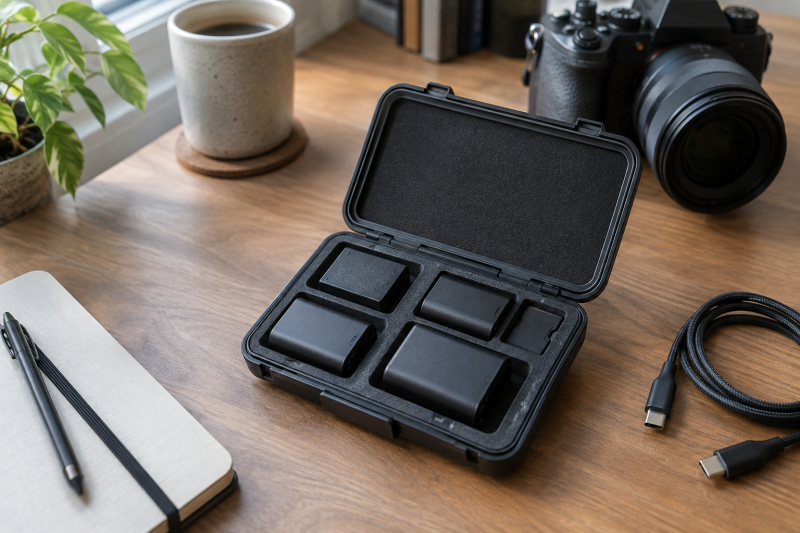
A camera battery case should keep loose packs sorted, reduce movement inside a larger gear bag, and make charged and depleted batteries easy to distinguish. Soft pouches fold flat and fit changing battery shapes, while structured ABS cases separate each battery and can add fitted memory-card slots. Neither style changes the battery’s electrical safety requirements, and none of the products here is described as a fireproof battery container.
This guide compares eight products with active New Amazon listings. The main differences are capacity, maximum battery dimensions, listed battery models, closure type, terminal separation, water or moisture language, status markers, memory-card storage, belt attachment, and packed size. Exact fit counts for more than the label, because a case that accepts an LP-E6 or NP-FZ100 may explicitly reject an NP-FW50, and broad “standard battery” wording does not replace measuring the pack.
The JJC Three-Battery Hard Case is our best overall organizer because its fitted ABS compartments separate three batteries, three sliders track charge state, and the lid stores three major card formats. The JJC BC Case is the better six-battery choice, provided each pack fits under 1.5 by 0.9 by 2.4 inches and is not an NP-FW50. For a light soft pouch without card storage, the NEEWER Four-Pocket Holder folds flat and lists a broad group of common camera batteries.
Camera Battery Case Comparison
| Image | Product | Details | Check Price |
|---|---|---|---|
 | YKEBVPW Four-Slot Camera Battery Case | Case style: Soft fold-flat 1680D nylon pouch Battery capacity: 4 Published fit: LP-E6, EN-EL15, NP-FW50, NP-F550, AA, AAA examples Card storage: None listed Status system: Reverse battery orientation | Check Price on Amazon |
 | NEEWER Four-Pocket DSLR Battery Case | Case style: Soft fold-flat polyurethane-coated nylon pouch Battery capacity: 4 Published fit: LP-E6, LP-E8, LP-E10, LP-E12, EN-EL14, EN-EL15, NP-FW50, NP-F550 Card storage: None listed Status system: Reverse battery orientation | Check Price on Amazon |
 | TXEsign TX-022.060 Camera Battery Storage Bag | Case style: Zippered nylon case with mesh pockets Battery capacity: 6 Published fit: GoPro, AA, DSLR, and Sony A77 battery examples Card storage: None listed Status system: None listed | Check Price on Amazon |
 | JJC BC-P2 Battery and Memory Card Pouch | Case style: Polyester belt pouch with hook-and-loop closure Battery capacity: 2 camera batteries Published fit: LP-E6NH, EN-EL15a, NP-FW50, NP-F550, NP-FZ100 and more Card storage: 1 zip pocket for SD, CF, or XQD cards Status system: None listed | Check Price on Amazon |
 | JJC Six-Battery and Memory Card Case with Labels | Case style: Sealed ABS hard case with foam lining Battery capacity: 6 Published fit: Up to 1.5 x 0.9 x 2.4 inches; not NP-FW50 Card storage: 16 microSD, 6 SD, 3 CFexpress A, 2 XQD or CFexpress B Status system: Number and label stickers | Check Price on Amazon |
 | JJC Three-Battery and Memory Card Hard Case | Case style: ABS hard case with fitted compartments Battery capacity: 3 camera batteries or alternate AA layout Published fit: Below 2.2 x 1.6 x 0.9 inches Card storage: 6 SD, 6 CFexpress B or XQD, 6 CFexpress A Status system: 3 built-in charge-state sliders | Check Price on Amazon |
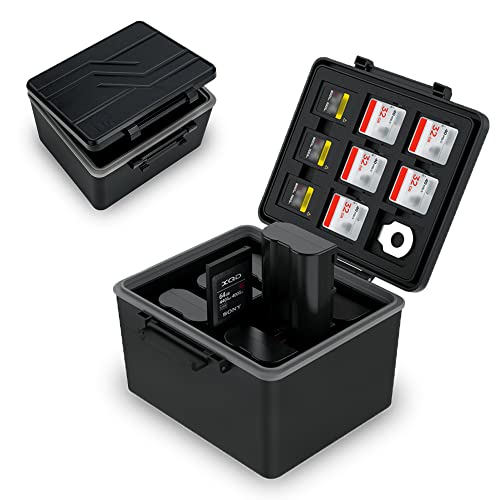 | JJC BC Case Six-Battery and SD Card Holder | Case style: Sealed ABS hard case with pre-cut EVA foam Battery capacity: 6 Published fit: Up to 1.5 x 0.9 x 2.4 inches; not NP-FW50 Card storage: 16 microSD, 6 SD, 3 CFexpress A, 2 XQD or CFexpress B Status system: Number and label stickers | Check Price on Amazon |
 | NOMATIC McKinnon Three-Battery Case | Case style: Soft case with magnetic closure Battery capacity: 3 Published fit: Most standard DSLR and mirrorless batteries; dimensions not stated Card storage: None listed Status system: Charged and dead sticker indicators | Check Price on Amazon |
Capacity figures describe slots, not guaranteed compatibility with every battery. JJC publishes a 1.5 by 0.9 by 2.4 inch maximum for its two six-battery cases and explicitly excludes Sony NP-FW50 packs. JJC specifies a different limit of 2.2 by 1.6 by 0.9 inches for the three-battery hard case. Compare all three battery dimensions and the terminal orientation before ordering.
1. YKEBVPW Four-Slot Battery Pouch — Best Fold-Flat Organizer
The YKEBVPW pouch is listed as being made of 1680D nylon and features four stitched compartments to keep batteries separate inside a camera bag. A fastening-tape flap closes over the pockets for quick access and helps prevent packs from falling out during movement. The soft pouch compresses flat when empty, so it is easy to store between shoots.
The listing names LP-E6, EN-EL15, NP-FW50, NP-F550, AA, and AAA examples and describes broad support across camera brands. No pocket dimensions are listed, so those examples are more useful than the general compatibility statement. Large NP-F packs may fit differently from compact mirrorless batteries and should be checked before travel.
The nylon is described as protecting against scratches and moisture, not as a sealed waterproof or impact-resistant enclosure. Batteries can be inserted in opposite directions to mark charged and depleted status, but the pouch has no dedicated status indicator. For a similar four-pocket format with a polyurethane coating and a more detailed battery list, compare the NEEWER Four-Pocket Holder.
[greenbox] Best for a mixed-camera kit that needs four soft compartments and minimum empty-bag bulk. [/greenbox] Our TakeThe 1680D pouch is a simple way to stop batteries from moving around in a bag. The pouch folds flat and is built for organization, not for rigid impact protection or a verified weather seal.
- Four stitched battery compartments
- Durable 1680D nylon
- Folds flat when empty
- No pocket dimensions supplied
- No rigid shell or dedicated status marker
2. NEEWER Four-Pocket Battery Holder — Best Soft Pouch
NEEWER’s holder is a soft nylon pouch with a polyurethane coating and four separately stitched pockets. Fastening tape closes the slots, and batteries come out quickly. Like the YKEBVPW, the holder compresses flat when not in use.
The compatibility list includes LP-E6, LP-E8, LP-E10, LP-E12, EN-EL14, EN-EL15, NP-FW50, and NP-F550 batteries, plus AA cells and camera examples. Batteries are not included. Because the listing gives no slot dimensions, compare the pack shape rather than assuming every variant within those families fits identically.
NEEWER suggests inserting full and empty batteries in opposite directions. That method is fast but depends on everyone using the same convention, so label the pouch or establish a consistent terminal orientation. The polyurethane-coated nylon is described as protective and durable, but no water-resistance or impact rating is listed. For a zippered six-pocket pouch, see the TXEsign TX-022.060.
[bluebox] Best for creators who want a documented four-pocket soft pouch for several common DSLR and mirrorless battery families. [/bluebox] Our TakeThe NEEWER is the strongest basic soft pouch because its battery list is unusually specific. It is a light organizer rather than a sealed or crush-resistant case.
- Four separate pockets
- Detailed compatibility examples
- Folds flat for storage
- No exact slot dimensions
- Charged-state tracking relies on orientation
3. TXEsign TX-022.060 Six-Pocket Case — Best Zippered Soft Case
The TXEsign case closes with a zipper and has six internal mesh pockets. The fully enclosed pouch can keep small packs and AA cells together without relying on one shared fastening flap. It is listed for several GoPro generations, DSLR batteries, and Sony A77-related use.
The nylon case measures 6.29 by 2.55 by 1.5 inches and weighs 1.75 oz. With published outer dimensions, you can reserve space in a small camera bag more easily. Individual pocket dimensions are not stated, so large camera packs still need a fit check.
With mesh you can see the packs, but it gives less shaped separation than pre-cut foam. The listing mentions no weather seal, rigid protection, charge-status markers, or memory-card slots. The active New listing was marked scarce. For batteries and cards in one compact pouch, compare the JJC BC-P2.
[graybox] Best for up to six small batteries when a light zippered enclosure is preferred over a fold-over flap. [/graybox] Our TakeThe TXEsign offers the highest pocket count among the soft-only organizers and publishes its outer size and weight. Mesh pockets and scarce stock are the main tradeoffs.
- Six internal mesh pockets
- Full zipper closure
- Only 1.75 oz
- No individual pocket dimensions
- Availability was marked scarce
4. JJC BC-P2 Battery and Card Pouch — Best Belt Pouch
The JJC BC-P2 has two main battery pockets and one zippered pocket for memory cards. The rear fastening system is a belt loop that can be removed without undoing the belt, and the pouch can also go inside a backpack. A hook-and-loop front closure gives fast access to the batteries.
Each main slot holds one camera battery, six AA or 14500 cells, eight AAA cells, or two 18650 cells according to the listing. Named camera packs include LP-E6NH, LP-E17, EN-EL15a, NP-FW50, NP-F550, NP-FZ100, NP-W126, and others. The zip pocket can carry SD, CF, or XQD cards without dedicated fitted slots.
The polyester construction is described as protection from dust, moisture, scratches, and damage, but it is not a sealed hard case. The two-battery limit makes sense for active shooting, where quick belt access counts for more than carrying an entire day’s inventory. For six batteries and fitted card slots, the JJC BC Case is the better organizer.
[greenbox] Best for carrying two working batteries and a few memory cards on a belt during an active shoot. [/greenbox] Our TakeThe BC-P2 is the only product here built around belt access, so it is useful during events or location work. The card pocket is flexible storage rather than a fitted card organizer.
- Removable belt-loop attachment
- Two flexible-capacity battery pockets
- Separate zippered card pocket
- Only two camera-battery slots
- No fitted memory-card compartments
5. JJC Six-Battery Case with Labels — Best Labeled Hard Case
This structured JJC case stores six camera batteries plus 16 microSD cards, six SD cards, three CFexpress Type A cards, and two XQD or CFexpress Type B cards. JJC describes the ABS shell and silicone sealing ring as water resistant, shock resistant, and dust resistant.
JJC specifies that each battery must fit within 1.5 by 0.9 by 2.4 inches, and the listing explicitly says Sony NP-FW50 batteries do not fit. Supported examples include LP-E6 variants, EN-EL15, NP-FZ100, NP-W235, DMW-BLF19, DMW-BLK22, and OM BLX-1. Exact dimensions should decide fit when a battery is not named.
The lid includes soft foam card slots and stores a flathead tool for quick-release plate screws. Number and label stickers are included for a written organization scheme, and the firm ergonomic lock helps prevent accidental opening. The almost identical JJC BC Case lists EVA card and battery storage with the same key capacity limits.
[bluebox] Best for a six-battery, multi-card kit that benefits from supplied number and text labels. [/bluebox] Our TakeThis case holds batteries and several card formats as one labeled set. The fixed dimensions and NP-FW50 exclusion are more important than the long compatibility list.
- Six battery compartments
- Fitted storage for four card categories
- Labels and flathead tool included
- Does not fit Sony NP-FW50 batteries
- Larger than soft battery-only pouches
6. JJC Three-Battery Hard Case — Best Overall
This JJC ABS case has three camera-battery compartments sized for packs below 2.2 by 1.6 by 0.9 inches. Named examples include Canon LP-E6, Sony NP-FZ100, Nikon EN-EL15, and Fujifilm NP-W235. The left and right areas can hold eight AA batteries instead, according to the listing.
Three small charge-status sliders sit beside the battery compartments. The sliders are more reliable than remembering an orientation convention and do not use up label stock. The fitted compartments separate batteries and are described as preventing accidental contact, while the shell protects against dust, moisture, and splashing water.
The lid holds six SD cards, six CFexpress Type B or XQD cards, and six CFexpress Type A cards in EVA slots. The case also has a snap closure, a card ejector, and a flathead screwdriver. We pick it as best overall for its balance of three working batteries, clear state tracking, and broad card storage. For a softer three-battery option without cards, the NOMATIC McKinnon Case is simpler.
[greenbox] Best for a three-battery mirrorless or DSLR kit that needs built-in charge tracking and fitted card storage. [/greenbox] Our TakeThe status sliders show charge state without battery flipping or disposable labels. With its hard shell and fitted card slots, it is the strongest balanced field case.
- Three dedicated charge-state sliders
- Separate fitted battery compartments
- Holds up to 18 cards across three formats
- Only three camera-battery positions
- Rigid shell does not fold for storage
7. JJC BC Case Six-Battery Organizer — Best High-Capacity Hard Case
The JJC BC Case holds up to six camera batteries plus six SD cards, 16 microSD cards, three CFexpress Type A cards, and two XQD or CFexpress Type B cards. The batteries are separated by pre-cut EVA foam, and the cards are held in fitted EVA slots in the lid.
Battery size is limited to 1.5 by 0.9 by 2.4 inches, with support listed for LP-E6 variants, EN-EL15, NP-FZ100, NP-W235, NP-W126, DMW-BLF19, and similar packs. The listing explicitly says it does not fit Sony NP-FW50. A silicone sealing ring and ABS exterior are described as protection from dust, moisture, splashing, and accidental contact.
The case has a solid snap closure and includes a flathead plate tool plus preprinted number and label stickers. Among the hard cases, it shares the most battery slots with the labeled JJC case, so it is our pick for creators who want batteries and media in one box. If charge-state sliders count for more than six-pack capacity, the JJC Three-Battery Hard Case is easier to track at a glance.
[bluebox] Best for a multi-camera creator kit carrying six compatible batteries and several card formats together. [/bluebox] Our TakeThe BC Case has six battery slots and keeps batteries separated in foam. It needs a label or consistent workflow to distinguish charged packs, and NP-FW50 users must choose another case.
- Six fitted battery compartments
- Stores four memory-card categories
- Sealing ring, labels, and plate tool included
- No built-in charged-state sliders
- Does not fit Sony NP-FW50 batteries
8. NOMATIC McKinnon Three-Battery Case — Best Magnetic Soft Case
The NOMATIC McKinnon case is a soft organizer for three standard DSLR or mirrorless batteries. A magnetic closure holds the packs and allows quick access. The compact pouch fits within a larger camera bag and has no fixed footprint like a hard ABS box.
Included sticker indicators mark charged and depleted batteries. The stickers give a visible state system without reversing the battery, though they can be lost or misapplied and need a consistent team convention. The product is described as durable and long lasting.
The listing gives overall case dimensions but does not state material, exact battery models, pocket measurements, weather resistance, terminal separation, or rigid protection. “Most standard batteries” is too broad to establish fit, so measure the packs and check the case before relying on it. For a soft holder with more named battery models, see the NEEWER Four-Pocket Holder.
[graybox] Best for three standard-size batteries when magnetic access and a soft compact form matter most. [/graybox] Our TakeThe magnetic closure and status stickers make for quick field use, but the missing measurements and materials make compatibility harder to judge than the other cases.
- Magnetic quick-access closure
- Three battery positions
- Charge-status stickers included
- No pocket measurements or model list supplied
- No weather or impact details stated
Buying Guide: Choosing a Camera Battery Case
Measure the battery in all three dimensions
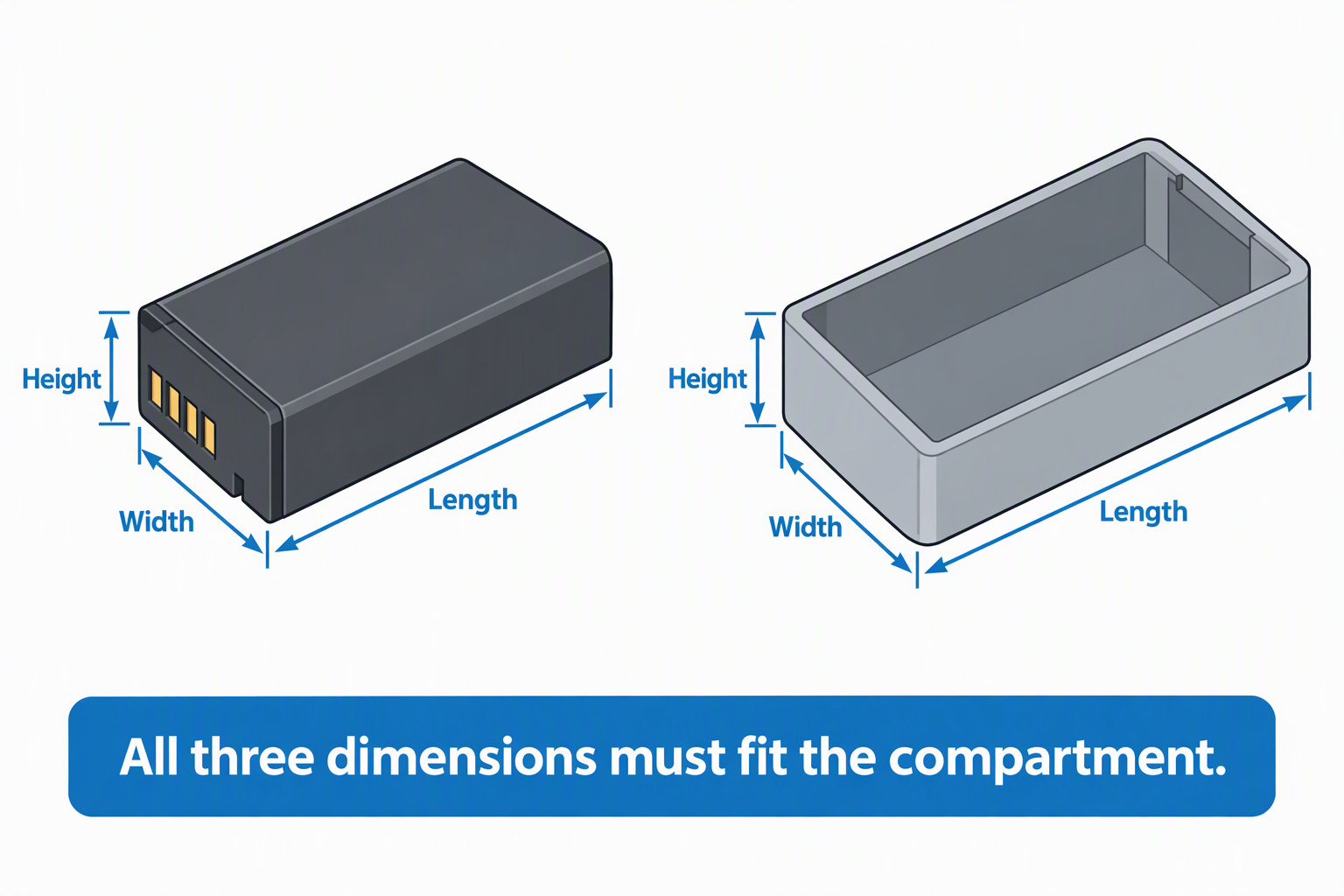
Battery model lists are helpful, but product revisions, third-party packs, and protective caps can change fit. Measure length, width, and height at the widest points, then compare with the case limit. All three dimensions must fit the compartment, not just the battery’s front profile.
JJC documentation caps batteries at 1.5 by 0.9 by 2.4 inches for the two six-pack cases and excludes NP-FW50. JJC lists the three-pack limit at 2.2 by 1.6 by 0.9 inches. Soft pockets have no published measurements here, so test their closure around the exact pack. Named compatibility does not replace a dimensional check.
Keep terminals separated from loose metal
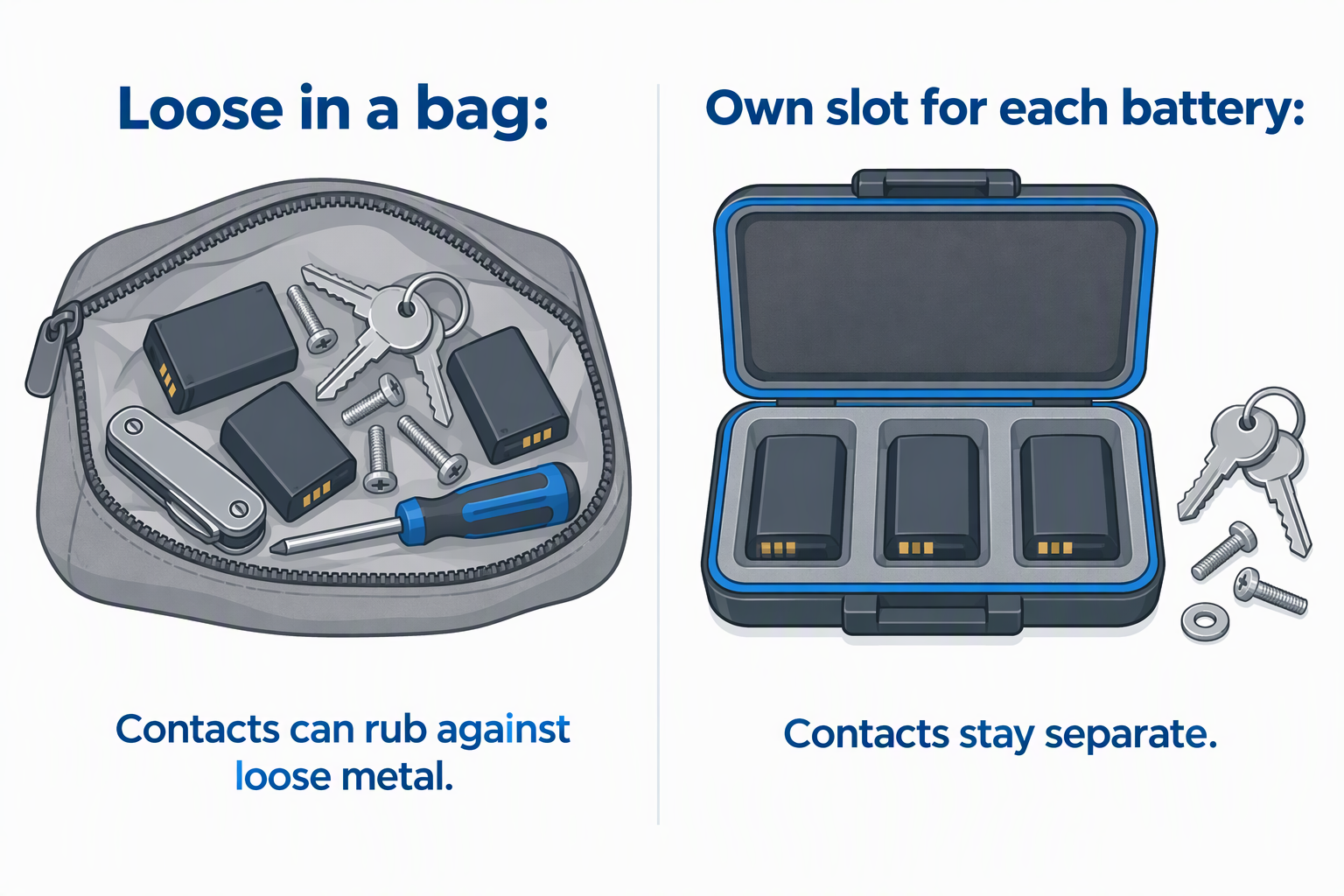
Individual compartments keep battery contacts from rubbing against keys, screws, cards, tools, or other packs inside the bag, in addition to keeping the bag neat. The hard JJC cases describe fitted sections that prevent accidental contact. Each battery should remain isolated in its own suitable slot.
Do not force multiple lithium packs into one compartment unless the case explicitly supports that arrangement. Inspect for torn mesh, compressed foam, or a closure that exposes contacts. Never store a damaged, swollen, leaking, or unusually hot battery in an organizer with healthy packs. A case cannot make a compromised battery safe.
Choose a repeatable charged-state system
Reversing batteries in a soft pouch is fast, but the meaning must be consistent. Labels are clearer for multi-person crews, while the three-position JJC case has dedicated sliders beside each compartment. The best system is one every operator understands immediately.
Define whether a marker means full, used, or needs testing, and reset it only after charging and verification. Keep questionable batteries separate rather than marking them as merely empty. A written numbering scheme can also connect a battery to maintenance notes. Status tracking should prevent uncertainty, not hide it.
Decide whether cards belong with batteries
Combining batteries and memory cards reduces the number of small cases in a bag and can keep one camera’s power and media together. Hard JJC models add fitted SD, microSD, CFexpress, and XQD positions. Fitted card slots protect organization better than one shared zip pocket.
The tradeoff is a larger single point of disruption, because misplacing one case can remove both media and power from the shoot. A battery-only pouch is lighter and keeps storage roles separate. Choose based on the crew’s packing checklist and whether cards need independent handoff. One-box convenience should match the production workflow.
Match soft or hard construction to the bag
Soft pouches compress, fold, and adapt to varied pack shapes. They work well inside a padded camera bag where the surrounding structure handles impacts. Hard ABS cases preserve compartment shape and offer stronger separation but take up their full volume even when partly empty. Soft cases favor low bulk, and hard cases favor fixed organization.
Do not turn “water resistant,” “moisture protection,” or “water splashing” into an immersion claim. Check the exact wording and keep batteries dry. A sealing ring helps close a case but does not establish a submersion rating. Weather language must stay within the listed claim.
Check closure and field access
Hook-and-loop flaps open quickly, zippers enclose the entire pouch, snap locks secure rigid cases, and magnets give fast access. Each approach has a tradeoff between speed, sound, retention, and accidental opening. The closure should stay shut inside a moving bag without making routine swaps frustrating.
Belt access can reduce downtime during an event, while a larger hard case may belong at the charging station. Practice opening the case with the gloves or conditions used on location. Keep the case away from rain and dirt during swaps. Fast access still needs deliberate handling.
Related Creator Power and Camera Guides
These guides cover charging, protection, maintenance, and rig hardware used around organized creator shoots:
- V-mount battery chargers for creator video kits
- Camera cleaning kits for mirrorless lenses and sensors
- Camera rain covers for outdoor creator shoots
- Camera monopods for run-and-gun creator video
- Camera top handles for handheld creator rigs
- Mirrorless camera cages for desk video rigs
- Camera suction mounts for vehicle creator shots
- Overhead camera mounts for desk tutorials
Frequently Asked Questions
Can any camera battery fit a universal pouch?
No. “Universal” or broad compatibility language still depends on pocket dimensions, pack shape, and closure space. Measure the exact battery before relying on a fit claim. Large video batteries, small mirrorless packs, and cylindrical cells use very different proportions.
Check whether the pouch closes without compressing the battery or exposing terminals. The hard JJC cases publish exact limits, while most soft products give model examples rather than dimensions. Return or replace a case that forces the pack.
Is a water-resistant battery case waterproof?
No. Water-resistant, moisture-protective, or splash-protective wording does not mean a case can be submerged or left in heavy rain. Use only the level of protection the listing states. None of these listings states an immersion rating.
Keep batteries dry and inspect the case after exposure. A silicone ring may reduce entry through the seam, but water can still enter during opening or through an imperfect closure. Dry the case separately before returning batteries.
What is the best way to mark charged batteries?
Use one repeatable visual system: status sliders, numbered labels, charged-state stickers, or a defined battery orientation. Consistency counts for more than the specific method. Everyone handling the kit should know the meaning without guessing.
Do not mix a questionable battery with ordinary depleted packs. Label and isolate anything showing damage, unusual heat, unreliable capacity, or charging problems so it can be evaluated according to the maker’s guidance.
Should memory cards and batteries share one case?
They can when the case has dedicated fitted compartments and the workflow benefits from one consolidated kit. Separate slots prevent loose batteries from contacting or crushing cards. The structured JJC cases are designed around this combined use.
Some crews prefer separate media and power cases so cards can be handed to an editor without moving the batteries. Consider who controls each item during the shoot and whether losing one box would remove both resources.
Are these cases safe for air travel?
The product listings do not state compliance with airline or transport requirements. A storage case does not replace current carrier and regulatory rules for spare lithium batteries, terminal protection, quantity, or carry-on placement.
Check the applicable airline and route requirements before travel. Use individual terminal protection and packaging as required, and never travel with a damaged or swollen pack. Do not infer approval from a product being described as a travel organizer.
Bottom Line
The JJC Three-Battery Hard Case is our best overall choice because it has separated battery compartments, three dedicated charge-state sliders, fitted storage for three card formats, and an ABS shell. The JJC BC Case is the better high-capacity organizer for six compatible batteries, while the labeled JJC alternative offers nearly the same capacity with its own sticker and tool arrangement.
For soft storage, choose the NEEWER four-pocket pouch for a broad documented model list, the TXEsign for six zippered mesh slots, or the JJC BC-P2 for belt access and a card pocket. The NOMATIC is the only magnetic three-battery option here, but it gives few fit details. Measure every battery, keep terminals separated, use one charged-state convention, and remember that organization does not replace battery inspection or transport rules.
Product capacities, fit dimensions, named battery and card compatibility, materials, closure features, protection claims, and availability were checked against the supplied Amazon product records dated October 14, 2026. Verify current fit, package contents, and battery handling requirements before purchase.