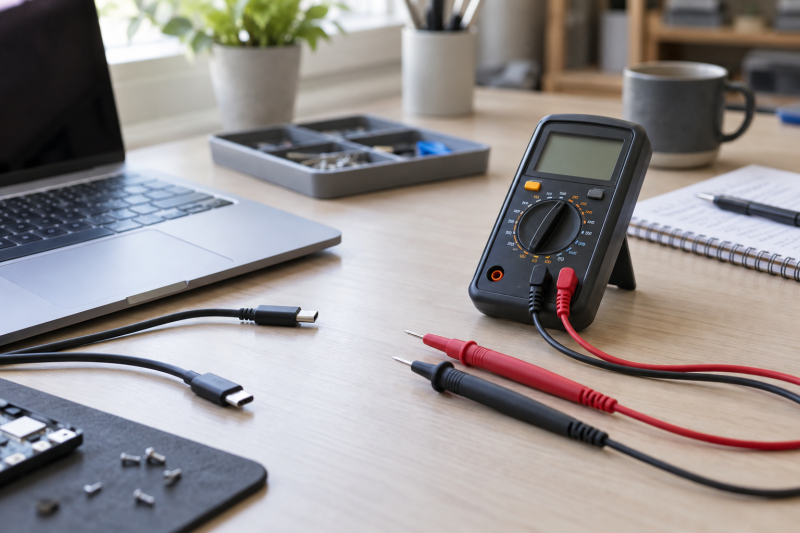
A digital multimeter belongs beside a USB-C repair desk because continuity, voltage, resistance, and diode checks answer different questions before you replace a cable, port, charger, or accessory. A USB-C power meter shows what travels through a cable. A multimeter helps isolate whether the problem sits in the cable, the device, or the power source around it.
The six meters here all list continuity and voltage measurement, but their layouts and extra functions serve different benches. Pick the meter that makes the checks you actually perform easier to reach, then stay within the listed measurement limits and safety category rather than treating a repair-desk tool as proof that an unfamiliar circuit is safe.
For desk diagnosis, continuity, resistance, diode test, readable leads, and a sensible range control usually matter more than collecting every measurement mode.Digital Multimeters Compared


1. KAIWEETS Digital Multimeter KM100 — Best Simple Meter for Continuity Checks
A desk that traces a suspect cable lead, checks whether two points connect, or compares a known-good accessory with one that is not behaving normally wants the first checks close together. The KAIWEETS KM100 does that with AC/DC voltage, DC current, resistance, continuity, and diode measurement, all listed functions.
Its listing also names data hold, a backlight, double fuses, overload protection, and a CAT III 600V rating. The included case, leads, and two AAA batteries make it the least complicated starting point here, although the listing specifically says it cannot measure AC current.
Our TakeBuy the KM100 when your desk needs a compact, familiar meter for continuity, resistance, diode, and voltage checks without a long mode list. Its stated CAT III 600V rating and double fuses make the safety information easier to find, while the lack of AC-current measurement keeps it out of a bench that needs that function.
- Continuity, resistance, diode, DC-current, and AC/DC-voltage functions cover common cable and accessory fault checks.
- A stated CAT III 600V rating, double fuses, and overload protection provide explicit listed safety information.
- Data hold and a backlight help preserve a reading when the probe points sit awkwardly behind a desk.
- The box includes a carrying case, two leads, and pre-installed AAA batteries for immediate basic desk use.
- The listing says it cannot measure AC current, limiting jobs that specifically require clamp-free AC-current testing.
- It uses two AAA batteries instead of the rechargeable Type-C arrangement stated for the FNIRSI DMT-99.
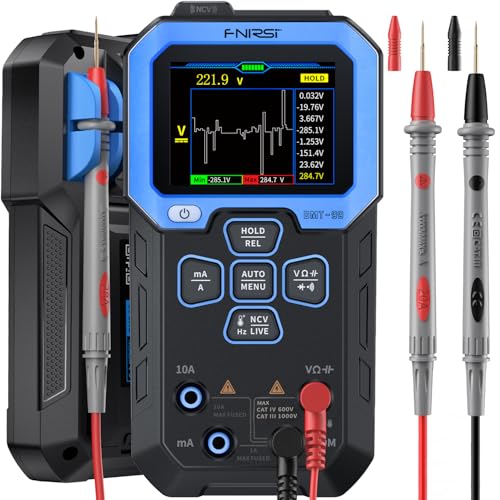
2. FNIRSI DMT-99 — Best Rechargeable Meter for Close Electronics Work
A repair bench where the meter stays close to small circuit boards, and where you would rather charge it from the same cable setup than keep spare cells nearby, suits the FNIRSI DMT-99. FNIRSI gives it a 9999-count True RMS display, a 2.4-inch color screen, and a built-in 1500mAh rechargeable battery with Type-C charging.
The listing also names Auto-Mode for AC/DC voltage, resistance, and continuity, plus AC/DC current, NCV, frequency, diode testing, a graphical waveform view, and monitoring alarms. It includes ultra-fine leads, a kickstand, and rear storage slots, so it is the pick to look at when small contact points and a more detailed display are the priority.
Our TakeBuy the DMT-99 when a 9999-count True RMS display, Type-C charging, and fine leads are useful every day at an electronics desk. Its extra modes give you more to learn than the KAIWEETS, but the screen, kickstand, and built-in battery make that trade reasonable for repeated diagnostics.
- A 9999-count True RMS display gives this meter the highest stated resolution among the six listed models.
- The 1500mAh rechargeable battery uses Type-C charging, avoiding routine AAA replacement at a USB-C repair desk.
- Auto-Mode detects voltage, resistance, and continuity, speeding up the first pass through a simple fault.
- Ultra-fine leads are specifically listed for SMD work and tight circuit boards around small connectors.
- A 2.4-inch color screen, kickstand, and rear storage slots keep readings and leads visible together.
- Graphic View and Monitoring Mode add listed tools for watching voltage or current changes over time.
- The deeper Auto-Mode, waveform, and monitoring feature set asks more setup decisions than a basic continuity meter.
- Its product listing names protection circuitry and ceramic fuses but does not state a CAT measurement category.
- Graphical views can help investigate intermittent behavior, yet they do not replace checking the circuit’s actual specifications.
3. AstroAI CM2K0R Clamp Meter — Best for AC Current Without Opening the Circuit
A repair bench that also checks an AC-powered device or cord can use a clamp. The AstroAI CM2K0R differs from the other meters because its jaw measures AC current around one conductor, and it is not a substitute for a regular probe measurement on a small USB-C accessory.
The listing also names AC/DC voltage, capacitance, resistance, diode, continuity, live-wire tests, NCV, data hold, Max/Min, a backlight, and a flashlight. AstroAI explicitly says the clamp cannot measure DC current and should not go around a whole power cord, details to understand before choosing the clamp shape.
Our TakeBuy the CM2K0R when your desk sometimes needs AC-current measurement around one conductor alongside normal voltage and continuity checks. Skip it for a bench that mostly handles small electronics, where a compact meter and fine probe placement come before a clamp jaw.
- The clamp jaw measures listed AC current around one conductor without requiring a series probe connection.
- NCV with sound and light alarms adds a separate listed way to detect nearby AC signals.
- Data hold, Max/Min, a backlit display, and a flashlight support reading measurements around a dim desk.
- The clamp cannot measure DC current, which the listing states directly and limits battery-powered repair checks.
- Its clamp must surround one conductor rather than an entire power cord, adding a usage constraint.
- A 2000-count display has less stated resolution than the FNIRSI DMT-99’s 9999-count screen.
- The larger clamp form can be less convenient than slim probes near a crowded USB-C connector or board.
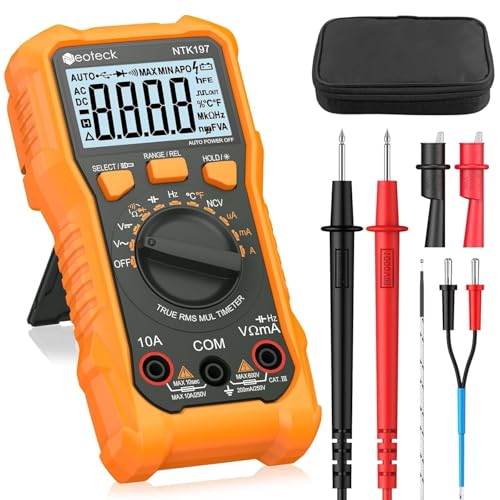
4. Neoteck VC746A — Best Budget Meter with Temperature and NCV
A bench that sometimes moves from a USB-C cable check to a fan, power brick, or other general electronics task wants a broad set of functions. The Neoteck VC746A lists a wide function set for a conventional 2000-count meter: AC/DC voltage and current, resistance, capacitance, frequency, duty cycle, continuity, diode, temperature, live-wire testing, and NCV.
Its listing gives DC-voltage accuracy up to ±(0.5%+4) and AC-voltage accuracy up to ±(0.8%+6), plus manual or automatic range selection, data hold, a 15-minute auto shutoff, backlighting, two rear pen holders, and an included screwdriver. Those stated details make it a practical middle ground rather than a specialist clamp or high-resolution screen.
Our TakeBuy the VC746A when you want a conventional meter that adds temperature, frequency, duty cycle, and NCV to common continuity work. It is a more varied everyday tool than the KAIWEETS, although its 2000-count LCD offers a less detailed stated display than FNIRSI’s 9999-count model.
- Temperature, frequency, duty cycle, live-wire testing, and NCV broaden the listed diagnostic functions beyond continuity.
- The listing states DC-voltage accuracy up to ±(0.5%+4) for a concrete figure to compare.
- Manual and automatic range modes let a buyer choose direct range control or simpler setup.
- Two rear pen holders keep the probes attached to the meter between short checks at a desk.
- A 15-minute auto shutoff, data hold, backlight, and included screwdriver add practical everyday desk details.
- The 2000-count LCD gives less stated display resolution than the 9999-count FNIRSI DMT-99 above.
- It uses standard batteries rather than the Type-C rechargeable battery listed for the FNIRSI meter.
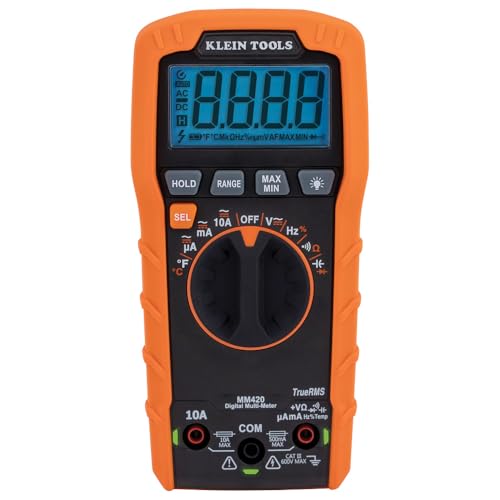
5. Klein Tools MM420 — Best Desk Meter for Clear Lead Setup
A desk where setup cues count as much as the reading suits the Klein MM420. Its Lead-Alert LEDs indicate proper test-lead placement, while auto-ranging and True Root Mean Squared measurement reduce two common sources of uncertainty when moving among different voltage or resistance checks.
The listing covers AC/DC voltage to 600V, AC/DC current to 10A, resistance to 50MΩ, continuity, temperature, capacitance, frequency, duty cycle, and diode test. It also names test-lead holders, a kickstand, an optional magnetic hanger, a 6.6-foot drop claim, and a package with safety-capped leads, a thermocouple, instructions, and two AAA batteries.
Our TakeBuy the MM420 when Lead-Alert LEDs, a stated 600V range, and a broad conventional measurement list make your desk work easier to set up correctly. It is the clearest choice here for buyers who value explicit lead guidance, but it does not include the FNIRSI’s Type-C rechargeable battery.
- Lead-Alert LEDs indicate proper lead placement, a directly listed aid before taking a voltage or current reading.
- Auto-ranging and True RMS measurement accompany stated ranges of 600V, 10A, and 50MΩ resistance.
- Continuity, temperature, capacitance, frequency, duty cycle, and diode test cover more than basic cable checks.
- Safety-capped leads, a thermocouple, a kickstand, and rear lead holders come with practical bench use in mind.
- The listed package runs on two AAA batteries instead of the FNIRSI DMT-99’s built-in rechargeable Type-C battery.
- The magnetic hanger is optional, so hands-free mounting needs a separately named Klein accessory.
- Its listing gives no screen count comparable with the FNIRSI DMT-99’s stated 9999-count resolution.
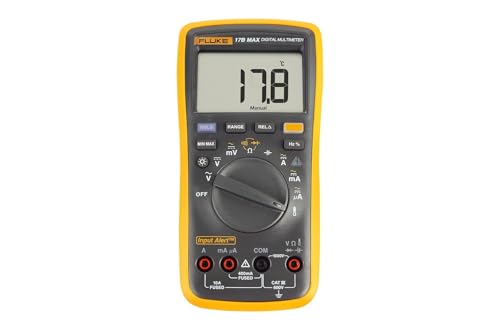
6. Fluke 17B+ — Best for a Broad Electrical Measurement Range
A bench whose general electrical work extends beyond low-voltage accessories wants an explicit range and category. The Fluke 17B+ lists the broadest stated voltage range on this page, reaching 1000V AC/DC and 10A current, with a CAT III 600V safety rating, although a high range does not make every high-voltage job a desk task.
For laptop and USB-C diagnosis, its resistance, continuity, capacitance, diode, frequency, and temperature functions are the relevant everyday features. The included Type K thermocouple reaches a stated 400C for heating and cooling work, which gives this meter a useful extra function when a bench also checks temperature-related equipment.
Our TakeBuy the Fluke 17B+ when you need a 1000V AC/DC stated range, CAT III 600V rating, and a conventional set of continuity, diode, capacitance, frequency, and temperature functions. It is the broad-range choice, and the FNIRSI has the more detailed screen and finer leads for small boards.
- A stated 1000V AC/DC range is the highest voltage figure among the six meters in this guide.
- The CAT III 600V safety rating is explicitly listed for common residential, commercial, and industrial electrical systems.
- Resistance, continuity, capacitance, diode, frequency, and temperature functions support several different fault-isolation checks.
- The included Type K thermocouple provides stated temperature measurement up to 400C for related bench equipment.
- Current measurement to 10A accompanies the voltage range for buyers who need a general electrical meter.
- The listing does not describe a Type-C rechargeable battery or fine SMD-oriented leads like the FNIRSI DMT-99.
- A broad 1000V range does not remove the need to follow the limits and procedures of the circuit being checked.
Buying Guide: Choosing a Digital Multimeter for a USB-C Repair Desk
Start with the measurement that answers your first question
When a USB-C accessory fails, continuity, voltage, resistance, and diode testing answer different questions. Continuity and resistance are useful for tracing a cable or connection path, while voltage testing checks what arrives at an accessible point. KAIWEETS KM100, Klein MM420, Neoteck VC746A, and Fluke 17B+ all list those core functions, so the basic choice is not about finding the only meter capable of a continuity beep.
Choose a larger function set only when you will use it. Neoteck VC746A adds temperature, frequency, duty cycle, and NCV. Fluke 17B+ includes temperature with a Type K thermocouple. FNIRSI DMT-99 adds graphical and monitoring modes. More functions do not make a repair diagnosis automatic, but they can keep you from needing a separate tool when the bench handles more than cables and chargers.
Choose a screen and range workflow you will actually use
FNIRSI DMT-99‘s 9999-count True RMS display is the clearest listed resolution figure here, while AstroAI CM2K0R and Neoteck VC746A name 2000-count displays. A count figure describes displayed resolution and promises nothing automatic about every measurement, so use it alongside the meter’s stated modes and the kind of change you need to see.
Auto-ranging makes a routine measurement faster when you do not already know the range. Klein MM420 lists auto-ranging and True RMS. Neoteck VC746A offers manual and automatic modes. FNIRSI DMT-99‘s Auto-Mode detects voltage, resistance, and continuity. Manual range selection is not a flaw when you want deliberate control, but an automatic mode removes one early decision on frequent simple checks.
Match leads and meter shape to the physical work area
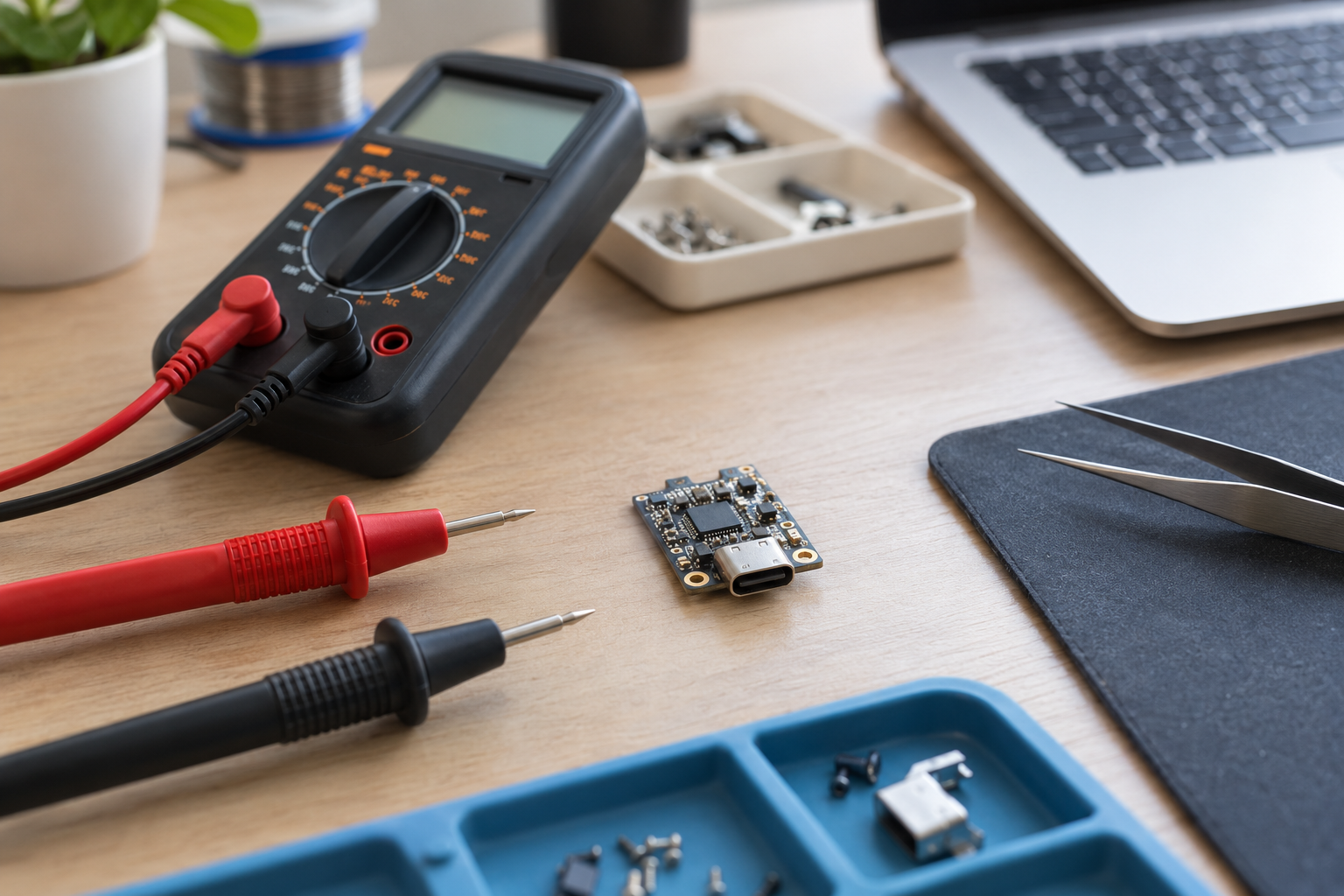
Small USB-C boards and connectors call for a meter that can reach the test points without crowding the repair. FNIRSI DMT-99 specifically lists ultra-fine leads for SMD and tight circuit boards, while Klein MM420 lists lead holders and Lead-Alert LEDs. Both details help when your normal work happens beside a laptop, a dock, or a compact power accessory rather than in an open electrical panel.
The AstroAI CM2K0R clamp serves a different physical job. Its jaw measures AC current around one conductor, which can be useful for a suitable AC lead but does not replace measurements with small probes on a USB-C cable. The listing warns against clamping an entire power cord and says the jaw cannot measure DC current, so do not buy the clamp form only because it looks more capable.
Treat stated safety ratings as limits, not a shortcut
KAIWEETS, AstroAI, and Fluke each state CAT III 600V information, while Klein lists 600V AC/DC measurement and safety-capped leads. These figures describe the product listings, not a universal instruction to probe any circuit. Identify the circuit, use the appropriate meter setting and lead placement, and stay within the equipment’s documented limits.
Protection features make a difference only when they are paired with correct use. KAIWEETS lists double fuses and overload protection. FNIRSI lists dual ceramic fuses and protection circuitry. Klein includes Lead-Alert LEDs. A feature that reduces an avoidable setup error is useful, but no feature substitutes for knowing what the probes are touching before you measure.
Decide whether rechargeability matters at your bench
The FNIRSI DMT-99 has a 1500mAh rechargeable battery with Type-C charging, a clear advantage if the meter stays in daily use beside USB-C cables and chargers. Its listed kickstand and storage slots also keep it ready on a crowded desk.
KAIWEETS, AstroAI, Klein, and the listed Fluke package use or include AAA batteries, which can be simple for an occasional meter because a replacement does not require a charging wait. Choose the power arrangement you will maintain, then keep the meter’s probes, safety limits, and core measurement functions ahead of a charging preference.
Know when a multimeter is not the same tool as a USB-C power meter
A regular multimeter checks general electrical quantities at probe points. An inline USB-C PD trigger board sits in a USB-C connection and reports information moving through that cable. They solve related but different diagnosis steps. Use an inline meter when the question is about a USB-C charger, cable, or device negotiation visible in the connection path.
Use one of these digital multimeters when you need continuity, resistance, diode, or direct voltage checks on accessible points around the accessory or its supporting equipment. The KAIWEETS KM100, Klein MM420, Neoteck VC746A, and Fluke 17B+ cover those conventional functions, while FNIRSI DMT-99 adds its screen and fine-lead details. Outlet power meters instead measure workstation draw at the wall. Keep the two tools separate in your decision, even when both sit on the same desk.
Frequently Asked Questions
Can a digital multimeter diagnose a USB-C cable?
It can help with continuity and resistance checks on accessible cable connections, and the KAIWEETS, Klein, Neoteck, and Fluke listings all include continuity and resistance functions. Those checks can narrow a basic fault question before you replace a cable or test a known-good accessory.
A multimeter does not take the place of an inline USB-C power meter when you need to observe information through an active USB-C connection. Use the tool that matches the question. Probes suit direct electrical checks, and an inline meter suits connection-path information.
Which listed meter is easiest to keep charged at a repair desk?
The FNIRSI DMT-99 is the only product here whose listing names a 1500mAh rechargeable battery with Type-C charging.
KAIWEETS, AstroAI, and Klein list AAA batteries, while the Fluke package includes AAA batteries. Rechargeability is a workflow choice, not a measurement-quality score, so a meter with replaceable cells can still fit a bench that uses it only occasionally.
Do I need a clamp meter for laptop and USB-C repairs?
Usually not for the basic continuity, voltage, resistance, and diode checks described here. AstroAI’s CM2K0R clamp is useful only when AC current around one conductor is part of the task. Its listing says not to clamp an entire power cord.
The same listing says the clamp cannot measure DC current. For small electronics repair points, conventional probes on KAIWEETS, FNIRSI, Neoteck, Klein, or Fluke are often the more directly relevant shape.
Why do display counts matter on a multimeter?
A display count is how much numerical resolution the meter can show in a stated range. FNIRSI lists 9999 counts, while AstroAI and Neoteck list 2000 counts, so shoppers have a visible difference to compare before looking at each meter’s specific functions.
The count alone does not settle every purchase. True RMS, accuracy figures, lead arrangement, range behavior, and the functions you use still determine whether a meter fits the diagnostic work in front of you.
Are CAT III and voltage figures enough to choose a safe meter?
No. KAIWEETS, AstroAI, and Fluke list CAT III 600V information, and Klein lists 600V measurement with safety-capped leads, but those figures are equipment limits rather than a general permission to test an unknown circuit.
Use the meter only within its stated functions and limits, select the right range and lead positions, and follow the procedures for the circuit being examined. The product listing can help compare meters, but it cannot replace safe working practice.
Bottom Line
Choose KAIWEETS for simple continuity checks, FNIRSI when Type-C rechargeability and a 9999-count display are the priority, Klein when explicit lead guidance helps at the desk, and Fluke when a 1000V stated range and broad conventional functions decide the purchase. AstroAI’s clamp is for one-conductor AC-current work, while Neoteck offers a wider general-purpose function list with temperature and NCV.