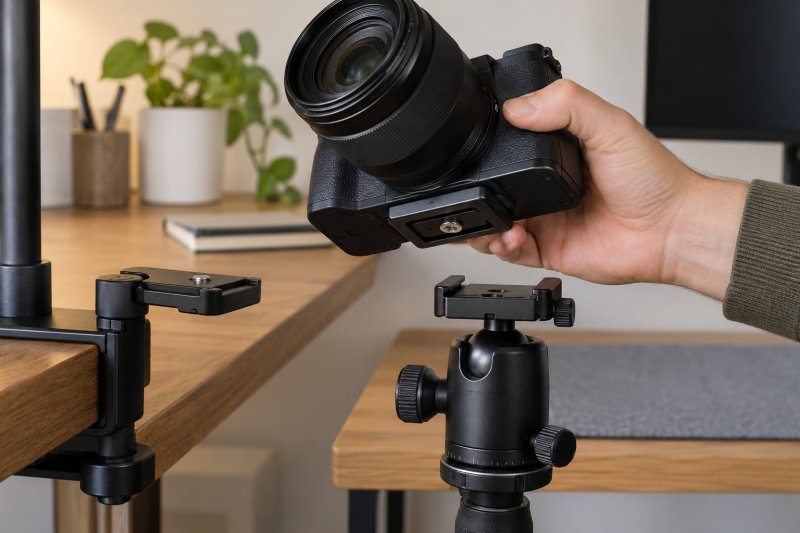
A quick-release plate saves time only when each support accepts the same interface. For moving a camera from a desk arm to a tripod, check the clamp standard, plate width, safety-stop position, and screw clearance before worrying about small convenience features. Arca-Swiss compatibility is a useful starting point, but different clamps, stop channels, and camera cages can still create a poor fit.
These six Amazon US plates have active New offers and use Arca-style interfaces, with choices for spare plates, compact square plates, a long rail, and named DJI-gimbal transfer. Check the desk arm, ball head, tripod clamp, cage, and camera base before ordering. See our desk camera arm guide and video tripod guide for the supports themselves.
A fast desk-to-tripod move starts with one shared clamp standard. Confirm physical fit on both supports before buying extra plates.Quick-Release Plates Compared
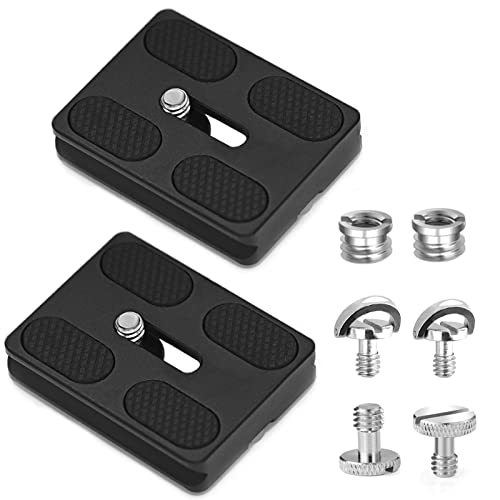
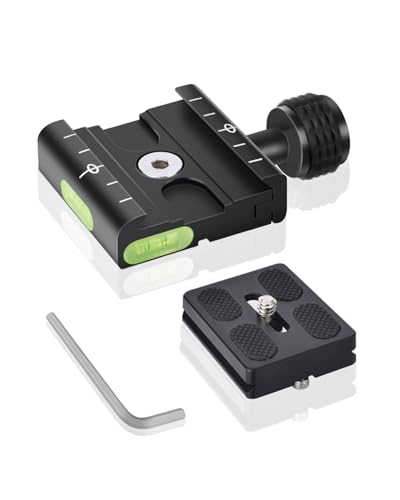
1. Harwerrel PU50 2-Pack — Matching Spare Plates
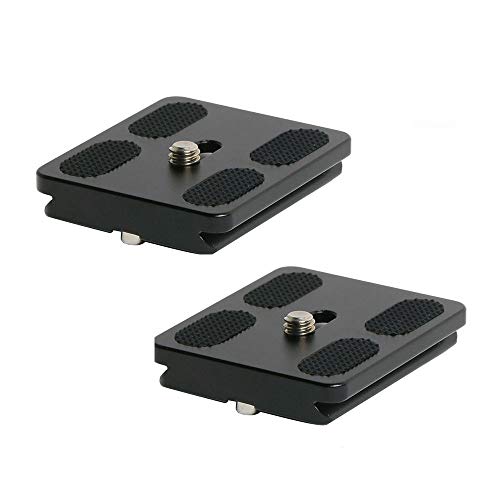
A pair of plates is useful when one stays under the camera and another stays with a second body or small accessory. Harwerrel lists two 50 mm Arca-Swiss-style quick-release plates, and the listing gives top and bottom dimensions and says the plates work with Arca-Swiss-type systems.
That shared label does not make every clamp identical. Slide the plate into both the desk arm and tripod clamp, check whether safety-stop screws interfere, and confirm the jaws close fully. A plate that fits loosely can shift composition when you move the camera.
Our Take Buy the Harwerrel if you need two matching 50 mm plates for a simple multi-support setup. Check each clamp first, because the shared standard is not a full mechanical guarantee.
- Two matching plates are listed.
- Arca-Swiss-type compatibility is listed.
- Each clamp needs a physical fit check.
- Short plate gives limited fore-aft adjustment.
2. FIFIELD 38mm 2-Pack — Compact Square Plates
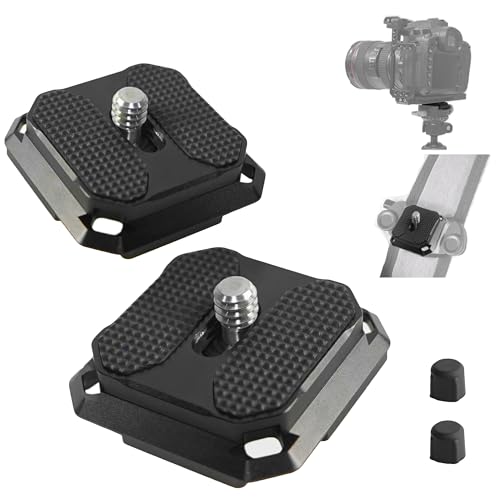
A square plate can be useful when a compatible clamp needs the camera in more than one orientation without reinstalling the plate. FIFIELD lists two 38 mm square Arca-Swiss plates with four-side slots, safety pins, and 1/4-inch screws. Rubber pads and a hex-lock screw are also listed.
Compact plates are not the best fit for every camera and long lens. The plate is smaller, so there is less room for balancing, and the safety pins need to line up with the clamp’s stop channel. Test the camera, lens, and cage together rather than fitting an empty plate.
Our Take Buy the FIFIELD if a compact two-pack and a square layout fit your clamps. It suits light camera setups but does not replace a longer balancing plate.
- Two compact square plates are listed.
- Safety pins and rubber pads are listed.
- 38 mm limits balance adjustment.
- Safety-pin fit varies by clamp design.
3. SmallRig 3061 5.5in Plate — DJI Gimbal Transfer
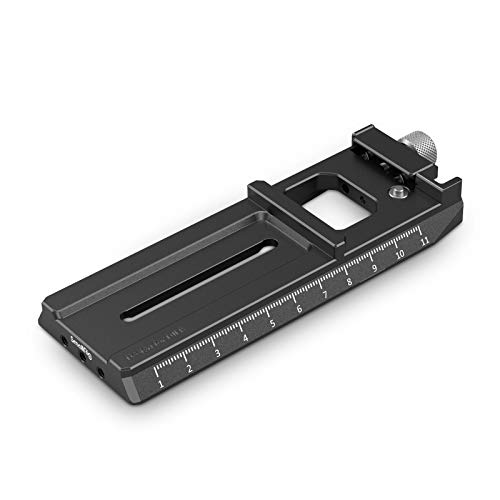
SmallRig lists the 3061 as a 5.5-inch plate for Arca-Swiss use with named DJI RS and Ronin gimbals. The listing says it can help move an Arca L bracket or cage directly between a tripod and compatible gimbal. The named gimbals are the reason to pick this plate.
The page also describes tool-free locking, adjustable anti-drop handling, and a bottom gear rack for slight adjustment. Confirm your exact gimbal model, cage, and clamp before treating it as a general plate. A long plate can change balance on both a desk arm and ball head.
Our Take Buy the SmallRig 3061 if your setup includes one of its named DJI gimbals and an Arca-style cage or bracket. It is the choice here for moving between a tripod and a named gimbal.
- Named DJI-gimbal compatibility is listed.
- Long plate supports position adjustment.
- Exact gimbal and cage fit must be checked.
- Long plate can change support balance.
4. HITHUT 100mm Plate — Longer Fore-Aft Adjustment
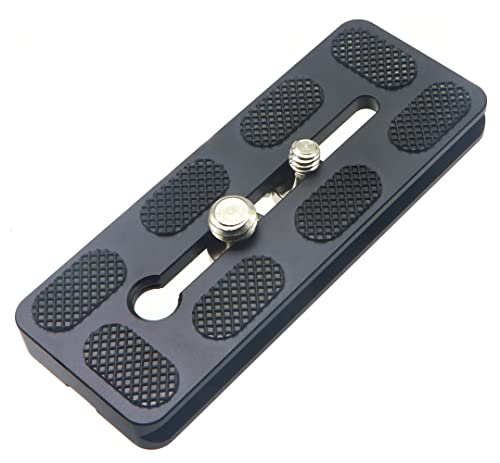
HITHUT lists a 100 mm / 3.93-inch Arca-Swiss-style plate with 1/4-inch and 3/8-inch mounting screws. A longer rail has more fore-aft placement room than a 38 or 50 mm plate. The extra room can help balance a camera with a heavier lens on a tripod head or desk arm.
The listing mentions rubber pieces and an anti-slip screw. The long plate must still clear the camera body, battery door, cage, and support clamp. Install it in the orientation you will use, then check whether it blocks any access needed during the shoot.
Our Take Buy the HITHUT if fore-aft adjustment counts for more than a compact plate. It is a useful choice when a camera and lens need careful balance on more than one support.
- 100 mm listed length gives adjustment room.
- 1/4-inch and 3/8-inch screws are listed.
- Long plate can block body access.
- Clamp and camera clearance must be checked.
5. Niewalda PU50 2-Pack — Tool-Free Ring Screw
Niewalda lists two PU-50 plates with 1/4-inch slotted screws, D-ring or C-ring screws, and 1/4-inch-to-3/8-inch adapters. The ring-screw option is useful for a kit that needs plate installation without reaching for a hex key. The listing describes the plates as compatible with Arca-type elements.
Tool-free attachment can speed a move, but it does not remove the need to check tightness. Verify the plate seats flat against the camera or cage, the rubber pad does not trap a cable, and the screw stays accessible after mounting. Use the same orientation on both supports.
Our Take Buy the Niewalda if you want spare PU-50 plates and a tool-free ring screw. The two-pack works best when your clamps accept its plate shape securely.
- Two plates and multiple screw types are listed.
- Ring screw supports tool-free attachment.
- Needs clamp-by-clamp compatibility checking.
- Short plate offers limited balance travel.
6. UTEBIT 50mm Plate — Built-In Bubble Levels
UTEBIT lists a 50 mm Arca-Swiss plate with three bubble levels, non-slip rubber, and 1/4-inch and 3/8-inch screw options. The levels may help with a quick rough setup, but they do not replace the horizon level in the camera or a careful framing check.
The listing says it works with many tripod, monopod, stabilizer, gimbal, and ball-head uses. The claim covers a category of uses and is not proof of a particular clamp fit. Check stop position, clamp width, and camera mounting surface before relying on repeated moves.
Our Take Buy the UTEBIT if a 50 mm plate with listed bubble levels and screw options fits your supports. It is compact and general, but clamp fit remains the deciding check.
- Three bubble levels are listed.
- Includes 1/4-inch and 3/8-inch options.
- Levels do not replace camera leveling.
- Arca-style clamp fit must be tested.
Buying Guide: Quick-Release Plates for Moving Between Supports
Identify the shared clamp standard first
The plate and both clamps must agree. Arca-Swiss-style is widespread, but plate widths, dovetail profiles, safety-stop screws, and clamp ranges can vary. Check the documentation and physical clamp before ordering several matching plates.
Test the full insertion and lock. Slide the plate into each support, close the clamp, and gently test the camera before trusting it. A proper fit needs full seating, a secure lock, and no interference from anti-drop screws or stop channels.
Choose length around balance and access
Short plates keep a small camera compact. A 38 or 50 mm plate can suit a mirrorless body and light lens. It is easier to leave on a camera bag or desk-mounted body without adding much length below the base.
Longer plates give more balancing travel. A 100 mm plate or a plate made for gimbal transfer can help shift the balance of a camera and lens. Check the battery door, tripod collar, cage, cable ports, and desk-arm jaws before choosing the longer plate.
Make the swap predictable during a shoot
Use the same plate orientation on every support. A consistent direction makes it easier to move the camera without guessing where the stop or clamp knob will be. Mark the intended position when a camera needs a particular balance point.
Recheck the lock after every move. Tighten the support clamp, confirm the plate cannot slide, and check the framing again after a desk-to-tripod transfer. A small plate shift can change composition or balance.
Frequently Asked Questions
Are all Arca-Swiss quick-release plates interchangeable?
No. Arca-Swiss-style is a category, not proof that every plate and clamp has identical geometry. Plate widths, dovetail profiles, safety-stop screws, and clamp ranges can vary. A listed Arca-style plate is a starting point, not a guarantee.
Test the plate in every support you plan to use with the camera, cage, and lens attached. The full setup can reveal clearance or balance issues that an empty plate test does not show.
Should I leave a quick-release plate on the camera?
Leaving a plate on the camera can make desk-to-tripod moves faster and repeatable. It works well when the plate does not block the battery door, interfere with a cage, or make storage awkward. A matching system works best when every support accepts the same shape.
Remove or change the plate when it prevents access you need or when another support requires a different interface. The goal is a secure repeatable move, not keeping one plate attached at all times.
What plate length should I use for a mirrorless camera?
Start with the smallest plate that gives enough room to balance the camera and lens you use. A 38 or 50 mm plate can be enough for a compact setup. A larger lens, cage, or desk arm may benefit from a longer plate.
Check the camera base and every clamp before choosing length. A longer plate helps only if it fits without blocking the battery compartment, cable route, or support hardware.