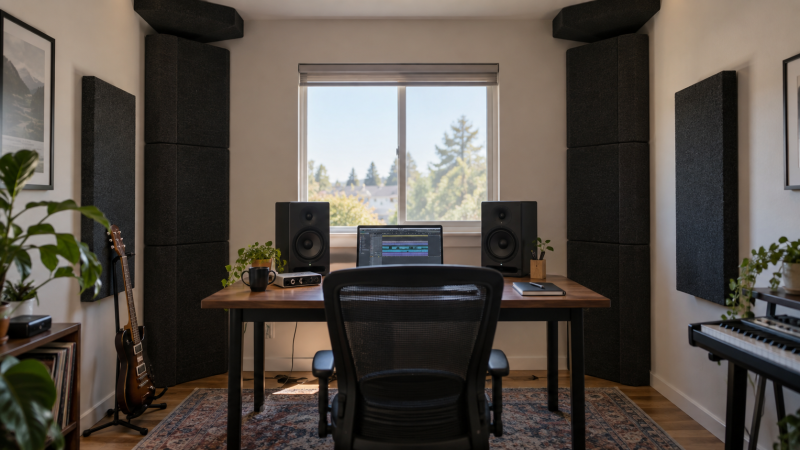
Low notes can seem louder in one part of a small room and weaker a short distance away. The room and listening position contribute to that unevenness. A foam product labeled “bass trap” is not a guaranteed fix. Corner treatment is a sensible area to investigate because corners are practical places to add thickness without covering the whole room. The only meaningful result is what changes at your listening position after installation.
These six active New products include small stackable foam blocks, larger wall-corner and ceiling-corner pieces, and a wood-faced hybrid panel. Their shapes and pack counts differ more clearly than their measured low-frequency performance. None of the listings used here provides a directly comparable test in your room. Plan the available corner depth, mounting method and return conditions before buying several packs.
Before mounting anything permanently, listen and, if possible, measure at the normal mix position. Treat a nearby corner and compare the same track at the same speaker level. If the bass still changes drastically when you move your head, adjust speaker or listener placement before assuming more foam is the answer.Bass Traps Compared
| Image | Product | Details | Check Price |
|---|---|---|---|
 | SD SODOCT Eight-Pack | Count: 8 Size: 8 × 8 × 12 in Placement: Wall / ceiling corner Best fit: Modular foam start | Check Price on Amazon |
 | TroyStudio Twelve-Pack | Count: 12 Size: 4 × 4 × 12 in Placement: Narrow wall corner Best fit: Tight corner stack | Check Price on Amazon |
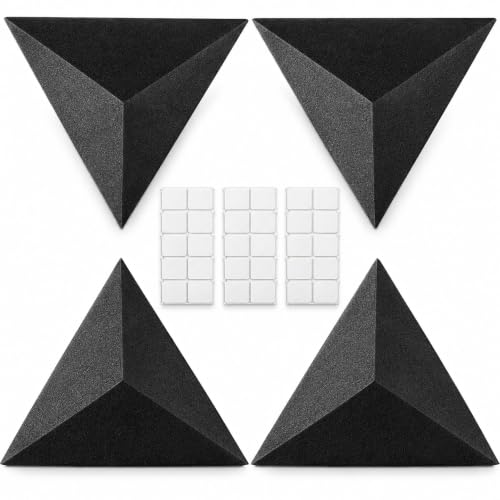 | Foroomaco Pyramid | Count: 4 Size: 16.5 in face, 12 in depth Placement: Ceiling junction Best fit: Upper corners | Check Price on Amazon |
 | Focusound Four-Pack | Count: 4 Size: 16.5 × 6.3 × 12 in Placement: Room corners Best fit: Wide foam wedges | Check Price on Amazon |
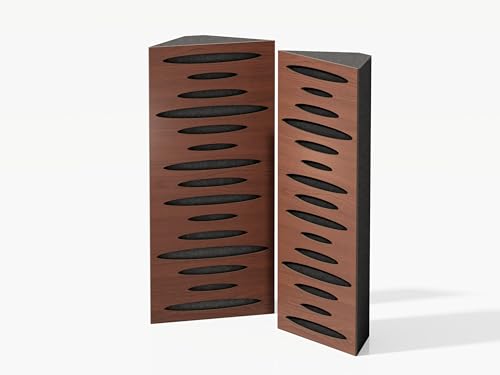 | ua acoustics PULSE-mini | Count: 2 Size: 500 × 235 × 105 mm Placement: Wall / upper corner Best fit: Wood-faced pair | Check Price on Amazon |
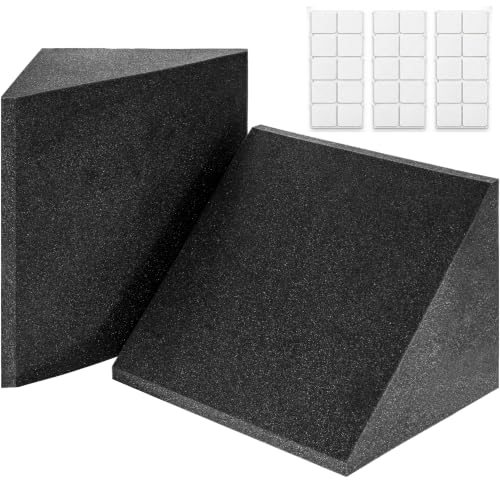 | Foroomaco Delta | Count: 2 Size: 16.5 × 15.8 × 12 in Placement: Vertical wall corner Best fit: Deep stackable pair | Check Price on Amazon |
1. SD SODOCT Eight-Pack — Best Modular Corner Start
The SD SODOCT listing contains eight black foam blocks, each described as 8 by 8 by 12 inches. That modular size lets you distribute pieces among several corners or stack a taller run in one location. The seller recommends placement from floor toward ceiling and also mentions grouped ceiling-corner use. The foam arrives compressed and the listing asks buyers to allow 24 to 48 hours for expansion before judging the shape.
The product page makes broad claims about eliminating standing waves and calls the material fire-proof. Neither claim is an established acoustic or safety result for this exact room. The features mention CA117/B1 fire-retardant language. Confirm any local fire-code need with the actual rating documentation rather than relying on a title. Double-sided tape or spray adhesive is not included, so installation material is a separate decision.
Our Take Pick this flexible eight-block package when the room has several usable corners. Buy for modular geometry, not a promise that eight small foam pieces will correct all low frequencies.
- Eight separate blocks.
- 8-by-8-by-12-inch size stated.
- Can be spread or stacked by corner.
- Mounting supplies not included.
- Fire and acoustic claims need independent verification.
2. TroyStudio Twelve-Pack — Best Narrow Stack
TroyStudio supplies twelve 4-by-4-by-12-inch foam pieces in this exact offer. The narrower face may fit a corner beside a desk, shelf or door where an 8-inch block would protrude too far. The listing names high-density polyurethane and says each panel weighs 0.07 pound. With twelve pieces, a buyer can build vertical coverage across more than one corner, but the listed face depth remains modest.
The seller says its design reduces low-pitched sounds more than regular foam panels do and cites a California Technical Bulletin 117-2013 flame-retardant claim. This article has no independently measured absorption curve or safety certificate. Mounting accessories are sold separately. The listing suggests spray adhesive, compatible tape, screws or T-pins. Choose a method that suits the wall and makes removal possible without damaging a rented room.
Our Take Pick this when limited corner clearance counts for more than maximum foam depth. Treat the low-bass claims as unverified until you test the installed stack.
- Twelve modular pieces.
- 4-inch face fits tighter corners.
- Several mounting routes described.
- Only 4 inches across the face.
- Adhesive or fasteners sold separately.
- No comparable bass absorption curve.
3. Foroomaco Pyramid — Best Ceiling-Corner Set
Foroomaco’s Pyramid package has four pieces for ceiling corners, the junction where two walls meet the ceiling. Each is listed with a 16.5-inch face and 12-inch depth of open-cell polyurethane foam. Those dimensions make it a distinct purchase from a thin wall tile and preserve floor space. The listing includes 30 double-sided adhesive tabs intended for the porous foam.
A falling block could hit a person or monitor, so ceiling placement carries a safety risk that floor and lower wall corners do not. Check the ceiling finish, weight, adhesive instructions and any landlord restrictions before installation. The seller describes cleaner low-end monitoring, but gives no directly comparable in-room measurement here. Four ceiling corners may not be equally accessible if windows, vents or lighting occupy the same area.
Our Take Pick this shape when ceiling-corner treatment is physically possible and secure mounting can be verified. Do not confuse included tabs with proof that every ceiling surface will hold them.
- Four purpose-shaped ceiling pieces.
- 12-inch listed depth.
- 30 adhesive tabs listed.
- Overhead mounting needs extra care.
- Cannot replace treatment along vertical corners.
4. Focusound Four-Pack — Best Wide Foam Wedge
Focusound lists four corner foam wedges measuring 16.5 by 6.3 by 12 inches. The bullets give a 30 kg/m³ density figure and say the package includes 30 pieces of double-sided tape. The wider face and 12-inch dimension make it easier to cover a visible stretch of a corner with fewer pieces than a slim 4-inch modular block, although exact placement depends on the room’s trim and outlets.
The product copy says its material can eliminate low-frequency sounds and that tape removes without wall damage. Neither outcome is guaranteed here. Density alone does not reveal an absorption curve, and tape removal depends on paint, wall finish and time installed. If a corner is behind a powered monitor, make sure the treatment does not cover ventilation or cabling. Test one discreet mounting spot before committing all four pieces.
Our Take Pick this four-piece wedge set for stated dimensions and included tape. Treat the density number as product data, not proof of solved bass or damage-free removal.
- Four 16.5-by-6.3-by-12-inch wedges.
- 30 kg/m³ figure listed.
- Tape included in the offer.
- No verified low-frequency response curve.
- Wall-safe tape claim depends on the finish.
5. ua acoustics PULSE-mini — Best Wood-Faced Pair
The PULSE-mini exact variant is a two-pack of 500-by-235-by-105 mm panels, roughly 19.7 by 9.25 by 4 inches. The features describe laminated HDF/wood facing with acoustic foam. The seller lists an overall NRC of 0.41 and a scattering range, but an NRC value is not a complete low-bass performance curve. Do not use that one number to rank it against the larger foam blocks in this article.
The listing says the panels can mount where two walls meet or at a wall-ceiling corner. Double-sided tape is included, with additional construction adhesive suggested for overhead installation. The panels are a more permanent installation than moving loose foam blocks around a room. The wood facing gives a different look, and the compact depth may appeal when large wedges would dominate a small desk area, but measured benefit at the mix position remains unknown.
Our Take Pick this compact wood-and-foam pair if you want less exposed foam. Treat the seller’s NRC and bass claims as incomplete evidence, especially below the midrange.
- Two wood-faced panels.
- Exact 500-by-235-by-105 mm size listed.
- Wall or upper-corner placement described.
- NRC 0.41 does not establish deep-bass behavior.
- Overhead use may need more permanent adhesive.
6. Foroomaco Delta — Best Deep Wall-Corner Pair
Foroomaco’s Delta offer contains two stackable 16.5-by-15.8-by-12-inch open-cell foam pieces for vertical wall corners. Multiple packs stack into a taller column because the top and bottom are flat. The Delta’s geometry differs from the same brand’s Pyramid ceiling-corner set, and it can be useful when there is clear floor-to-ceiling corner space behind the speakers. The listing includes 30 adhesive tabs.
One two-piece pack does not cover an entire vertical corner. Calculate the room height and how much of it you intend to treat before budgeting. The seller says the deep body reduces boomy buildup, but no measured response at your listening position is supplied. If stacking above head height, confirm that the installed pieces cannot fall. Leave electrical outlets and speaker vents accessible.
Our Take Pick this listed wall-corner shape for a measured vertical-corner plan. Budget for the coverage height you need, not only the two pieces in one box.
- Two deep 12-inch wall-corner pieces.
- Stackable flat ends.
- Adhesive tabs included.
- Two pieces cover limited height.
- Secure stacking and mounting need checking.
Buying Guide: Test the Room, Then Treat Corners
Locate the bass problem before covering the walls
In a small mixing room, speaker and listener positions affect what you hear. Move the chair a modest distance and notice whether a bass note changes dramatically. If it does, adding a few foam pieces without planning the layout may leave the main listening position unchanged. Start with a repeatable track and fixed speaker level. A measurement microphone and room-response software can give clearer before-and-after evidence if available.
Check speaker positioning before spending on treatment. Our desktop-speaker guide covers a different decision, selecting speakers for a work desk. A bass trap cannot repair a damaged speaker or a bad output setting. It is a room-treatment tool whose effect must be evaluated as part of the whole listening setup.
Pick thickness and corner geometry deliberately
The product shapes here range from a 4-inch face to larger 12-inch-deep corner bodies. Deeper porous material may be a more plausible starting point for lower-frequency control than a thin decorative tile, but these listings do not provide comparable absorption curves. A ceiling-corner pyramid and a vertical wall-corner delta piece also serve different mounting positions. Choose the area you can safely reach and treat consistently.
Plan coverage height and pack count. Two tall blocks do not equal a floor-to-ceiling column. Small pieces can fill a narrow gap but may require many packs for meaningful area. Check windows, vents, outlets, speaker clearance and door swing. An attractive symmetrical room is not necessarily an acoustically measured room. Take a before-and-after reading instead of buying only by photographs.
Mount safely and separate treatment from isolation
Some products include adhesive tabs, while others require separate tape, spray adhesive or pins. Wall paint, ceiling finish and rental restrictions can change what is safe. A ceiling-mounted panel must not fall onto a person or equipment. Do not infer that a seller’s fire-retardant phrase means a product satisfies your building’s actual safety requirements. Get appropriate documentation where that applies.
Acoustic treatment is meant to change sound behavior inside a room. It does not soundproof the wall against a neighbor or stop outside traffic. A microphone reflection shield is a smaller accessory for local mic reflections, not a replacement for room corners. If the goal is to keep sound from leaving the room instead of mixing, these foam corner products are the wrong purchase.
Frequently Asked Questions
Will foam bass traps fix every low-frequency problem?
No. Placement, thickness and room geometry affect the result, and none of these six listings supplies a directly comparable in-room bass-response test. Foam blocks may change some reflections. They cannot guarantee a flat response at your chair. The name “bass trap” is a product category label, not proof of deep-bass performance.
Start with speaker and listening positions, then test one treatment position at a time. If a note is strong in one seat and weak a short distance away, that situation may call for broader room analysis rather than another identical foam pack. Keep before-and-after levels and positions the same when judging a change.
Are ceiling-corner pieces better than wall-corner pieces?
Neither is universally better. A ceiling junction and a vertical wall corner are different physical locations, and access or mounting safety may decide which can be treated. The Foroomaco Pyramid is shaped for ceiling corners, while the Delta is shaped to stack along wall corners. One does not turn into the other by rotating it.
Choose a reachable, unobstructed corner and plan secure attachment. A vent or light may make a ceiling corner unusable. A door or bookshelf may interrupt a wall corner. Do not install overhead foam solely because the package includes adhesive tabs. Confirm the surface and attachment instructions first.
Does an NRC number tell me how a trap handles deep bass?
Not by itself. The PULSE-mini listing gives overall NRC 0.41, but one summary number does not show what happens at each low frequency. No comparable absorption curve for all six exact products is provided here, and marketing descriptions use different terms and test claims.
If deep-bass control is the priority, look for frequency-specific evidence or measure the installed room response. Do not rank a wood-faced panel above or below thick foam solely because one product page prints an NRC value. Physical depth, placement and amount of coverage still need attention.
Source boundary: Product identities, pack counts, dimensions, materials and included mounts come from six exact Amazon US listings checked for active New offers at the time of research. We did not measure absorption, room response, fire ratings or mounting safety. The featured image is illustrative, not a listed model. Verify current package contents and installation requirements before buying.