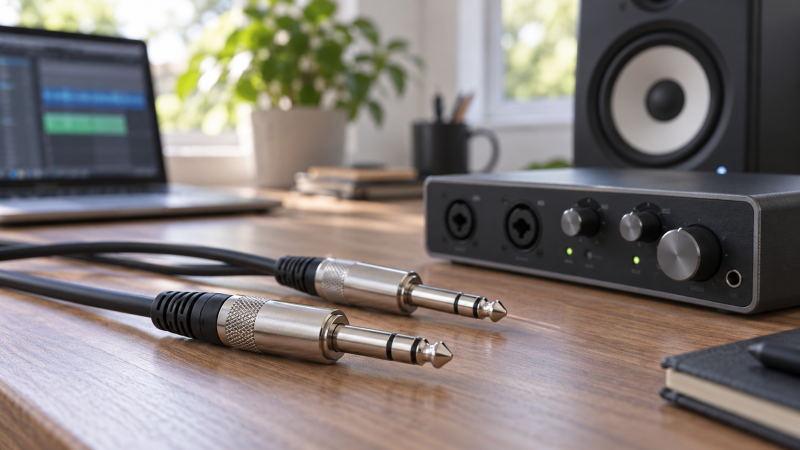
A laptop audio interface may have balanced quarter-inch line outputs for powered monitors. A TRS cable with tip, ring and sleeve contacts can carry one balanced mono output to one compatible monitor input. The same plug shape can also carry unbalanced stereo in a different connection, so the port labels count for more than the word “stereo” in a product title. Do not assume a headphone output becomes a balanced monitor output just because both use a quarter-inch socket.
These six active-New TRS-to-TRS choices cover short and medium runs, a paired interconnect, and different jackets. For two powered monitors, you ordinarily need one cable per left/right channel, assuming each speaker accepts quarter-inch balanced TRS. Check both the interface and monitor ports, then measure the path behind the desk. A cable cannot create a balanced signal if either device uses the connection differently.
Before ordering, read both device manuals or port labels: balanced line out on the interface, compatible balanced line in on each monitor, and separate left and right channels. A three-contact plug is necessary for a TRS path but is not proof that the entire system is balanced.Balanced TRS Cables Compared
| Image | Product | Details | Check Price |
|---|---|---|---|
 | Tisino 6.6-Foot | Length: 6.6 ft Count: 1 Jacket: Rubber + nylon Best fit: Short single run | Check Price on Amazon |
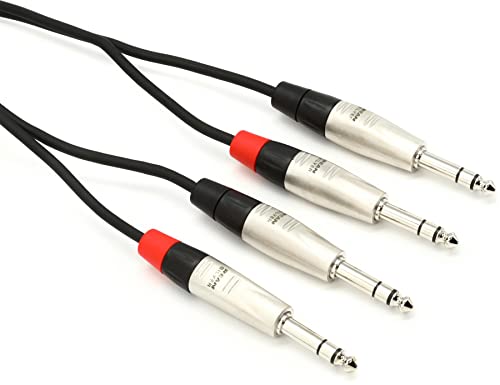 | Hosa HSS-005X2 | Length: 5 ft Count: Dual interconnect Jacket: Not specified Best fit: Close monitor pair | Check Price on Amazon |
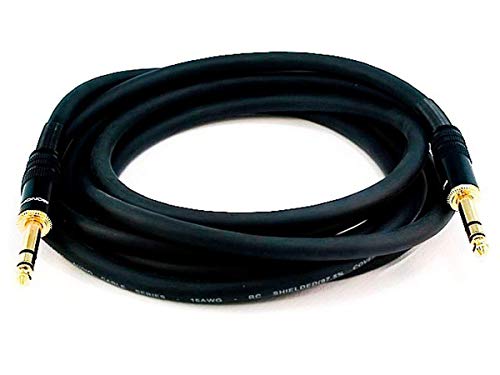 | Monoprice 10-Foot | Length: 10 ft Count: 1 Jacket: Not specified Best fit: Middle single run | Check Price on Amazon |
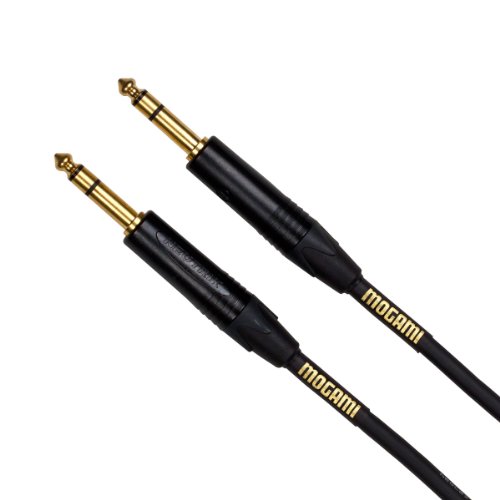 | Mogami Gold 6-Foot | Length: 6 ft Count: 1 Jacket: Not specified Best fit: Quad-shield choice | Check Price on Amazon |
 | CableCreation TRS | Length: 6/7 ft conflict Count: Verify offer Jacket: PVC listed Best fit: Short multi-use lead | Check Price on Amazon |
 | Birvemce 10-Foot Pair | Length: 10 ft each Count: 2 Jacket: TPE + nylon Best fit: Paired middle run | Check Price on Amazon |
1. Tisino 6.6-Foot — Best Single Short Run
Tisino explicitly describes this 6.6-foot TRS-to-TRS cable as an interconnect for pro-audio equipment with balanced phone jacks, including studio monitors and mixers. Its bullets name 20 AWG oxygen-free copper, shielding, gold-plated quarter-inch TRS connectors, a rubber-and-nylon jacket and a reusable cable strap. Those construction details help identify the exact offer, but they do not establish how it sounds against another properly functioning cable.
The offer is a single cable, so a two-monitor interface usually needs two of the same length. Six and a half feet can fit a nearfield desk when the interface sits near the speakers, but it may not reach cleanly if the cable must descend behind a desk before rising to the monitor. The seller also names guitars and keyboards, but balanced line-output use depends on the connected equipment, not simply on a cable’s product category.
Our Take Pick this clear single-run choice if both ports are balanced TRS and the desk route fits 6.6 feet. Count two cables for a conventional left/right pair.
- Balanced pro-audio use stated.
- 20 AWG and shielding described.
- Reusable strap listed.
- One cable in the exact offer.
- 6.6 feet may not reach a wide desk route.
2. Hosa HSS-005X2 — Best Short Pair
Hosa’s HSS-005X2 listing identifies a dual quarter-inch TRS male-to-male balanced interconnect with 5-foot length. That pairing is useful when an interface’s two line outputs sit between two nearby powered monitors. The feature data is brief. It names the dual REAN connector construction but does not supply conductor gauge, shielding type or bend-cycle results for this exact product.
Treat “dual” as the reason to inspect the product photos and current package description, not as license to infer hidden electronics. Each left/right output still needs its own signal path. Five feet is deliberately short. Route it behind the desk and check that both monitor positions can be reached with a little slack. Avoid stretching a cable taut just because the product is sold as a stereo pair.
Our Take Pick this as the simplest paired short-run option if your two monitor inputs and interface outputs are close. Measure both paths before choosing the 5-foot version.
- Dual balanced interconnect named.
- 5-foot length suits close monitors.
- REAN connectors described.
- May be too short for widely spaced speakers.
- Returned construction details are sparse.
3. Monoprice 10-Foot — Best Single Middle Run
Monoprice lists a 10-foot quarter-inch TRS male-to-male cable in its Premier series. Its feature bullets state 16 AWG stranded copper conductors, copper-braid shielding with a listed 97.5% coverage figure and gold-plated plugs. The seller explicitly says the same cable can serve as an unbalanced stereo patch or a balanced mono patch, depending on the equipment connected. That distinction is unusually useful for a buyer comparing port labels.
One 10-foot lead can reach a monitor placed farther from the interface, but two monitors generally need two cables. The shielding coverage number is a construction figure from the seller, not an audible noise-reduction result. Route the cable so the plugs are not bent sharply behind the speaker. If only one side has a hum, swap cables and ports during diagnosis before ordering a replacement.
Our Take Pick this useful 10-foot single run for its explicit balanced-mono wiring language. Buy a second if the other monitor also needs TRS and the route length matches.
- 10-foot length stated.
- Balanced mono use explicitly described.
- 16 AWG and braid figure listed.
- Only one cable in the offer.
- Coverage figure does not prove lower audible noise.
4. Mogami Gold 6-Foot — Best Listed Quad Shield
Mogami’s exact offer is a 6-foot TRS-to-TRS interconnect marketed for balanced line outputs, mixers and powered speakers. Its features name Neglex Quad shielding, spiral copper shielding and black-body gold-contact TRS connectors. The details make this cable an option focused on construction, but the seller’s promise of neutral tone and eliminated hum is not a controlled comparison with the other cables here.
For a two-monitor desk, remember that the offer is a single cord. Check the current warranty terms separately, because a feature bullet says lifetime coverage but does not supply the full service conditions. A short premium cable cannot correct a noisy power arrangement, a loose monitor input or a headphone socket mistakenly used as a line output. Test the complete chain before attributing every hum to the wire.
Our Take Choose it if you want the specified quad-shield construction on a short single run. Do not treat its marketing copy as proof that other working balanced cables color the sound.
- 6-foot balanced interconnect.
- Quad-shield construction named.
- Gold-contact TRS ends described.
- Single cable, not a monitor pair.
- No independent sound comparison supplied.
5. CableCreation TRS — Best Short Multi-Use Lead
CableCreation’s title identifies a quarter-inch TRS balanced-stereo cable, and its features name monitor, mixing-board and instrument connections. The bullets also list oxygen-free copper, a PVC outer layer, zinc-alloy connector cases and gold-plated plugs. They conflict on length, saying 6 feet in one place and 7 feet in another. Check the selected offer’s listed length and pack contents before counting on a precise desk route.
The same three-contact connector can be used for different signals, so a multi-use product list is not a promise that every device uses balanced mono. Confirm the interface output and monitor input first. The seller also mentions a two-pack in a feature bullet even though the title does not. Do not assume how many independent cables arrive without checking the exact offer. If your monitors need two runs, resolve that before purchase.
Our Take Pick this short TRS lead if its listed length and package count are confirmed. Its listing is less clear than the explicitly paired Hosa offer.
- TRS ends and monitor use named.
- PVC and connector materials listed.
- Short desk-oriented length described.
- Length conflicts between returned bullets.
- Pack count needs exact-offer verification.
6. Birvemce 10-Foot Pair — Best Paired Middle Run
Birvemce’s title describes a two-pack of 10-foot quarter-inch TRS cables. The bullets describe copper cores, multilayer shielding, gold-plated connectors, a soft TPE outer layer and braided nylon cover. They also call the cable balanced TRS and describe use with studio monitors and mixers. A paired 10-foot format can serve two speakers when a short 5-foot pair cannot follow the desk edges cleanly.
The seller’s “noise free” and long-lasting claims are not independent tests. Note that one bullet emphasizes stereo signal from a TRS plug, while another calls it a balanced cable, and the two are different uses of the same three contacts. Only the connected ports determine which signal is carried. Verify the line-output and monitor-input wiring instead of treating the cable as a converter between stereo and balanced mono.
Our Take Pick this paired 10-foot route for left and right monitors if the exact ports support balanced TRS. Ignore the promise of guaranteed silence and test the actual system.
- Two 10-foot leads in the title.
- Multilayer shielding described.
- Flexible jacket materials listed.
- Stereo and balanced marketing can confuse signal use.
- No independent noise or longevity result.
Buying Guide: Match Ports Before Materials
Understand what balanced TRS carries
In a compatible line-level connection, one TRS cable carries one balanced mono channel. Tip and ring carry related signal paths while sleeve is the reference, so the receiving equipment rejects some interference. A stereo headphone jack can use the same shape for left and right unbalanced audio, which is why plug appearance alone cannot answer the question. Read the interface and monitor port documentation.
For left and right powered monitors, connect left output to left speaker and right output to right speaker with separate cables if both sides have balanced quarter-inch inputs. An interface with XLR or RCA outputs needs a different cable or connection plan. See our USB audio-interface guide for adjacent interface choices, then return to the actual port labels before ordering wires.
Measure both monitor runs and pack counts
Measure from each interface output behind the desk to its monitor, leaving slack at each plug. Speaker placement may make one run longer than the other. Hosa lists a dual 5-foot product that can fit a compact desk. Birvemce lists two 10-foot leads for a longer route. The single-cable offers need two units for two independent monitor inputs unless you already own one matching lead.
Leave enough room to unplug a monitor without tugging the interface. Keep a loose bend near the connector, not a tight kink against the wall. A short cable stretched across a desk can pull a speaker, while a long coil can collect beneath a chair. Choose the package that matches the actual route and leaves a little service slack, not the longest number on the search page.
Troubleshoot hum without blaming the cable first
Balanced cabling can help reject some interference when both connected ports are balanced and working correctly. It cannot repair a damaged connector, an incorrect output selection or an equipment-ground problem. Seller descriptions of “no hum” are not guarantees for an entire laptop, interface and speaker system. Start by checking port type and gain, then swap the left and right cables to see whether a problem follows a cable.
If the noise remains on the same side, inspect the monitor and interface port before buying another wire. If it follows one lead, check that lead and its plugs. A monitor can also have a local input-sensitivity setting. Our desktop-speaker guide is about the speaker itself, a different buyer decision from the balanced line between equipment.
Frequently Asked Questions
Is a TRS cable always balanced?
No. TRS describes three contacts, not the signal assigned to them. A balanced mono line connection and an unbalanced stereo connection can both use the same physical plug. Monoprice explicitly describes both use cases for its cable. The connected equipment determines which applies.
Check the interface line-output specification and the monitor input specification. If one side is unbalanced or wired differently, a TRS cable cannot make that port balanced by itself. Do not use a headphone-output label as evidence of a balanced monitor feed.
Do two studio monitors need two cables?
Usually yes, when each speaker has its own balanced quarter-inch input and the interface has separate left and right outputs. One cable carries one mono channel in that connection. A product sold as dual or a two-pack may give both leads, while a single-cable offer does not.
Check what is actually in the selected offer, especially when listing bullets conflict with a title. Route both cables before committing to a length. If one monitor is farther away, two identical cable lengths are convenient but not mandatory when each one safely reaches.
Will an expensive cable improve my monitor sound?
The listings do not establish that. They describe conductor gauges, shielding and connectors, but this guide has no controlled audio comparison among these six cables. A correctly connected, undamaged cable should first solve the practical task of getting signal from interface to monitor without strain or crackles.
If sound is missing or noisy, verify output assignment, monitor power and input setting. Swap cables and ports to isolate a fault. Price or a shielding adjective cannot substitute for that check, and a cable cannot improve a speaker’s underlying performance.
Source boundary: Exact product identity, length/pack claims and construction details come from six Amazon US listings checked for active New offers at the time of research. Some CableCreation bullets conflict on length and pack count. We did not test balanced-port wiring, audible noise, durability or warranty service. The featured image is illustrative, not a listed model. Confirm current offer details and both equipment port types before buying.