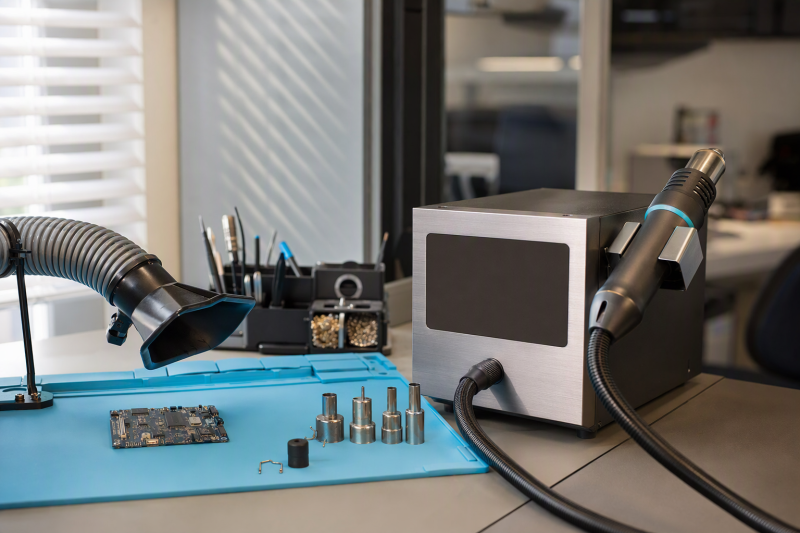
Removing a small surface-mount part requires controlled heat over an area, not just a hot iron tip. A hot-air station lets you set temperature and airflow and fit a nozzle to the component. The risk is that too much air can shift nearby parts while too much heat can damage pads, connectors, or plastic. A big number on the display is not the temperature at the joint.
This guide covers six exact hot-air stations with active New Amazon US offers. The meaningful differences are included nozzle sizes, airflow control, presets, handpiece replacement, and space on the bench. Listings do not establish measured nozzle temperature, airflow, grounding, or fail-safe behavior. The stations are not safe for beginners merely because a listing mentions “safety.” Confirm local mains voltage, ventilation, and your experience with scrap boards before using any of them on a valuable device.
Choose a nozzle and airflow that heat the target without blowing adjacent components away. Practice the motion and cooldown on a scrap board first.Hot-Air Rework Stations Compared
| Image | Product | Details | Check Price |
|---|---|---|---|
 | YIHUA 959D Digital | Range: 212-932F listing claim Presets: Three Flow: Up to 120 L/min claimed Best fit: Repeatable stored settings | Check Price on Amazon |
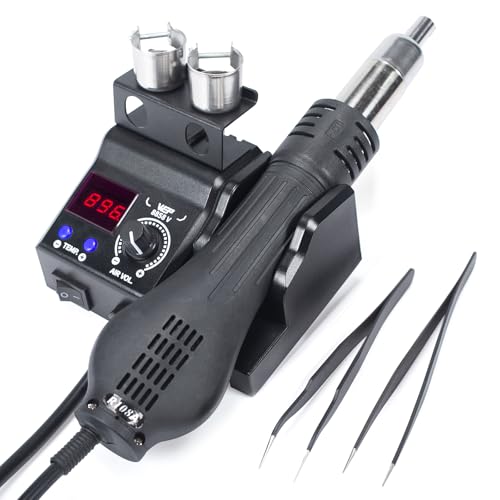 | WEP 8858-V Compact | Range: Not stated in checked bullets Nozzles: Three included Mount: Integrated gun/nozzle holders Best fit: Tight repair bench | Check Price on Amazon |
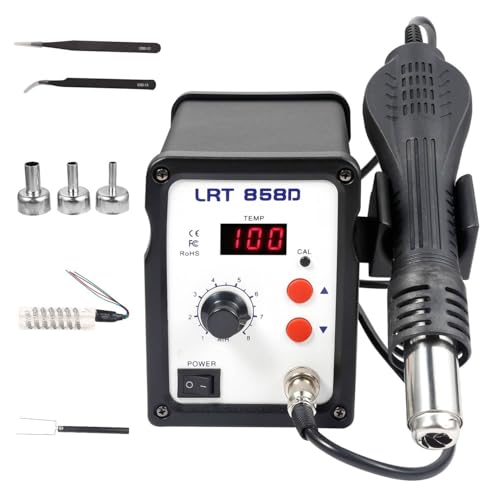 | LRT 858D 700W | Power: 700W listing claim Fan: Brushless claim Controls: Digital temperature and airflow Best fit: Simple hot-air unit | Check Price on Amazon |
 | ATTEN ST-862D | Power: 1000W listing claim Range: 100-480C claim Nozzles: Four included Best fit: Higher-flow multi-nozzle bench | Check Price on Amazon |
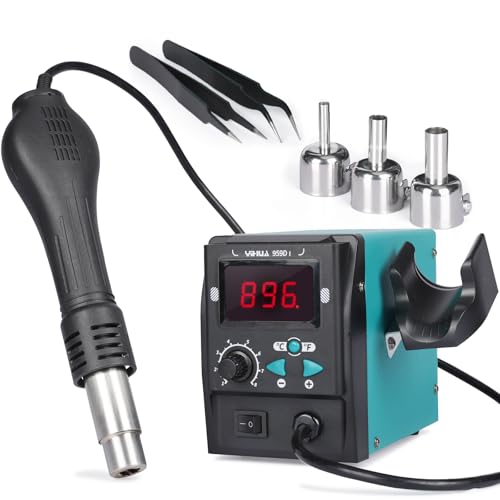 | YIHUA 959D I | Range: 212-896F claim Nozzles: 5, 8, 10 mm Flow: Up to 120 L/min claimed Best fit: Explicit small nozzle sizes | Check Price on Amazon |
 | WEP 2009D-II | Range: 212-896F claim Nozzles: 0.2, 0.31, 0.39 in Gun: Detachable R118B Best fit: Replaceable handpiece | Check Price on Amazon |
1. YIHUA 959D Digital — Best Stored Settings
YIHUA’s 959D offers three preset channels for repeatedly used temperature and airflow settings. The seller lists a 212-932°F set range and a maximum airflow figure of 120 L/min. Those numbers do not establish measured air temperature or flow at a particular nozzle. Presets can reduce repetitive setup when switching between a small connector and a larger shield, but the saved setting must still be appropriate for the board and surrounding components.
The listing describes quick heating when lifted from the holder and cooldown behavior in the holder. It also makes a fire-prevention claim for a fail-safe function, which the listing alone cannot verify. Always return the gun to a sound holder and let the fan complete its cooldown. This exact model is listed for 110-127V US power, so check your supply before use. The checked bullets do not give included nozzle dimensions, so accessory fit is a question to settle before buying.
Our Take Choose the YIHUA 959D if you repeat the same jobs and want stored settings. Its heat accuracy was not measured, and you need to settle its nozzle bundle and US voltage requirement before buying.
- Three stored setting channels.
- Holder-triggered cooldown described.
- Nozzle sizes absent in checked bullets.
- Fail-safe and airflow claims untested.
2. WEP 8858-V Compact — Best Small-Bench Footprint
WEP describes a palm-sized main unit with an integrated handpiece rest and nozzle holder. The box lists three nozzles and both bent and straight tweezers. A separate airflow knob on the front is simpler than going through a menu while positioning a board. The checked bullets do not specify the three nozzle diameters or a numerical temperature range, so confirm those details on the exact listing before treating it as a fit for fine SMD work.
The seller claims PID temperature control, calibration, and a hot-air fail-safe, none of which is independently established by the listing. The small case takes up little bench area, but do not put the holder where a hot nozzle can point at a cable, screen, or hand. The product is explicitly rated 110-127V for US power and warns against 220V. A compact station is useful only if the handpiece can be parked safely and its cable does not drag across the work mat.
Our Take Choose the WEP 8858-V if desk space is scarce and you want manual airflow control. Check nozzle sizes, voltage, and a safe place for the holder.
- Integrated holders save space.
- Three nozzles and airflow knob listed.
- Nozzle diameters omitted in checked bullets.
- US-only voltage claim.
3. LRT 858D 700W — Best Basic Digital Unit
LRT lists a 700W heating system, digital temperature display, adjustable airflow, and a brushless fan. Its product page markets the station for SMD, USB-C port, and laptop board repair. Those applications are plausible for a hot-air tool but do not verify its actual control at a small plastic connector. The checked bullets do not give an exact temperature range, nozzle set, airflow range, or handpiece replacement path. Ask for those details before choosing it over better documented alternatives.
The seller claims rapid heat-up, stable recovery, low noise, and long fan life. None was independently measured. A display reports the station’s sensed or set temperature, not the exact temperature of a pad hidden under a chip. A basic unit can work for occasional practice, but if you cannot source the right nozzle and replacement gun, it becomes a poor long-term bench choice. Use appropriate ventilation and do not aim hot air at exposed battery material.
Our Take Choose the LRT 858D as a basic digital candidate if you have confirmed its nozzle set and replacement path first. Several performance claims are unverified, and the missing nozzle and service details are the main reason to look closely at it.
- Digital display and adjustable airflow listed.
- Brushless-fan design claim.
- Nozzle and flow specifications missing in checked data.
- Recovery and fan-life claims unverified.
4. ATTEN ST-862D — Best Four-Nozzle Bundle
The ATTEN ST-862D listing states 1000W, 110V AC, a 100-480°C range, up to 120 L/min, and three quick-access setting groups. Its package includes four nozzles, a holder, ground wire, and manual. Four included nozzles give a starting range for different components, but the checked bullets do not state each diameter. The seller’s claimed ±1°C stability should not be read as measured pad or joint temperature. The location and conditions of that measurement are not verified here.
This model may suit a bench that already has a contact iron and needs a dedicated hot-air tool with stored settings. The listing calls it antistatic and emphasizes heat stability, neither tested on the exact Amazon unit. Verify grounding and nozzle availability, especially when working near ESD-sensitive devices. With its 110V specification, matching your supply is essential. A high-flow maximum is not necessarily desirable around tiny neighboring components. Controlled low flow can be the safer starting point.
Our Take Choose ATTEN if you want four nozzles and three presets in a station listed at high power. Verify nozzle sizes and grounding, and treat its stability number as an untested listing claim.
- Four nozzles and three preset groups listed.
- Temperature and maximum flow claims stated.
- Individual nozzle sizes not stated in checked bullets.
- ±1°C stability unverified at the board.
5. YIHUA 959D I — Best Explicit Nozzle Sizes
The YIHUA 959D I is a different exact product from the 959D above. Its listing states three nozzle diameters: 5, 8, and 10 millimeters, plus two tweezers with claimed ESD safety. Those numbers let you assess whether the supplied tools match a small connector, medium IC, or larger area before buying. The seller describes an adjustable 212-896°F range and a maximum airflow claim of 120 L/min. Neither figure says what heat reaches the board through each nozzle.
The unit is described as showing live temperature and cooling in its holder to 212°F before standby. A 212°F nozzle is still hot and must remain clear of people and materials. Its PID behavior and ESD status were not independently verified. The listing calls for 110-127V US power. Compared with the 959D and its presets, this model’s strength is clarity about included nozzle sizes. Do not merge the specifications of the two models because their names are close.
The included 5, 8, and 10 mm nozzle sizes are a useful clue to fit before you buy, and airflow and board temperature still need careful setup.Our Take Choose the YIHUA 959D I if you want a bundle with stated nozzle sizes to check before buying. Keep its hot standby state and US voltage in mind.
- Three specific nozzle diameters.
- Holder cooldown and tweezers listed.
- Standby at 212°F is not touch-safe.
- Actual airflow and ESD claims untested.
6. WEP 2009D-II — Best Replaceable Handpiece
WEP’s 2009D-II lists a detachable R118B hot-air gun and three nozzles at 0.2, 0.31, and 0.39 inches. A replaceable handpiece may lower the cost of future repair if it remains available, but that supply was not checked. Four preset channels and a one-to-ten airflow scale are described. The scale is not an absolute flow measurement and should not be compared directly with another seller’s L/min maximum. The station also includes tweezers and an IC extractor.
The seller gives a 212-896°F set range, digital calibration, and a cool-air button. It says placement in the holder cools the gun to 212°F, and again that temperature is not touch-safe. The listing does not establish measured calibration, fan speed, or actual nozzle temperature. The detachable gun is most useful for a bench that expects frequent service, while four presets help repeated jobs. Confirm the exact replacement R118B and nozzle compatibility before relying on that long-term value.
Our Take Choose the WEP 2009D-II if you want documented nozzle diameters, a detachable gun, and four presets. Read its airflow scale and cooldown temperature carefully.
- Detachable gun and three stated nozzle sizes.
- Four presets and cool-air mode listed.
- Replacement-gun supply not verified.
- One-to-ten airflow scale lacks absolute units.
Buying Guide: Control Heat and Air at the Component
Start with nozzle size and airflow
Match the nozzle opening to the target, not just the station’s advertised maximum temperature. A narrow nozzle can localize heat but may create a strong jet. A broad nozzle warms more surrounding material. YIHUA 959D I lists 5, 8, and 10 mm options, while WEP 2009D-II lists three sizes in inches. Convert and compare the actual openings before buying replacement parts. A close nozzle can still heat nearby plastic, so shield sensitive areas according to a competent repair method.
Airflow should be controllable at the low end because too much flow can move small parts before their solder releases. Sellers describe L/min maxima or a numbered one-to-ten scale, but those are not directly comparable measurements at the board with a nozzle fitted. Practice on scrap material, observe how nearby components react, and change one setting at a time. A high-flow station is useful only if it can also deliver the gentler flow your small board needs.
Treat the display as a set point, not joint temperature
The display shows a set or sensed station temperature, while the actual pad depends on airflow, distance, nozzle, board copper, and exposure time. Do not copy a temperature from a video without checking the solder alloy and board. A seller’s ±1°C or PID claim does not prove that a laptop connector remains within safe limits. The checked listings do not establish measured output at a joint.
Presets save time only after a safe process is established. If the board starts to discolor or a nearby part moves, stop. More heat is not automatically the cure. For the disassembly step before board work, our USB-C electric screwdriver guide covers a separate mechanical tool. Keep thermal and mechanical steps distinct rather than forcing hot air into every repair.
Plan voltage, ventilation, and cooldown
Several models here explicitly require 110-127V US power. ATTEN also lists a US-voltage requirement. Never assume that a product with an Amazon US listing will accept another mains voltage. Inspect the exact power label and plug. Keep the handpiece holder on a stable surface, with the nozzle pointed away from cables, the laptop, and your body. A station that automatically cools in its holder may still be very hot while doing so.
Use local fume capture or appropriate ventilation and follow your solder/flux safety guidance. OSHA discusses local exhaust as an effective control for airborne contaminants from soldering and brazing. Protect ESD-sensitive boards and remove or isolate power sources per the device’s service instructions. Do not heat a battery. If you are unsure of the procedure, practice with scrap boards or use a qualified repair technician. Our USB-C hub guide covers post-repair port selection, not safe rework technique.
Frequently Asked Questions
Is a 1000W hot-air station safer or better for tiny SMD parts?
No. A wattage figure describes a power capability or claim, not the air speed or heat at a tiny component. Compare nozzle fit, airflow control, and cooldown behavior instead of ranking these stations by wattage. The checked listings do not establish measured output or control accuracy for any unit.
For a small part, a compatible nozzle and steady low airflow can be more important than maximum power. Excess air can blow neighboring parts away. Excess heat can damage pads and plastic. Use a practiced process, ventilation, and an appropriate board fixture.
Does automatic standby make the gun safe to touch?
No. A handpiece cooled to 212°F is still hot. Both YIHUA 959D I and WEP 2009D-II describe holder cooldown to that figure. The cooling fan may need time to finish before the station is powered down, so follow the exact instructions for the model.
Keep the nozzle in its holder and away from cables and people. Never rest it on a mat or assume an indicator means the metal is cool. A fail-safe claim on a listing is not a substitute for safe handling.
Do I still need a contact soldering iron?
Often, yes. Hot air heats an area, which can help lift or place small surface-mount parts but also warms neighbors. A contact iron can be more direct for an accessible single joint or wire. Which tool is appropriate depends on the component, board, solder, and repair procedure.
All six products here are hot-air stations, not replacements for every contact task. If a listing bundles a separate iron in another variant, do not assume it is included in the product discussed here. Plan a safe tool set rather than maximizing heat modes in one purchase.
Bottom Line
WEP 8858-V is the compact option with an integrated holder, YIHUA 959D I has nozzle sizes stated in millimeters, and WEP 2009D-II adds a detachable gun and four presets. Whichever you choose, verify power, nozzle fit, airflow control, ventilation, and the cooldown path before heating a valuable board.