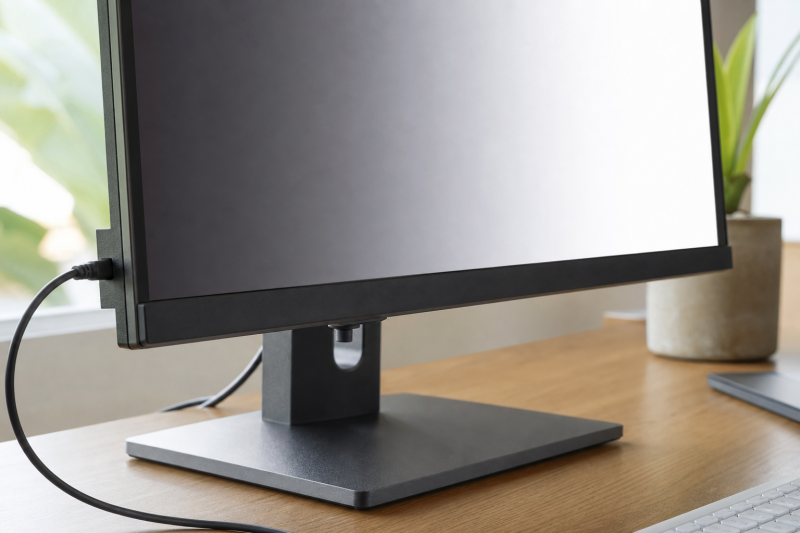
A missing Windows 11 brightness slider is not automatically a fault when the screen is an external USB-C monitor. Microsoft says that external-monitor users may not see that slider and should use the monitor’s own controls. First test the physical on-screen display. Only troubleshoot DDC/CI or the connection route if the monitor can change its backlight locally but supported control software cannot.
Everything below assumes the external screen already shows a normal image. For a blank screen or no signal, use the USB-C monitor connection guide instead.
Start with the control that failed
Do not treat every greyed slider or dark image as the same problem.
| Control result | What it establishes | Correct branch |
|---|---|---|
| Monitor buttons change brightness | The monitor backlight and local control work | Decide whether Windows control is expected; then test supported DDC/CI software |
| Brightness is greyed out in the monitor menu | Local brightness control is unavailable in the observed state | Record the active preset and input, then read the exact manual |
| Monitor menu value moves but luminance does not | The monitor accepts its own command but the backlight does not follow | Monitor-local result; keep Windows and control software out of the comparison |
| Vendor software detects the monitor but cannot change brightness | Video works; the software control command is failing or unsupported | Check DDC/CI, model support, and a direct display route |
| Vendor software does not detect the monitor | The control application has no usable management path | Verify support and remove converters/extenders for one comparison |
| Only the Windows quick-settings slider is missing | Normal behavior for many external monitors | Use the monitor OSD; do not repair what Windows does not promise |
When the monitor buttons change the screen, the backlight can respond. Reinstalling a graphics driver cannot improve that proof.
Test the monitor’s own brightness control
Open the monitor’s on-screen display with its physical button or joystick. Record the current input, picture preset, brightness value, contrast value, and any locked-menu indicator before changing anything.
Move brightness down by a visible amount, wait a few seconds, then return it to the original value. Keep the same image on screen. You are checking the panel backlight control, not judging whether a different photo looks darker.
If brightness is unavailable, consult the exact manual for the active preset and record only what that manual states about the control in that mode. Do not guess which mode is responsible, and do not factory-reset the monitor before saving color, KVM, input, USB-C, and power settings that may be difficult to reconstruct.
If the menu value changes but the screen does not, repeat the test on the monitor’s built-in menu background. That removes the Windows desktop and application from the comparison. A failure visible on the monitor’s own menu is local to the monitor, and it does not establish a Windows problem.
Set the right expectation for Windows 11
Open Settings > System > Display and identify the external monitor. Windows provides brightness controls for supported displays, but Microsoft explicitly warns that the brightness slider may be absent when an external monitor is attached. Its supported fallback is the monitor’s own buttons.
Both of these can be true at once:
- Windows drives the external monitor at its correct resolution.
- Windows does not expose a native external-monitor brightness slider.
Do not use the built-in laptop display’s automatic brightness, content-adaptive brightness, or ambient-light setting as proof that Windows should control the external panel. Those controls describe the built-in display on supported PCs.
A utility that places a dark overlay on the desktop is also a different mechanism. It may make pixels look darker without reducing the monitor’s physical backlight. Software dimming is not proof that hardware brightness control works.
Check whether the monitor supports DDC/CI control
Some monitor makers provide Windows software that changes the monitor through DDC/CI, the display-control channel. Support depends on the exact monitor and the maker’s application.
Dell’s Display Manager documentation says it communicates with supported Dell monitors over DDC/CI. It also identifies routes that may prevent communication even though an image is visible. Video success does not guarantee that a management command survives every extender, hub, converter, or virtual display path.
Use the exact monitor support page to answer three questions:
- Is this monitor supported by the maker’s current Windows control software?
- Does its on-screen display include a DDC/CI switch, and is it enabled?
- Does the maker document the active cable/input route for software control?
Do not install an unrelated maker’s utility. Dell Display Manager is evidence for Dell’s control path, not a universal monitor application.
Build one clean DDC/CI comparison
If the physical OSD works and the exact model supports software control, simplify the display route:
- Save open work and the monitor’s current input settings.
- Remove a KVM, extender, converter, wireless-display layer, or intermediate hub from the video path.
- Connect the monitor directly to a documented host display output with a documented cable.
- Keep one display active for the comparison.
- Restart the vendor application and check whether it detects the exact monitor.
- Change brightness once, then restore the original value.
Dell notes that some low-cost extenders, hubs, and converters may not support DDC/CI properly. Its related guide also excludes virtual and wireless displays from the supported DDC/CI path. A direct-route success therefore isolates the added path as a control-channel problem; it does not mean the removed device is bad at carrying video.
If control fails on both direct and complex routes, verify that DDC/CI is enabled in the monitor menu. Then compare the vendor application’s supported-model list and its current release notes. Preserve the application version and exact monitor identifier.
Keep USB data separate from display control
A USB-C monitor may carry video, charging, and USB hub data over one connector, but those functions still have separate states. DDC/CI commonly follows the display-management route. It is not proven by a working webcam, Ethernet jack, or flash drive attached to the monitor.
Likewise, a working picture does not prove DDC/CI. If you are unsure whether the host port is providing a native display route, the DisplayPort Alt Mode check can identify the connection. It does not create brightness support and should not be used to broaden this diagnosis into a no-signal article.
Record the complete route in one line, such as laptop USB-C -> cable -> monitor USB-C input. If an adapter is present, include its direction and model. That line makes a direct-versus-intermediate comparison reproducible.
Stop at the responsible layer
- Monitor OSD changes the backlight; Windows slider is absent: use the monitor controls. There may be no Windows fault.
- Monitor OSD works; supported vendor software works only on a direct cable: the intermediate route does not preserve the required control path.
- Monitor OSD works; supported software detects the display but commands fail directly: the DDC/CI control path is failing on a route the maker documents as supported.
- Monitor OSD brightness is locked: use the exact manual to identify the active mode before resetting anything.
- Monitor OSD value changes but the monitor’s own menu does not become lighter or darker: keep Windows and control apps out of the case; the local monitor behavior is the material evidence.
Sources
Microsoft defines the key expectation in Change display brightness and color in Windows: an external monitor may have no Windows brightness slider, so its own buttons are the supported control. Dell’s P2422HE Display Manager guide documents DDC/CI communication and the effect of some extenders, hubs, and converters. The P2722HE Display Manager guide supplies the virtual/wireless-display boundary. Those Dell rules remain model and application specific.