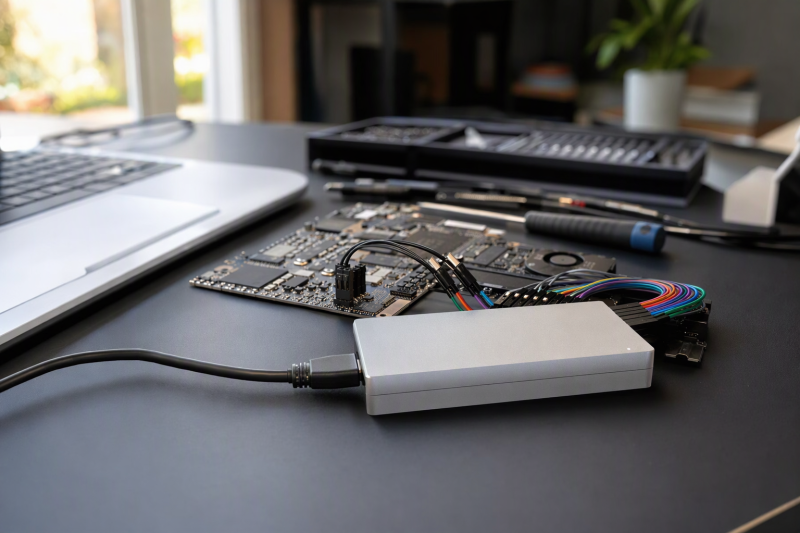
A logic analyzer records digital high and low states over time. On a USB-C repair bench, it can help with accessible control lines, embedded controllers, UART logs, I2C peripherals, SPI devices, and other digital interfaces around the system. It does not replace a USB-C cable tester, power meter, oscilloscope, or protocol-specific compliance equipment.
The DreamSourceLab DSLogic Plus is our best overall pick because it combines 16 channels, adjustable thresholds, shielded leads, long stream captures, and buffered sampling up to 400 MHz, with the highest rate available only on fewer channels. Innomaker’s LA1010 offers a simpler 16-channel middle tier at a stated 100 MHz per channel. For lower-rate UART, I2C, and SPI work, the 24 MHz eight-channel tools cost less and occupy less bench space.
Input compatibility is as important as speed. HiLetgo publishes an input range of -0.5 to 5.25 volts with separate low and high thresholds, while DKARDU and xicoolee list support for inputs up to 5.5 volts but use different threshold descriptions. Never assume a logic input tolerates a signal merely because the connector fits or the software can decode its protocol.
| Image | Product | Details | Check Price |
|---|---|---|---|
 | HiLetgo 3-01-0015 | Best fit: Basic analyzer with published input levels Channels: 8 Maximum sample rate: 24 MHz Input range: -0.5V to 5.25V Logic levels: Low to 0.8V; high from 2.0V | Check Price on Amazon |
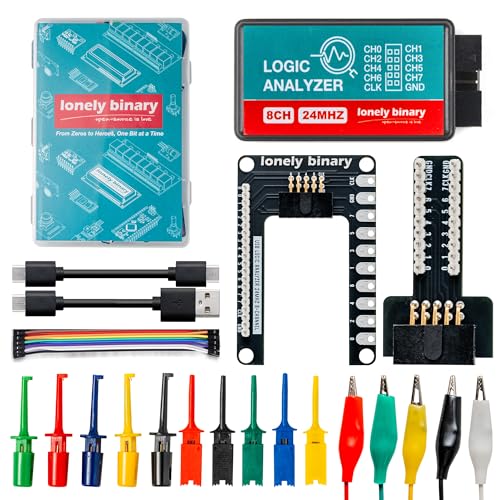 | LONELY BINARY Logic Analyzer Kit | Best fit: Complete 24MHz starter kit Channels: 8 Maximum sample rate: 24 MHz Host cables: USB-A and USB-C Included probes: 10 hooks; 5 alligator clips; jumpers | Check Price on Amazon |
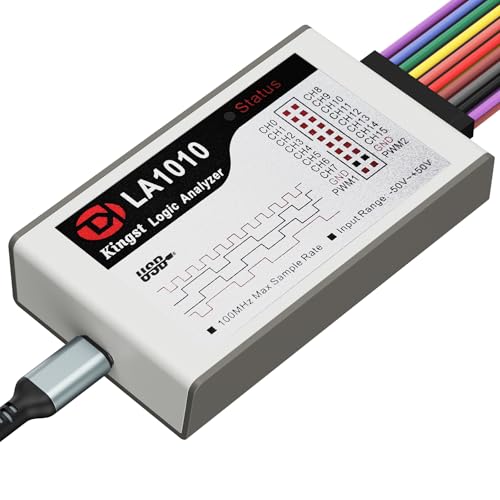 | Innomaker LA1010 | Best fit: 100MHz sixteen-channel middle tier Channels: 16 Maximum sample rate: 100 MHz per channel stated Decoders: 30+ Hosts: Windows 10/11; macOS 10.12+; Linux | Check Price on Amazon |
 | DreamSourceLab DSLogic Plus | Best fit: Advanced stream and buffer capture Channels: 16 Buffer rates: 400MHz/4ch; 200MHz/8ch; 100MHz/16ch Memory: 256 Mbit SDRAM Software: DSView; Windows; macOS; Linux | Check Price on Amazon |
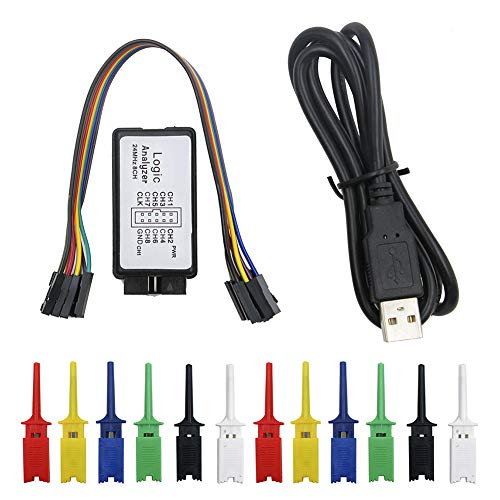 | KeeYees KYES57 | Best fit: Kit with many SMD hook clips Channels: 8 Maximum sample rate: 24 MHz Included clips: 12; 6 colors Software: Sigrok compatible stated | Check Price on Amazon |
 | DKARDU JK-US-155 | Best fit: Fixed-threshold budget analysis Channels: 8 Maximum sample rate: 24 MHz Input range: 0 to 5.5V Logic threshold: 1.5V stated | Check Price on Amazon |
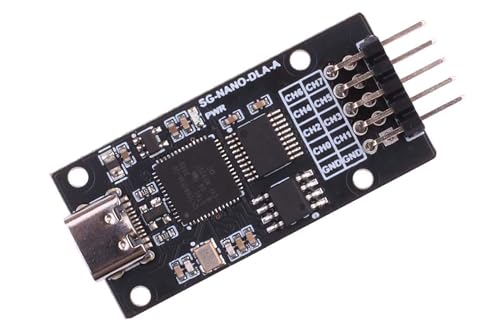 | xicoolee XI-SG-NANO-DLA-A | Best fit: Protected mini USB-C analyzer Channels: 8 Maximum sample rate: 24 MHz Input range: 0 to 5.5V Protection: TVS; self-recovering fuses | Check Price on Amazon |
 | VQP DSLogic Plus | Best fit: Alternative dual-mode 16-channel package Channels: 16 Maximum sample rate: 400 MHz stated in title Memory: 256 Mbit SDRAM; 16G stream depth stated Hosts: Windows XP-10; macOS; Linux | Check Price on Amazon |
How we compared digital logic analyzers
All eight products have a New offer and are presented for digital capture, protocol decoding, embedded debugging, or electronics analysis. We compared channel count, sample modes, rate at each active-channel count, onboard memory, stream depth, voltage range, logic thresholds, probe accessories, host connector, operating-system support, and named protocol decoders.
The highest printed sampling rate may apply only to a reduced number of channels or buffer mode. It also does not certify the analyzer for every USB-C or USB data lane. The correct choice starts with the accessible signal’s voltage, timing, ground reference, and decoder support, then adds enough sample headroom and capture depth for the event being investigated.
1. HiLetgo 3-01-0015 — Best Basic Analyzer with Published Input Levels
Our take: HiLetgo’s eight-channel analyzer is the clearest basic option for buyers who want input electrical figures before connecting probes. The listing specifies an input range from -0.5 to 5.25 volts, a low level from -0.5 to 0.8 volt, and a high level from 2.0 to 5.25 volts.
HiLetgo rates each of the eight channels to sample at up to 24 megasamples per second. Selectable rates are listed at 24, 16, 12, 8, 4, 2, and 1 MHz plus several lower settings down to 25 kHz. The product title identifies UART, I2C, and SPI debugging, and the included USB cable has an EMI ferrite ring.
Typical input impedance is listed as 1 megohm in parallel with 10 pF, and the 24 MHz crystal is specified at plus or minus 20 ppm. The impedance and crystal figures make it easier to compare than other inexpensive modules that publish only channel count and speed. The record does not state operating-system support or included test hooks.
Pros
- Eight channels sample at selectable rates up to 24 MHz.
- Input range and separate high and low logic levels are published.
- Typical 1 MΩ parallel 10 pF input impedance is stated.
- The USB cable includes an EMI ferrite ring.
Cons
- Host operating-system support is not stated.
- Test hooks and breakout adapters are not listed as included.
2. LONELY BINARY Logic Analyzer Kit — Best Complete 24MHz Starter Kit
Our take: LONELY BINARY is the pick for a new bench that usually needs probe hardware along with an eight-channel, 24 MHz analyzer. It includes a breakout board with 2.54 mm male pins and pads for alligator clips, plus a separate breadboard adapter for access to all eight channels.
The accessory kit contains ten test clips, five alligator clips, jumper wires, USB-A and USB-C cables, and a storage case. The bundle reduces the need to source probe hardware separately. The listing names I2C, SPI, and UART analysis and supports Windows, Mac, Linux, and Ubuntu host systems.
No input voltage range, logic threshold, impedance, memory depth, or exact software package is given in the supplied details. The missing electrical details make it the best convenience kit rather than the best electrically documented analyzer. Verify signal compatibility before connecting its probes to a board.
Pros
- Eight channels and 24 MHz cover common lower-rate embedded buses.
- Breakout and breadboard adapters simplify bench connections.
- Ten test clips, five alligator clips, and jumper wires are included.
Cons
- Input voltage range and logic thresholds are not stated.
- Capture depth and analyzer software are not identified.
- The 24 MHz ceiling is below the faster 16-channel options.
3. Innomaker LA1010 — Best 100MHz Sixteen-Channel Middle Tier
Our take: The LA1010 is the pick for buyers who want 16 inputs and a 100 MHz sampling rate per channel as stated by Innomaker. That combination supports more simultaneous lines and faster transitions than the 24 MHz eight-channel kits without moving to the DSLogic Plus buffered and streaming architecture.
Innomaker states the bundled KingstVIS software includes decoding for more than 30 protocols, including I2C, SPI, UART, and CAN. The listing positions the analyzer for microcontrollers, ARM systems, FPGAs, digital circuits, and long-term monitoring. Captured waveforms appear on the host computer in real time.
Host support includes Windows 10 and 11 in 32- and 64-bit versions, macOS 10.12 or later, and Linux, with automatic driver installation stated. The supplied record does not publish input voltage, threshold, impedance, memory depth, or how long-term monitoring changes the available sample rate.
Pros
- Sixteen inputs capture twice as many lines as the eight-channel kits.
- A stated 100 MHz per-channel rate provides a clear middle tier.
- KingstVIS decodes more than 30 named and related protocols.
- Windows, macOS, and Linux support is listed.
Cons
- Input voltage limits and logic thresholds are not stated.
- Memory depth and sample-duration limits are omitted.
4. DreamSourceLab DSLogic Plus — Best Overall Advanced Analyzer
Our take: DSLogic Plus is the strongest choice when the bench needs both long captures and faster buffered bursts. DreamSourceLab specifies 16 digital channels, 256 megabits of onboard SDRAM, adjustable threshold in 0.1 increments, shielded fly wires, and a unibody aluminum case.
Stream mode transfers data to PC memory and reaches a stated depth up to 16G samples. Its published rate tradeoffs are 100 MHz on three channels, 50 MHz on six, 25 MHz on twelve, and 20 MHz on all sixteen. Buffer mode uses onboard memory at 400 MHz on four channels, 200 MHz on eight, or 100 MHz on sixteen.
The manufacturer notes the USB 2.0 host interface uses a USB-C connector. DSView runs on Windows, macOS, and Linux and is described as open source with nearly 100 protocol decoders. The 400 MHz headline therefore applies to four-channel buffer mode, not a simultaneous 16-channel stream.
Pros
- Stream and buffer modes trade capture duration against sample rate explicitly.
- All 16 channels reach 100 MHz in buffered mode.
- Adjustable thresholds and shielded leads support cleaner digital capture setup.
- DSView supports nearly 100 decoders on three host platforms.
Cons
- The 400 MHz maximum is limited to four buffered channels.
- Stream mode drops to 20 MHz when all 16 channels are active.
- USB-C describes the connector while the host interface remains USB 2.0.
5. KeeYees KYES57 — Best 24MHz Kit with Twelve Test Hooks
Our take: KeeYees suits a bench where probe access is the main purchasing obstacle. It pairs an eight-channel, 24 MHz analyzer with twelve SMD IC hook clips in six colors, and the colors make it easier to tell several leads apart.
The listing positions the device for microcontroller, ARM, and FPGA development, especially UART, SPI, and I2C debugging. It is compatible with open-source programs including sigrok and lists protocol analysis for RS232, SPI, I2C, and 1-Wire.
KeeYees points buyers to a GitHub tutorial containing a guide, demo code, programming tools, and required libraries. The supplied product record does not state input voltage, logic thresholds, host operating systems, memory depth, or connector type. The included probes are the main reason to choose it over another 24 MHz module.
Pros
- Twelve color-coded SMD hook clips support multi-line probing.
- Eight channels at 24 MHz suit common UART, SPI, and I2C work.
- Sigrok compatibility adds an open-source software path.
Cons
- Input voltage and logic thresholds are not published.
- Host connector and operating-system support are not stated.
- Documentation requires retrieving the linked tutorial separately.
6. DKARDU JK-US-155 — Best Fixed-Threshold Budget Kit
Our take: DKARDU is the budget pick for buyers who want one fixed, documented threshold. Its eight inputs accept a stated 0 to 5.5-volt range, with signals below 1.5 volts read as low and signals above 1.5 volts read as high. That simple threshold can suit some 5-volt and 3.3-volt digital work but needs checking against the actual circuit.
Each channel reaches 24 megasamples per second, with selectable rates from 24 MHz down to 25 kHz. DKARDU names UART, I2C, and SPI automatic analysis and says the device is designed for compatibility with Saleae Logic Analyzer software.
The package title includes a mini-USB cable, Dupont cable, and six-color test-hook set. No input impedance, memory depth, host operating-system list, or exact number of clips is supplied in the bullets. Choose it for the documented 1.5-volt decision threshold, and don’t assume it matches adjustable-threshold analyzers.
Pros
- The 0 to 5.5V input range and 1.5V threshold are stated.
- Eight channels sample at selectable rates up to 24 MHz.
- UART, I2C, and SPI analysis is listed.
Cons
- The fixed 1.5V threshold cannot be tuned for different logic families.
- Input impedance, capture depth, and OS support are not provided.
- Software compatibility is stated without a version or support boundary.
7. xicoolee XI-SG-NANO-DLA-A — Best Protected Mini Analyzer
Our take: xicoolee is the pick for buyers who want a compact eight-channel analyzer with explicit onboard protection features. Its USB-C host connector sits beside TVS protection and self-recovering fuses, and the module has a more documented protection design than most 24 MHz boards in this group.
xicoolee specifies that all eight channels can sample simultaneously at up to 24 MHz. The documented input range is 0 to 5.5 volts, with high recognized above 2 volts and low below 1.5 volts. Treat the gap between those thresholds as an undefined region, not as a high or a low.
PulseView serves as the host software and supports more than 100 protocol interpretations according to the listing. Windows, Linux, and Mac compatibility is stated. The supplied record does not list probe count, included cables, input impedance, or sample depth.
Pros
- TVS protection and self-recovering fuses are built into the mini board.
- Eight channels reach 24 MHz simultaneously.
- Input range and separate high and low thresholds are published.
- PulseView supports Windows, Linux, and Mac hosts.
Cons
- Probe accessories and included cable details are not stated.
- Input impedance and capture depth are omitted.
8. VQP DSLogic Plus — Best Alternative Dual-Mode 16-Channel Analyzer
Our take: VQP is the alternative for buyers who want a dual-mode, sixteen-channel analyzer in a different package. It lists a DSLogic Plus architecture with 16 channels, stream and buffer modes, 256 megabits of SDRAM, adjustable thresholds, and shielded wires. The product title states a 400 MHz maximum and 16G sampling depth, while the bullets do not give the per-channel rate breakdown found in DreamSourceLab’s listing.
Stream mode transfers captures to the host for longer duration, while buffer mode stores data temporarily for higher sampling. The host connection is USB 2.0 through a USB-C interface. Its software supports nearly 100 decoders and is described as open source on GitHub.
Host compatibility is stated for Windows XP through Windows 10, macOS, and Linux. Windows 11 is not listed in the supplied record. This model fits buyers who want the dual-mode feature set, but they should confirm exact software, firmware, and active-channel rates rather than importing the other DSLogic listing’s matrix.
Pros
- Sixteen channels support stream and onboard-buffer capture modes.
- The title states 400 MHz maximum rate and 16G stream depth.
- A 256-Mbit SDRAM buffer is listed.
Cons
- Per-channel sample-rate combinations are not provided in this record.
- Windows support stops at Windows 10 in the stated compatibility list.
- Exact software and firmware versions are not identified.
Buying Guide: Choosing a Logic Analyzer for a USB-C Repair Bench
Match the input voltage and threshold before sample rate
A safe, readable connection begins with the signal’s electrical levels. HiLetgo accepts -0.5 to 5.25 volts, reads low through 0.8 volt, and high from 2 volts. DKARDU accepts 0 to 5.5 volts around a fixed 1.5-volt threshold. xicoolee accepts 0 to 5.5 volts, with low below 1.5 and high above 2 volts.
Missing input specifications are a buying limitation. LONELY BINARY, Innomaker, KeeYees, and VQP do not publish input ranges in the supplied records. DreamSourceLab provides adjustable thresholds but no range here. Confirm compatibility from the exact product documentation before probing USB-C control circuitry or any small electronics board.
Read channel count together with sample mode
More channels reveal relationships between several lines. The low-cost analyzers are specified with eight channels, while Innomaker, DreamSourceLab, and VQP provide sixteen. Innomaker states 100 MHz per channel. The eight-channel kits top out at 24 MHz according to their listings.
DreamSourceLab publishes the clearest rate tradeoff. Its buffer reaches 400 MHz on four channels, 200 MHz on eight, and 100 MHz on sixteen. Stream mode reaches 100 MHz on three but 20 MHz on all sixteen. Select the active-channel count and rate needed for the event rather than comparing only maximum headlines.
Choose capture duration for the fault pattern
A short fast event and a long intermittent event need different capture modes. DSLogic Plus buffer mode uses 256 megabits of SDRAM for high-rate bursts, while stream mode transfers to PC memory for longer captures up to a stated 16G depth. Innomaker also names long-term monitoring but does not publish its sample-depth limits.
The 24 MHz kits omit depth figures in the supplied records. They can still help with recurring UART, I2C, SPI, and 1-Wire traffic, but the available capture length depends on their software and host path. A thermal camera shows heat rather than digital timing, so it answers a different intermittent-fault question.
Plan probes, adapters, and board support
A complete accessory kit reduces improvised connections. LONELY BINARY includes ten hooks, five alligator clips, jumper wires, breakout boards, and USB-A and USB-C host cables. KeeYees supplies twelve color-coded SMD hooks. DKARDU’s title lists a Dupont cable and colored clip set.
Hold the board steady while you probe it. A PCB holder supports the board, while helping hands can position light leads. Keep probe ground references short and follow the analyzer’s instructions rather than letting clips pull on exposed pads.
Separate logic analysis from USB-C qualification
A general logic analyzer does not certify high-speed USB-C cable or data-lane performance. The products here are presented for UART, I2C, SPI, CAN, 1-Wire, embedded buses, and general digital capture. A USB-C cable tester is the more direct tool for pin continuity, eMarker, and cable wiring.
Power behavior needs a different instrument. A USB-C electronic load creates controlled current demand, while an ESD wrist strap addresses static handling. Keep consumables such as solder wick and removed drives placed in an M.2 SATA enclosure outside the live capture area. An analyzer should be one defined instrument in the procedure, not the assumed answer to every USB-C fault.
Frequently Asked Questions
Can a 24MHz logic analyzer decode USB-C Power Delivery?
The supplied product records do not explicitly claim USB Power Delivery decoding. The 24 MHz tools name UART, I2C, SPI, RS232, or 1-Wire, while their software may support many additional protocols depending on version and hardware setup.
Do not infer a verified USB PD workflow from sample rate alone. Confirm voltage thresholds, probe point, decoder support, and product documentation for the exact analysis. A USB-C protocol or cable tool may be more direct for negotiation information.
Is 400MHz available on all sixteen DSLogic Plus channels?
Not in DreamSourceLab’s published mode matrix. Buffer mode reaches 400 MHz on four channels, 200 MHz on eight, and 100 MHz on sixteen. Stream mode tops out at lower rates as more channels are enabled.
VQP states a 400 MHz maximum and sixteen channels but does not publish its per-channel combinations in the supplied record. Do not copy DreamSourceLab’s exact matrix onto the VQP listing without confirming the model documentation.
Why do logic thresholds matter?
The analyzer decides high or low by comparing the input with threshold levels. A signal that falls into an undefined region may not be interpreted reliably. HiLetgo and xicoolee publish separate high and low limits, while DKARDU describes a single 1.5-volt decision point.
Adjustable thresholds, such as those listed for DSLogic Plus, can help match different logic families when used within the analyzer’s full input specification. Threshold control does not raise the maximum safe input voltage.
How many channels do I need?
Eight channels cover many common serial buses and related control lines. UART may need only a few signals, while SPI or several simultaneous status lines can use more. The lower-cost products all provide eight inputs.
Sixteen channels are useful when timing relationships span a wider bus or multiple interfaces. Innomaker provides 16 at a stated 100 MHz per channel, while DSLogic Plus adds stream and buffer choices. More channels also create more setup and data to interpret.
Which software offers the most protocol decoders?
DreamSourceLab DSView and VQP’s listed software each claim nearly 100 decoders, while xicoolee says PulseView supports more than 100 protocol interpretations. Innomaker KingstVIS lists more than 30 standard protocols.
Counts do not guarantee the decoder needed for a particular repair or software version. Check the exact protocol, host operating system, and maintained release before choosing. Open-source availability can help inspect support, but hardware compatibility still has to be checked.
Final recommendation
DreamSourceLab DSLogic Plus is the best overall analyzer for a repair bench that needs 16 channels, adjustable thresholds, long streams, and high-rate buffered captures. Innomaker LA1010 is the simpler 100 MHz middle tier, while HiLetgo offers the clearest electrical input documentation among the basic eight-channel models.
Choose LONELY BINARY for a full accessory kit, KeeYees for twelve hook clips, DKARDU for a stated 1.5-volt threshold, xicoolee for onboard TVS and resettable-fuse protection, or VQP for an alternate dual-mode 16-channel package. The best fit begins with signal voltage and active-channel needs, not maximum sample rate alone.