The StarTech 10GbE USB4 Ethernet Adapter is the best pick for most buyers who already have a confirmed USB4 or Thunderbolt host path. StarTech documents a detachable cable, multi-rate RJ45 networking, broad operating-system support, and the most useful warning in this category: the adapter needs PCIe tunneling and will not run in USB-only mode. That warning matters, because a USB-C connector tells you the plug shape, not the protocol behind it.
Buy a 10GbE adapter when you move large files to a fast NAS or server, your switch and cabling already support the rate you want, and your storage can keep up with it. If the router, switch, NAS, Internet service, or the work you actually do tops out near 1GbE or 2.5GbE, a simpler 2.5GbE adapter is the smarter purchase. A 10GbE link cannot make a slower storage or network path run at 10Gb/s.
Every specification below comes from a current manufacturer page or official document. Amazon told us only which listing matches which model and whether it was in stock the day we looked. The list is short on purpose: discontinued hardware, generic Gigabit dongles, docks with Ethernet built in, and USB-C products on the wrong protocol do not belong on it.
This post includes affiliate links, for which we may earn a commission at no extra cost to you should you make a purchase using our links. As an Amazon Associate, we can earn from qualifying purchases. Learn more.Table of Contents
Updated July 21, 2026
This is a full rebuild of the older Thunderbolt 3 Ethernet adapter page, which mixed aging 10GbE products with ordinary 1GbE USB-C dongles and hubs. The address has not changed. The picks have: six current 10GbE adapters in a fixed, evidence-backed order.
An Amazon availability check on July 21, 2026 found all six exact listings with at least one active new offer each. That is a snapshot of one day, not a promise that stock will still be there when you read this. Compatibility and specification wording below follows the manufacturers, not the marketplace.
Quick Picks
- Best overall cross-generation pick: StarTech 10GbE USB4 Ethernet Adapter for a USB4 or Thunderbolt computer with PCIe tunneling.
- Best compact RJ45 alternative: SABRENT Thunderbolt/USB4 to 10GbE for a supported USB4, Thunderbolt 3, or Thunderbolt 4 host.
- Best Thunderbolt 4-specific pick: OWC Thunderbolt 4 10G Ethernet Adapter for a desk that needs RJ45, multi-rate negotiation, and a supplied certified cable.
- Best RJ45 pick for a QNAP or NAS workflow: QNAP QNA-UC10G1T when you can follow QNAP’s exact host, driver, BIOS, and copper-network requirements.
- Best SFP+ pick: QNAP QNA-UC10G1SF for an existing SFP+ switch, NAS, direct-attach cable, or optical network path.
- Best USB4-focused value alternative: Cable Matters USB-C to 10GbE Adapter when the host offers a fast enough USB-C data path and you accept the manufacturer’s platform-specific throughput limits.
Thunderbolt and USB4 10GbE Adapter Comparison
| Image | Product | Details | Check Price |
|---|---|---|---|
 | StarTech 10GbE USB4 Ethernet Adapter | Host interface: USB4 40Gbps with PCIe tunneling; StarTech also lists Thunderbolt 3, 4, and 5 compatibility Network port: RJ45, 10GBASE-T and NBASE-T Negotiated rates: 10/5/2.5/1Gbps and 100Mbps OS/support boundary: Windows 10/11, macOS 12.4+, Ubuntu 22.04/24.04; USB-only mode is unsupported Power/cable note: Bus-powered aluminum enclosure; detachable 50cm USB4 cable Best for: Cross-generation USB4 or Thunderbolt systems with a proved PCIe-tunneling path | Check Price on Amazon |
 | SABRENT Thunderbolt/USB4 to 10GbE | Host interface: USB4, Thunderbolt 3, or Thunderbolt 4 Network port: RJ45 Negotiated rates: 10/5/2.5/1GbE plus Fast Ethernet and Ethernet OS/support boundary: Confirm the exact host and current driver scope before purchase; Wake-on-LAN and PXE are documented Power/cable note: Bus-powered aluminum housing with status LEDs; cable length was not established in the supplied evidence Best for: A compact RJ45 alternative for a supported USB4 or Thunderbolt host | Check Price on Amazon |
 | OWC Thunderbolt 4 10G Ethernet Adapter | Host interface: Thunderbolt 3, 4, or 5, or USB4 Network port: RJ45, 10GBASE-T Negotiated rates: 10/5/2.5/1Gbps and 100Mbps OS/support boundary: OWC lists Mac and Windows compatibility; Windows and Linux require an Ethernet driver Power/cable note: Bus-powered, fanless ventilated aluminum housing; certified 0.3m Thunderbolt 4 cable Best for: A Thunderbolt 4-centered desk that also needs broad host-generation support | Check Price on Amazon |
 | QNAP QNA-UC10G1T | Host interface: Windows USB4 or Thunderbolt 4; macOS Thunderbolt 3 or 4 Network port: RJ45, 10GBASE-T Negotiated rates: 10/5/2.5/1GbE OS/support boundary: Windows 11 and Ubuntu need the AQC113 driver; macOS 12.7-15.4 is listed; no Windows on Arm or Boot Camp Power/cable note: Includes a 1m USB4 cable; use RJ45 cabling and a switch or peer that support the intended rate Best for: A QNAP or NAS workflow that uses copper RJ45 infrastructure | Check Price on Amazon |
 | QNAP QNA-UC10G1SF | Host interface: Windows USB4 or Thunderbolt 4; macOS Thunderbolt 3 or 4 Network port: SFP+ Negotiated rates: 10GbE SFP+; no RJ45 or lower-rate negotiation claim is made OS/support boundary: Windows 11 and Ubuntu need the AQC100 driver; macOS 12.7-15.4 is listed; no Windows on Arm or Boot Camp Power/cable note: Includes a 1m USB4 cable; requires a compatible SFP+ DAC or optical link Best for: An existing SFP+ switch, NAS, or direct-attach workflow | Check Price on Amazon |
 | Cable Matters USB-C to 10GbE Adapter | Host interface: USB-C data, USB4, or Thunderbolt 3, 4, or 5; a 20Gbps or faster host is recommended for best results Network port: RJ45 Negotiated rates: 10/5/2.5/1Gbps and 100Mbps OS/support boundary: Latest Windows and macOS are listed as plug-and-play; older Windows and some Linux kernels may need the RTL8159 driver Power/cable note: Aluminum housing with heat sink and integrated braided USB-C pigtail Best for: A USB4-focused value alternative when the host and network path are checked first | Check Price on Amazon |
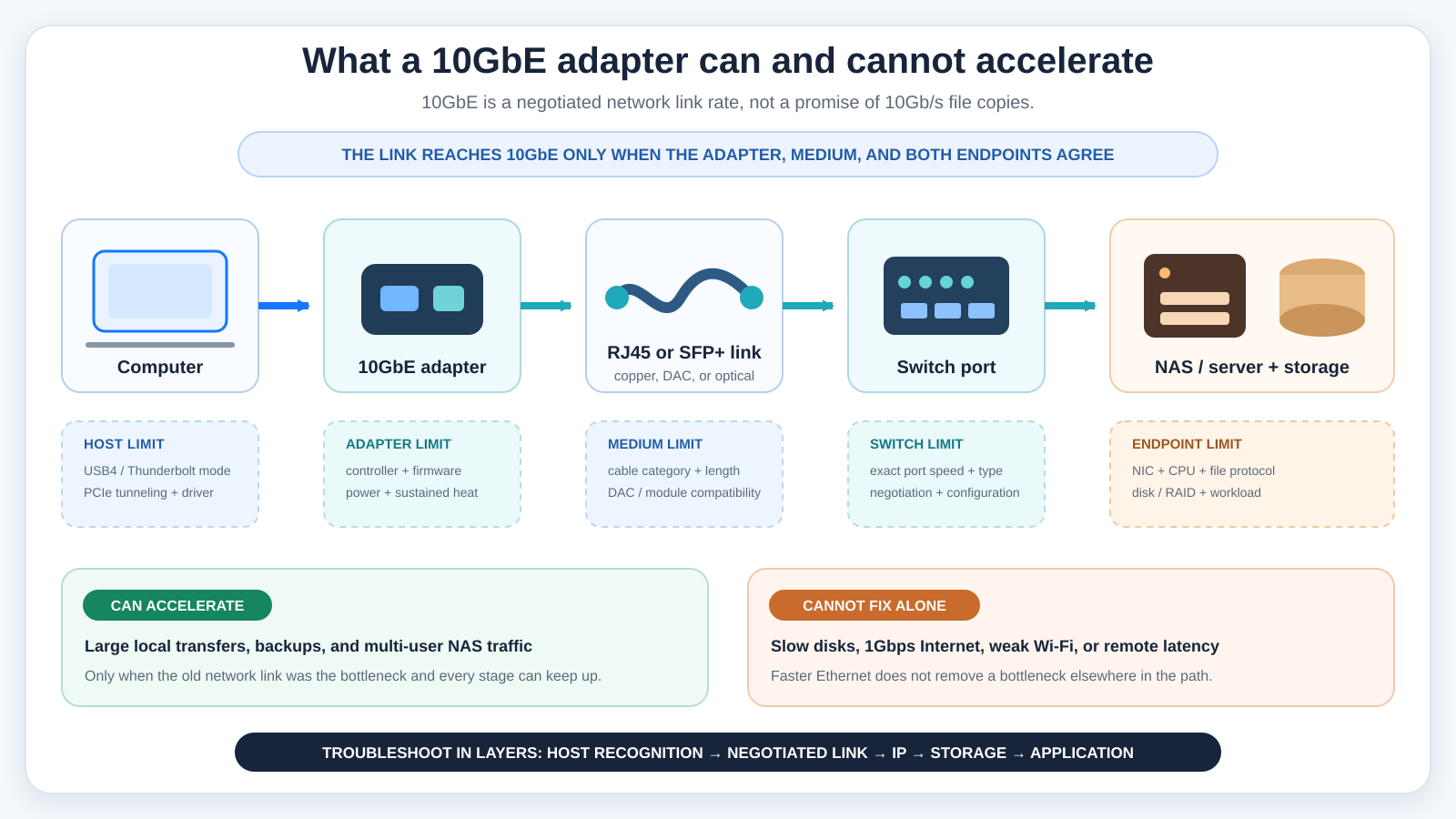
The table keeps host transport separate from the network port, and that split matters. A USB-C socket is not proof of USB4 or Thunderbolt, and SFP+ is not another name for RJ45. A link forms only at a rate the adapter, the switch or peer, and the medium between them all support at once.
Which 10GbE Adapter Should You Buy?
| Choose this | If you want |
|---|---|
| StarTech USB4-10GBE-ETHERNET | The clearest PCIe-tunneling boundary, broad listed OS support, and detachable USB4 cable |
| SABRENT NT-P10G | A compact bus-powered RJ45 option for USB4 or Thunderbolt 3/4 |
| OWC OWCTB4ADP10GBE | A Thunderbolt-centered RJ45 adapter with a certified short cable and multi-rate fallback |
| QNAP QNA-UC10G1T | Copper RJ45 for a QNAP or NAS setup where you can follow the exact driver and host notes |
| QNAP QNA-UC10G1SF | SFP+ for a compatible switch, NAS, DAC, or optical link |
| Cable Matters 201496 | A USB-oriented alternative with explicit Windows and macOS performance expectations |
Table of Contents
- StarTech 10GbE USB4 Ethernet Adapter
- SABRENT Thunderbolt/USB4 to 10GbE
- OWC Thunderbolt 4 10G Ethernet Adapter
- QNAP QNA-UC10G1T
- QNAP QNA-UC10G1SF
- Cable Matters USB-C to 10GbE Adapter
- How to choose a 10GbE adapter
- Setup checklist
- Frequently asked questions
- How we research and select
- Honorable mentions and exclusions
1. StarTech 10GbE USB4 Ethernet Adapter — Best Overall
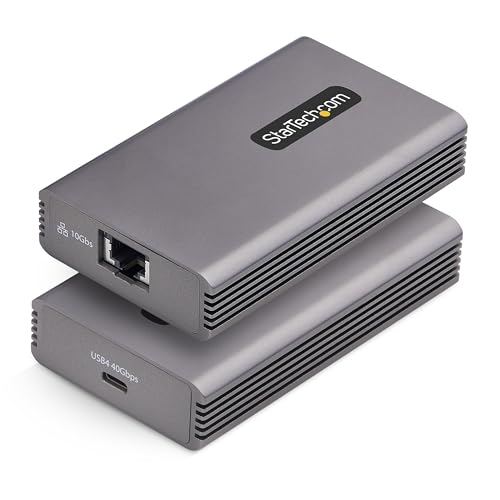
StarTech earns the top spot because its datasheet draws a line the rest of this category leaves blurry: the difference between a connector that fits and a host that works. Model USB4-10GBE-ETHERNET runs on a 40Gbps USB4 bus and lists compatibility with Thunderbolt 3, 4, and 5, and StarTech says plainly that PCIe tunneling is required and USB-only mode is unsupported. Read your computer’s port documentation before ordering. Do not assume any USB-C socket will do.
On the network side there is a single RJ45 port, and StarTech documents 10GBASE-T and NBASE-T support with auto-negotiation at 10, 5, 2.5, and 1Gbps plus 100Mbps. That spread suits a staged upgrade, because the adapter can meet older copper equipment at a lower shared rate instead of demanding that every link jump to 10GbE at once.
Listed operating systems are Windows 10 and 11, macOS 12.4 or later, and Ubuntu 22.04 or 24.04. StarTech also documents Wake-on-LAN, a detachable 50cm USB4 cable, bus power, an aluminum enclosure, and passive cooling, and gives the dimensions as 108.5 x 75 x 28.5mm at 186g. Those figures are StarTech’s, not ours.
One contradiction inside StarTech’s own document stays out of the recommendation. The datasheet narrative names one Marvell controller while the hardware table lists different bridge and network-controller identifiers. Choosing this adapter does not depend on settling that, so we leave the exact chipset out rather than guess which line is right.
Our Take
Choose the StarTech when you want the clearest documentation of the host requirement and a detachable cable. Skip it if your computer offers only an ordinary USB data mode without PCIe tunneling, however well the plug fits.
- Explicit PCIe-tunneling and USB-only warning
- RJ45 negotiates five documented Ethernet rates
- Detachable 50cm USB4 host cable
- Windows, macOS, and named Ubuntu support
- Will not work in USB-only mode
- Official datasheet conflicts on exact chipset identity
2. SABRENT Thunderbolt/USB4 to 10GbE — Best Compact RJ45 Alternative
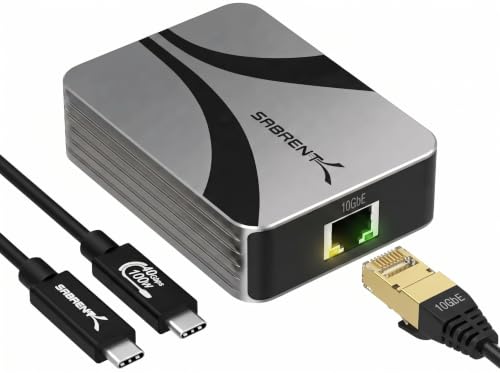
The SABRENT NT-P10G is for the buyer who wants bus-powered 10GbE over copper and nothing else, without stepping up to a full dock. SABRENT documents USB4, Thunderbolt 3, and Thunderbolt 4 host support. Those are the transports it names, so this is not a general-purpose USB-C dongle and should not be bought as one.
According to SABRENT, the RJ45 connection runs 10GbE and falls back to 5GbE, 2.5GbE, 1GbE, Fast Ethernet, and Ethernet. The product page also documents Wake-on-LAN and PXE, which matter if you administer the machine remotely or boot it over the network. Both still depend on the computer, firmware, operating system, driver, and network being configured for them.
SABRENT describes an aluminum housing with link-status LEDs, and covers the adapter for one year, or two if you register it within 90 days. The manual carries a May 17, 2026 date, which counts for something in a category still crowded with Thunderbolt 3 hardware from years ago. On July 21, 2026, SABRENT’s own page showed the product available to order, and the exact Amazon listing carried one active new offer.
SABRENT’s server returned HTTP 429 and rate-limited our request during this research pass, so the section above stays inside the manufacturer documentation we could confirm. That is why you will not find a controller name, a host-cable length, an operating-system version, or a speed figure here. None of them was established.
Our Take
Choose the SABRENT for a compact RJ45 path when your computer explicitly supports USB4, Thunderbolt 3, or Thunderbolt 4. Look elsewhere if you need a documented Linux version or a stated cable specification before you commit.
- Compact bus-powered RJ45 design
- USB4 and Thunderbolt 3/4 host support
- Multi-rate copper Ethernet fallback
- Wake-on-LAN and PXE documented
- Direct product page was rate-limited during research
- Confirmed documentation does not establish cable length
- Extended warranty requires timely registration
3. OWC Thunderbolt 4 10G Ethernet Adapter — Best Thunderbolt 4-Specific Pick
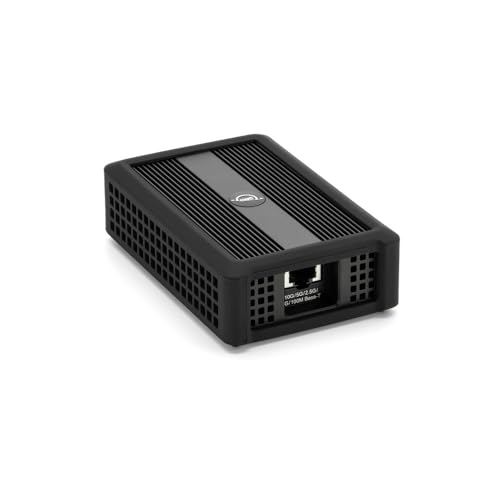
OWC’s OWCTB4ADP10GBE is the strongest Thunderbolt 4 choice here, though OWC certifies it more broadly than that: Thunderbolt 3, 4, and 5 or USB4 Mac and Windows computers. It reaches the network over RJ45 at 10GBASE-T and auto-negotiates 10, 5, 2.5, and 1Gbps plus 100Mbps, which keeps it useful while a switch, NAS, or office network works through different copper Ethernet generations.
The certified 0.3m Thunderbolt 4 cable in the box removes one variable from the host side, and OWC lists the adapter as bus-powered, so there is no separate brick. The ventilated aluminum housing doubles as the heat sink, and there is no fan. Fanless means no fan noise. It does not mean the case stays cool under sustained traffic, and we will not promise a temperature.
OWC also publishes cable-distance guidance, which is rarer than it should be: 10GbE up to 55m on Cat6 and up to 100m on Cat6a, with 5GbE and 2.5GbE requiring an NBASE-T-compatible switch or router. Check the run itself before trusting it. The category printed on the one patch lead you can see says nothing about the terminations, patch panels, and switch-port configuration behind the wall.
OWC reports more than 900MB/s in its own testing and immediately qualifies it: speed varies with the computer, the network condition, and the network configuration. Windows or Linux also needs an Ethernet driver. Read that number as OWC’s result under OWC’s conditions, not as the rate your file copy will hit. The page documents Wake-on-LAN and a one-year OWC limited warranty.
Our Take
Choose the OWC when you want a certified cable in the box, real copper-distance guidance, and multi-rate RJ45. Skip it if you need SFP+, or if your Windows or Linux build cannot take the required driver.
- Certified 0.3m Thunderbolt 4 cable included
- Clear Cat6 and Cat6a distance guidance
- Five documented RJ45 network rates
- Bus-powered fanless aluminum housing
- Windows and Linux require an Ethernet driver
- No SFP+ network interface
- Manufacturer speed result is configuration-dependent
4. QNAP QNA-UC10G1T — Best RJ45 Pick for QNAP and NAS Workflows
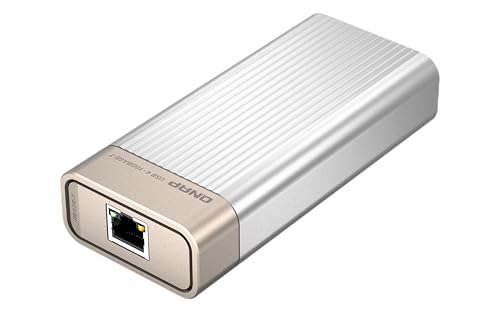
The QNAP QNA-UC10G1T is the focused RJ45 pick for anyone building around a QNAP NAS or another copper 10GbE endpoint. QNAP calls it a USB4 Type-C to 10GBASE-T adapter and puts a 1m USB4 cable in the box. Note how the compatibility summary splits by platform: Windows goes through USB4 or Thunderbolt 4, macOS through Thunderbolt 3 or 4.
The network port negotiates 10, 5, 2.5, and 1GbE. QNAP says to connect it to a switch, NAS, or peer over Cat5e, Cat6, Cat6a, or better, though the rate you get depends on the whole copper channel and both endpoints. If you are designing for a clean 10GbE link, check the switch-port standard and the cable run first. Two Cat5e installations can behave very differently.
QNAP’s compatibility notes are narrow and unusually detailed, which is a compliment. The Marvell AQC113 driver is listed for Windows 11 and for Ubuntu 22.04 on kernel 6.5.0-41, and macOS 12.7 through 15.4 is listed. Windows on Arm and Windows through Boot Camp are excluded outright. QNAP also warns that some 11th-generation Intel Core systems, the Tiger Lake generation, may not recognize the adapter over Thunderbolt 4 or USB4, and that certain motherboards need USB Host Controller Support and extra PCIe resources enabled in firmware.
QNAP publishes high transfer figures from its own lab, taken on named SSDs in a named RAID configuration at MTU 9000 against a specific server and workload. That is a controlled QNAP setup describing itself, not a forecast for your laptop and your NAS. One more limit before you order: QNAP says its QNA adapters do not work through a Thunderbolt 2-to-3 adapter.
Our Take
Choose the QNA-UC10G1T when RJ45 matches your switch and NAS and you are willing to follow QNAP’s driver and host notes exactly. Skip it for Windows on Arm, Boot Camp, or an unverified Tiger Lake system.
- Exact QNAP and NAS-focused RJ45 role
- Includes a 1m USB4 cable
- Negotiates 10/5/2.5/1GbE
- Detailed platform and driver documentation
- No Windows on Arm or Boot Camp support
- Tiger Lake recognition warning
- Some PCs need firmware resource changes
5. QNAP QNA-UC10G1SF — Best SFP+ Pick

The QNAP QNA-UC10G1SF is the only pick here for an SFP+ network. There is no RJ45 jack on it, and it is not the copper model above wearing a different socket. Buy it when your switch, NAS, or server exposes a compatible SFP+ port and you already know whether that link will run on a direct-attach copper cable or on matched optical transceivers and fiber.
A 1m USB4 host cable is included, and the platform split matches the RJ45 sibling: Windows through USB4 or Thunderbolt 4, macOS through Thunderbolt 3 or 4. The driver differs. QNAP’s current page calls for the Marvell AQtion AQC100 driver on Windows 11 and on the named Ubuntu 22.04 kernel build, and lists macOS 12.7 through 15.4.
Every host restriction from the copper model carries over. QNAP excludes Windows on Arm and Boot Camp, flags recognition trouble on Tiger Lake systems, asks for the host’s USB controller and reserved PCIe resources to be configured where required, and rules out a Thunderbolt 2-to-3 adapter path. That level of detail makes the QNAP pair a gift to a careful system builder and a poor choice for anyone hoping to plug in and walk away.
On the network side, QNAP tells you to run an SFP+ DAC cable to a compatible 10GbE switch, NAS, or device. Going optical instead means mutually compatible 10GbE SFP+ modules at both ends and the right fiber between them. We make no claim of 5GbE, 2.5GbE, 1GbE, or RJ45 fallback for this exact model, because the current product page does not establish those modes.
Our Take
Choose the QNA-UC10G1SF only when SFP+ is already part of your network plan. If you need ordinary twisted-pair copper and multi-rate negotiation, one of the five RJ45 picks is the answer.
- Only selected adapter for SFP+ networks
- Includes a 1m USB4 host cable
- Detailed Windows, macOS, and Ubuntu boundaries
- Fits compatible NAS and switch workflows
- No RJ45 network port
- Requires a compatible DAC or optical link
- No documented lower-rate negotiation in source
6. Cable Matters USB-C to 10GbE Adapter — Best USB4-Focused Value Alternative
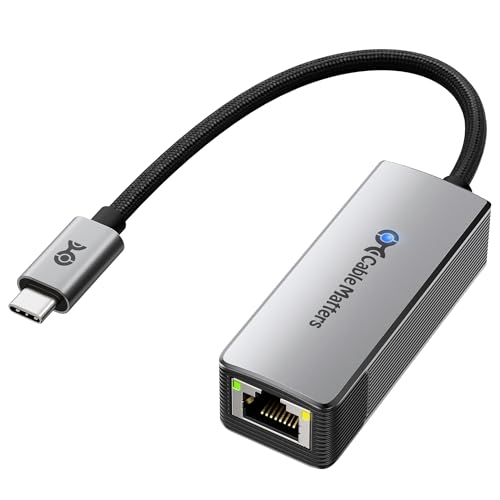
Cable Matters model 201496 is the USB-oriented alternative, and it is unusually candid about what the 10GbE label buys you. The page lists compatibility with USB-C data ports, USB4, and Thunderbolt 3, 4, or 5, then recommends a USB 3.2 Gen 2×2 20Gbps port or faster for its best results. Hold both statements at once. Connecting at all and performing at the top of the range are not the same claim.
The RJ45 port auto-negotiates 10, 5, 2.5, and 1Gbps plus 100Mbps. Cable Matters names a Realtek RTL8159 controller and describes an aluminum housing with thermal silicone, a heat sink, and an integrated braided USB-C pigtail. That is sensible construction for something this small, though a materials list predicts nothing about how warm it runs in your room under your workload.
Cable Matters calls current Windows and macOS plug-and-play, and points older Windows releases or slow Linux kernels at the current RTL8159 driver. Android and Xbox One S are excluded outright. If you need a fixed Linux support matrix, confirm your distribution and kernel before ordering, because “Linux” is not one static platform.
Cable Matters describes typical throughput of about 7Gbps on Windows and about 5Gbps on macOS, and only with a 20Gbps-plus host, 10GbE equipment, Cat6 or Cat6a, and the rest of its stated conditions. It notes that macOS may report a 5Gb link, and recommends leaving the setting on Autoselect rather than forcing 5000Base-T. Those are Cable Matters’ platform-specific statements, not measurements of ours and not a guarantee.
Our Take
Choose Cable Matters when you want a current USB-based design and can live with the platform ceiling it publishes. Skip it if your host offers only a slower USB-C data mode, or if you need a more exact Linux support table than this one.
- Explicit Windows and macOS speed expectations
- Five documented RJ45 network rates
- Integrated braided host cable
- Current USB4 and Thunderbolt compatibility wording
- Best results need a 20Gbps-plus host
- macOS expectation is below Windows result
- Some Linux kernels may need a driver
How to Choose a 10GbE Adapter
USB-C Shape Versus USB4 or Thunderbolt Transport
USB-C is a connector shape and nothing more. The port behind it might carry an older USB data mode, a 20Gbps USB path, USB4, Thunderbolt, DisplayPort, charging, or some mix of those. Laptop markings are inconsistent, so use the computer maker’s documentation for your exact model, or the hardware report in your operating system.
The picks above show how much this varies. StarTech requires PCIe tunneling and rejects USB-only mode. QNAP requires USB4 or Thunderbolt 3 or later, then narrows further with its own platform matrix. Cable Matters allows broader data-capable USB-C operation but recommends a 20Gbps or faster host for best results. When a port description is vague, our USB4 explainer and USB4 versus Thunderbolt 4 comparison will help you pin down the transport before you spend anything.
Thunderbolt 5 compatibility does not push the Ethernet link past 10GbE. It gives you a capable host path, but the adapter still terminates in a 10GbE network interface. A faster transport helps only when a slower host path would otherwise have been the bottleneck.
RJ45 and 10GBASE-T Versus SFP+
RJ45 10GBASE-T runs on familiar twisted-pair copper and is usually the easier choice in a home, an office, or any network with mixed rates. Five of the six picks here use it. Their lower-rate negotiation also helps when a switch or NAS port tops out at 5GbE, 2.5GbE, or 1GbE.
SFP+ is a modular interface instead. The QNAP SFP+ pick needs a compatible DAC or optical path: a DAC for a short direct link or a rack connection, or matched modules at both ends plus the right fiber for anything optical. SFP+ can slot neatly into an existing server or switch design, but it is not automatically the better port. The right interface is the one already supported by the equipment you plan to connect.
Negotiated Rates and the Rest of the Infrastructure
A link forms at the highest rate the two endpoints and the medium all support. Connect a 10GbE adapter that documents 2.5GbE negotiation to a 2.5GbE switch and the link settles at 2.5GbE. The adapter does not drag the switch upward. If an SFP+ device documents no lower-rate modes, do not assume it has the same fallback.
Map the path from laptop to destination. Write down the adapter’s network port, the switch-port standard, the NAS or server NIC, the cable category or SFP+ parts, and any patch panel in between. OWC gives one useful copper reference, rating Cat6 for 10GbE up to 55m and Cat6a up to 100m. Installation quality and the condition of the full channel still decide what you get.
Windows, Linux, and macOS Boundaries
Operating-system support changes with the controller and the model. “Works with Windows” says nothing about Windows on Arm, and “Linux” says nothing about a kernel or a driver. QNAP excludes Windows on Arm and Boot Camp, names exact drivers for Windows 11 and one Ubuntu kernel, and warns about Tiger Lake recognition. StarTech lists Windows 10/11, macOS 12.4+, and two Ubuntu releases. OWC says Windows and Linux require an Ethernet driver. Cable Matters warns that some Linux kernels may need the RTL8159 driver.
Running a Linux workstation? Start with our guide to Thunderbolt docks that work with Linux for platform context, then go back to the adapter maker’s current driver page. A marketplace title or an old forum post is not evidence when a kernel update can change the answer.
Cables, Transceivers, and Host Leads
Treat the host cable as part of the adapter, not an accessory. StarTech includes a detachable 50cm USB4 cable, OWC a certified 0.3m Thunderbolt 4 cable, and QNAP a 1m USB4 cable. Keep those rated cables with their adapters unless a replacement is explicitly capable of the required protocol. Our Thunderbolt 5 cable guide and USB-C cable guide explain how identical-looking plugs hide very different data capabilities.
The network cable or transceiver is a separate problem. On RJ45, validate the whole copper channel and the switch-port rate. On SFP+, match the DAC or optical modules to both endpoints. A transceiver that slides into the cage can still be unsupported by the switch or NAS vendor.
Real Throughput, Heat, and Storage Bottlenecks
The 10GbE label describes the negotiated network rate. It is not a file-copy promise. Ethernet framing, TCP or another protocol, file sharing, encryption, CPU load, driver quality, storage speed, switch behavior, cable errors, and the application itself all take their cut of time or bandwidth. A single hard drive, a slow RAID layout, or a busy NAS can be the limiting stage while the network happily reports a 10GbE link.
The manufacturers’ own numbers show how much the conditions matter. OWC reports more than 900MB/s in its own test and warns that system and network configuration move the result. QNAP publishes higher lab figures under a named SSD, RAID, MTU, server, and workload. Cable Matters describes lower typical results that differ by platform. Each number answers a different test question, so do not line them up as though the products had been measured side by side.
Aluminum housings, heat sinks, vents, and passive cooling show up across these products for a reason: sustained high-rate networking makes heat, and that heat has to leave the enclosure. “Fanless” means there is no fan making noise. It does not mean the case stays cool. Give the adapter air, and keep it out from under cable piles and soft material.
When a 2.5GbE Adapter Is Enough
Choose 2.5GbE when the switch, router, NAS, and Internet path are all 2.5GbE or slower, or when a single hard drive is what limits your transfers. It usually means fewer equipment changes and far less host-path checking. Step up to 10GbE when a fast local storage target and a capable switch already justify it, or when you are deliberately upgrading the complete path.
If what you really need is several ports, charging, displays, and Ethernet in one box, compare a USB4 hub or dock instead. A dedicated network adapter is the cleaner answer only when Ethernet performance and compatibility are the whole job.
10GbE Adapter Setup Checklist
- Identify the exact host port. Confirm the laptop or desktop model, the port protocol, the operating system, the architecture, and any PCIe-tunneling requirement. The USB-C shape is where you start, not where you stop.
- Check the current driver and firmware notes. Download from the adapter or controller maker and nowhere else. For QNAP that means the exact AQC113 or AQC100 requirement; for Cable Matters, the current RTL8159 path. Settle the Windows on Arm, Boot Camp, and Linux-kernel limits before you buy, not after.
- Use the supplied cable, or one rated for the job. A replacement USB-C cable has to carry the required USB4 or Thunderbolt data path. A cable that charges well tells you nothing about how it moves data.
- Choose RJ45 or SFP+ deliberately. RJ45 needs the right copper cable and 10GBASE-T-capable equipment. SFP+ needs a compatible DAC, or optical modules and fiber. The two are not interchangeable.
- Verify the switch port itself. Plenty of switches mix 1GbE, multi-gigabit RJ45, 10GBASE-T, and SFP+ ports in one chassis. Confirm the exact port you plan to use and any management setting attached to it.
- Verify the NAS or server NIC. The destination has to expose the rate you want and agree with the host on IP network, MTU, and file-sharing protocol. A portable SSD plugged in somewhere else does nothing for a slow NAS array.
- Check storage before you blame Ethernet. Inspect what the source and destination storage can actually sustain, using tools appropriate to your operating system. One slow disk will hold a 10GbE link far below its ceiling.
- Start with standard settings. Get a stable link first, then touch jumbo frames, flow control, offloads, or manual rate settings. QNAP recommends MTU 9000 for its lab-style performance, but every device along that path has to be configured to match.
- Read the link status and try both directions. Adapter LEDs and operating-system tools will confirm the negotiated rate. Transfers often behave differently each way, because the storage, cache, CPU, and protocol work at each end are not the same.
- Keep the adapter ventilated. Sustained 10GbE traffic warms the enclosure. Give a passive housing open air, and do not read a warm case on its own as proof of failure.
Frequently Asked Questions
Does USB-C Support 10Gb Ethernet?
Sometimes, but the connector alone cannot answer the question, because USB-C carries several different data protocols and speeds. The StarTech pick needs PCIe tunneling and explicitly does not support USB-only mode. QNAP requires USB4 or Thunderbolt 3 or later. Cable Matters makes the broadest claim, including data-capable USB-C, and still recommends a 20Gbps or faster host for its best results.
Start with your computer’s exact port specification, then the adapter maker’s host requirement. If the laptop documentation lists only a basic USB mode, a product that relies on USB4, Thunderbolt, or PCIe tunneling may not enumerate at all. Even when a USB-based adapter does connect, a slower host path can hold throughput below what the 10GbE network side could otherwise carry.
Does Thunderbolt 3 Support 10GbE?
Yes, as long as the exact adapter lists Thunderbolt 3 and the computer provides a working Thunderbolt 3 path. StarTech, SABRENT, OWC, and both QNAP products keep Thunderbolt 3 within their documented host scope, though QNAP separates Windows and macOS compatibility and warns that a Thunderbolt 2-to-3 adapter does not work for its QNA line.
Thunderbolt 3 host support is not a guarantee of 10Gb/s file copies. The adapter still has to negotiate the network link, and the switch, NAS, cable or transceiver, storage, driver, and workload all get a say. On older Thunderbolt computers, check the security or device-authorization settings while you confirm host recognition, then verify the negotiated Ethernet rate separately.
Will a 10GbE Adapter Work on a 2.5GbE Network?
It can, provided both the adapter and the network port support 2.5GbE negotiation. The StarTech, SABRENT, OWC, QNAP RJ45, and Cable Matters picks all document 2.5GbE among their copper rates. Connect one to a 2.5GbE switch and it runs at the shared 2.5GbE rate, not at 10GbE.
Do not stretch that answer to cover every SFP+ product. The QNAP QNA-UC10G1SF page establishes 10GbE SFP+ but does not establish a 2.5GbE fallback. The link medium and the far endpoint matter as much as the number printed on the adapter, so check the exact switch port. One chassis can hold different port types and speeds side by side.
Is SFP+ Better Than RJ45?
Neither one is better in the abstract. RJ45 is convenient when your switch, wall cabling, and NAS already use twisted-pair copper, and it can offer documented multi-rate fallback. SFP+ fits networks designed around DACs or optical links, which covers plenty of racks, servers, and NAS devices.
Decide from the two endpoints and the cable run. A short SFP+ DAC can be tidy and direct, optical SFP+ can suit longer or electrically isolated links, and RJ45 may be easier in an office that already has copper in the walls. The QNAP QNA-UC10G1SF is the SFP+ pick in this guide; the other five are RJ45. Remember that an SFP+ cage cannot accept an RJ45 patch cable without an additional compatible module, and that module support has to be checked with the equipment maker.
Why Is a 10GbE Transfer Slower Than 10Gb/s?
The label describes the Ethernet link rate and nothing else. Real applications carry Ethernet, IP, transport, and file-sharing overhead, then wait on the host controller, driver, CPU, switch, NAS or server, storage, and workload. Errors and thermal limits can narrow the result further. Turning the link rate straight into a promised file-copy number skips every one of those stages.
OWC, QNAP, and Cable Matters all publish results, under conditions that have little in common. OWC flags computer and network configuration, QNAP names its lab storage and MTU setup, and Cable Matters describes typical results that differ by platform. None is a universal benchmark. If your transfer feels slow, verify the negotiated link first, then work through the storage and network layers separately.
Does 10GbE Reduce Internet or Gaming Latency?
Not on its own. A faster local Ethernet link helps only when the old local link was the constraint. When Internet service is slower than the Ethernet link in front of it, the service remains the limit. Game latency is more often dominated by something else entirely: the route to the server, congestion, Wi-Fi elsewhere in the path, buffer behavior, or the game server itself.
A wired connection can certainly be steadier than a weak wireless one, but that is a wired-versus-wireless path change, not proof that 10GbE itself lowers latency. For local NAS work, the extra bandwidth can shorten large transfers when storage and the rest of the network keep up. Buy these adapters for high-speed local networking. Do not buy one as a gaming-ping upgrade.
Do These Adapters Work on Linux?
Support is product by product. StarTech lists Ubuntu 22.04 and 24.04. OWC says Linux requires an Ethernet driver. QNAP names Ubuntu 22.04 with kernel 6.5.0-41 and requires the AQC113 driver for its RJ45 model or the AQC100 driver for its SFP+ model. Cable Matters says some Linux kernels may need the current RTL8159 driver. The SABRENT documentation we could confirm does not establish a Linux version.
Check the current manufacturer driver page against your distribution, kernel, CPU architecture, and Secure Boot setup before ordering. A controller supported in one kernel can still need a newer driver, a firmware package, or a signing step in another. General Linux compatibility language is no substitute for the exact environment you plan to run.
How We Research and Select
We set the six-product list and its order before drafting, and did not revise either afterward. Each product had to clear three bars: an exact model, an exact Amazon listing with an active new offer on the day we checked, and current manufacturer evidence for the host and network path. Amazon settles which listing is which and whether it was in stock. The manufacturers settle every technical claim. Nothing was borrowed from a similar-looking sibling model or an older version of this article.
For each one we compared host protocol, RJ45 or SFP+, negotiated network rates, operating-system and driver limits, architecture and firmware warnings, supplied cable, power, enclosure design, and what the network side demands. Where a page was unreachable or a manufacturer contradicted itself, we said so rather than paper over the gap. We claim no personal testing and no measurements of our own.
The ranking rewards a complete buyer path, not a spec-sheet headline. StarTech leads on the clarity of its USB-only exclusion and the breadth of its documented platform scope. SABRENT and OWC are the compact RJ45 alternatives. QNAP covers both copper and SFP+ NAS workflows with exact support warnings. Cable Matters supplies a current USB-based option and is unusually candid about what each platform will do.
Honorable Mentions and Exclusions
The CalDigit Connect 10G fits this category on paper, but CalDigit’s US store showed it out of stock at the cutoff. The Sonnet Solo10G was excluded because Sonnet classified it as end-of-life. Neither gets a product card here, and neither gets an availability claim we cannot support.
The old OWC, LINKUP, Cable Matters, and StarTech Thunderbolt 3 listings from the former article are gone as well, because none passed a fresh check on exact identity and current availability for this rebuild. Generic Gigabit or 2.5GbE dongles, USB-C hubs, docks with built-in 10GbE, PCIe network cards, used-only listings, and discontinued products all sit outside what this guide covers: external 10GbE adapters.
If a full docking station is what you actually want, read the dock guides instead. No network adapter is going to produce displays, charging, and extra USB ports. And if fast external storage is the real bottleneck, our Thunderbolt external-drive guide covers that path separately.