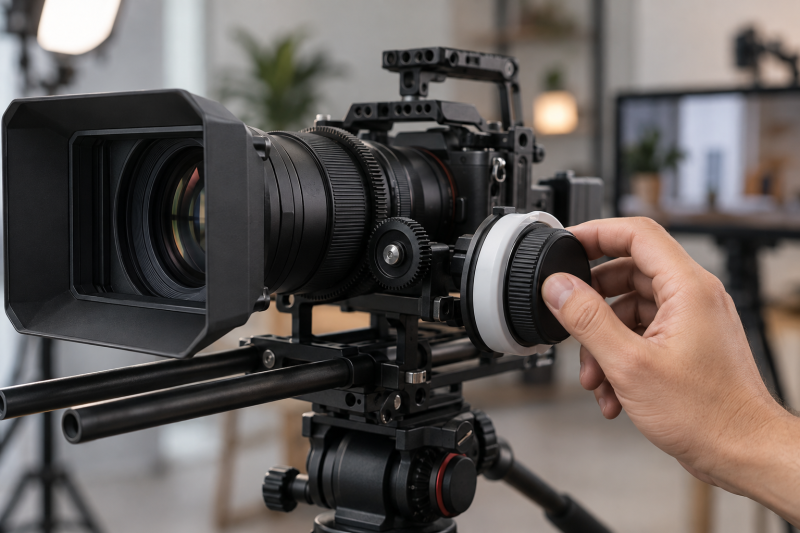
A follow-focus kit gives the operator a larger, repeatable control surface than a bare lens ring. For a mirrorless video rig, the first question is whether the rig has the 15 mm rod, lens gear, clearance, and mounting position the kit needs, before whether the kit is mechanical or wireless. A well-made follow focus still cannot work if the gear ring slips, the lens has no usable travel, or the camera cage leaves no room for the wheel.
These six Amazon US products have active New offers. They cover manual wheels with A/B stops, a motor made for a named FeiyuTech gimbal family, and a wireless SmallRig kit with a matte box. Check your lens diameter, gear-ring fit, rod support, power route, and camera balance before buying. For the rest of the rig, see our camera cage guide and tripod guide.
A follow focus is a rig component, not a universal lens accessory. Confirm rods, gear engagement, and clearance before choosing a wheel or motor.Follow-Focus Kits Compared


1. FeiyuTech Scorp FF — Compatible Scorp Gimbal Rigs
FeiyuTech lists the Scorp FF as a brushless follow-focus motor compatible with named Scorp-series gimbals, including Scorp 3, Scorp 2, Scorp-C2, and Scorp Pro. The Scorp FF is not a general-purpose rod-mounted wheel. Its purpose is to add focus or focal-length control through the compatible gimbal’s multifunction dial.
The listing says it supports lenses up to 10 cm in diameter and offers automatic or manual calibration. Confirm the specific gimbal model and lens clearance before treating it as a fit. A motor that mounts correctly can still change gimbal balance, so balance the complete camera, lens, and follow-focus assembly rather than the camera alone.
Our Take Buy the FeiyuTech Scorp FF only if the camera is already on one of its named Scorp gimbals. It is the most direct option here for those gimbals, and it does not replace a standard 15 mm rod kit.
- Lists compatibility with named Scorp gimbals.
- Brushless motor and calibration options are listed.
- Not described as a universal rod-mounted kit.
- Lens diameter and gimbal balance need checking.
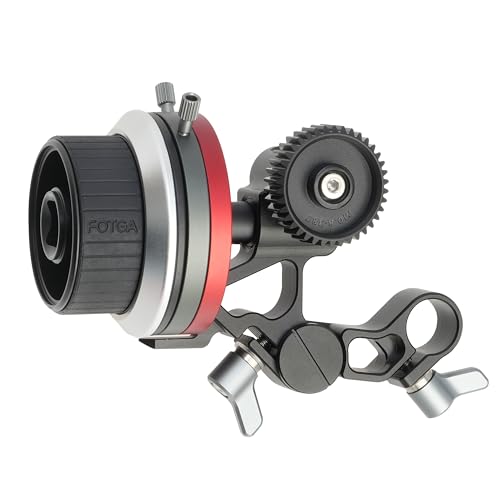
2. FOTGA Mini Follow Focus — Compact Manual Kit
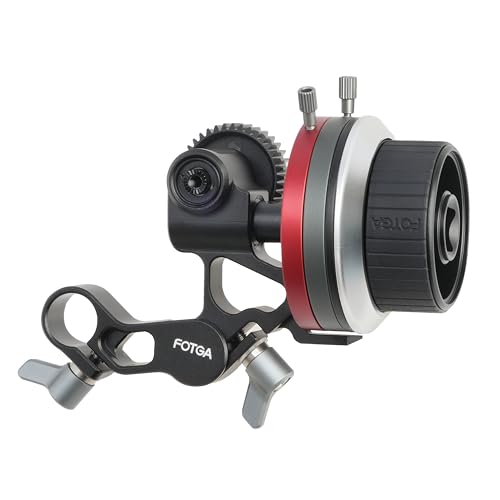
FOTGA lists a compact manual follow focus with A/B stops, a 15 mm rod clamp, a gear-ring belt, extension arm, and two supplied gears. The stops are the useful feature for repeatable moves between two marked distances. It is a conventional mechanical layout for a mirrorless cage rig that already has a compatible rod path.
The listing says the two gears are M0.8-38T and M0.8-43T, and they can mount on the left or right. Left or right mounting helps with rig layout, but it does not prove the belt will grip every focus ring. Install the ring without overtightening it, check that the wheel does not bind through the lens travel, and verify that the camera still clears the cage and support.
Our Take Buy the FOTGA Mini Follow Focus if a compact 15 mm manual system with simple A/B stops is enough. It is a basic rig component, so exact lens-gear contact is more important than its accessory list.
- A/B stops and two gears are listed.
- 15 mm clamp suits common video-rig layouts.
- Needs compatible rods and lens gear contact.
- Mechanical fit must be checked on the full rig.
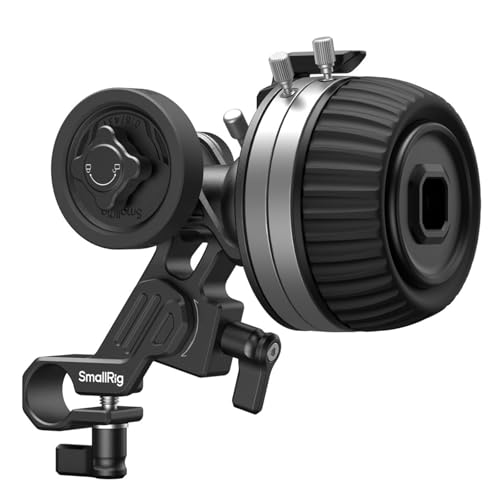
3. SmallRig F50 — Adjustable Damping
SmallRig lists the F50 with adjustable rotational play, a damping lever, A/B stop handling, and a 15 mm rod mounting path. The listing gives a damping range of 0.3 kgf to 1.0 kgf and says the wheel can use silicone gears to drive mirrorless lenses directly. Driving the lens that way is useful only when the particular lens ring has stable, non-slipping contact.
It also says the silicone gear is for DSLR or mirrorless lenses, while cinema lenses should use gear drive without it. Treat the lens-type split as a compatibility branch rather than an optional detail. Decide what lens type is on the rig, then test a full pull from near to far focus before marking a take.
Our Take Buy the SmallRig F50 if you want the most explicit listed damping adjustment among the manual wheels here. The damping range is useful, but the wheel must match the lens and rod layout.
- Adjustable damping and A/B stops are listed.
- Supports 15 mm rod mounting.
- Silicone gear has lens-type limits in the listing.
- Needs tight, non-slipping lens contact.
4. Hersmay Mini Follow Focus — NATO-Rail Rig
Hersmay lists a metal mini follow focus with A/B stops, a 15 mm rod and NATO-rail clamp, plus M0.8-38T and M0.8-43T gears. The added NATO component is relevant only when the cage or support system already uses that standard. It can keep a compact rig organized, but it is not a reason to add a NATO rail if the rest of the setup does not need one.
The listing describes the kit as suitable for DSLR and mirrorless cameras. Camera body size is less important than lens and support geometry. Confirm that the rod position lines the wheel gear up with the lens ring, then check whether the wheel lands on the preferred operating side after the camera is mounted.
Our Take Buy the Hersmay Mini Follow Focus if a NATO-compatible 15 mm support path is already part of the camera rig. The clamp is a layout feature, while gear alignment remains the main fit check.
- NATO rail and 15 mm support are listed.
- A/B stops and two gears are included.
- NATO feature only matters on a compatible rig.
- Lens-ring alignment still needs checking.
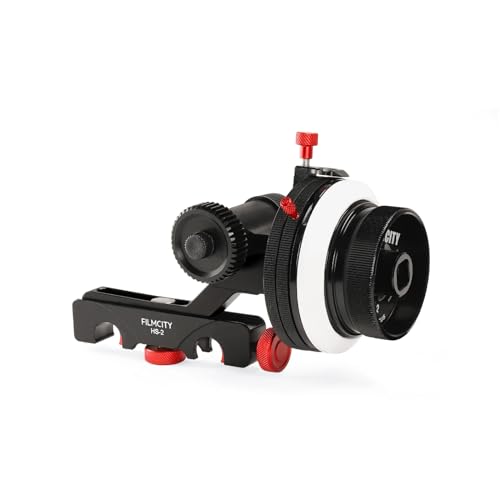
5. FILMCITY HS-2 — Hard Stops and Crank
FILMCITY lists the HS-2 with 0.8 pitch, 43-tooth gear, hard stops, a quick-release 15 mm rod clamp, a speed crank, and a gear belt for lenses from 46 to 110 mm. The stated belt range is a more concrete starting point for lens fit than a generic “universal” label. Measure the lens where the belt sits, not only the front filter diameter.
The listing also mentions a flippable gearbox for left- or right-hand use and a marking disk for stop points. The gearbox and marking disk are useful operator controls, but they do not replace repeatable lens mechanics. Test the exact focus range with the chosen lens, because a hard stop should not force a lens past its own physical end.
Our Take Buy FILMCITY if the listed belt range, hard stops, and speed crank match the rig. It suits operators who want a conventional marked wheel setup.
- Lists a 46-110 mm belt fit range.
- Hard stops, marking disk, and crank are listed.
- Still requires 15 mm rod support.
- Lens diameter must be measured at the belt position.
6. SmallRig Wireless Follow Focus Lite — Wireless Control With Matte Box
SmallRig lists a wireless follow-focus kit with a receiver motor and a Mini Matte Box Lite. Its motor has a listed 4.3 kgf.cm peak torque and accepts 5 V to 18 V input. Power planning is part of the rig plan, so identify the battery, PD, or other power route rather than assuming the camera body will power the motor.
The listing says the matte box fits different lens dimensions with adapter rings and supports round filters up to a stated diameter. The matte box can be useful for controlling stray light, but it adds another clearance and balance element. Fit the motor, gear, lens, matte box, and power lead together before a shoot.
Our Take Buy the SmallRig Wireless Follow Focus Lite if remote focus control and a matte box belong in the same planned rig. It is the most involved system here, so verify motor power and lens clearance before committing.
- Wireless motor and matte box are listed together.
- Motor input range and peak torque are specified.
- Needs a deliberate motor power route.
- Matte box adds clearance and balance checks.
Buying Guide: Follow Focus for a Mirrorless Camera Rig
Start with rods, cage clearance, and lens gearing
Most manual systems need a 15 mm rod path. A lens alone does not provide a place to mount the wheel. Look at the camera cage, baseplate, rods, and lens support as one assembly. If the rod height does not align the follow-focus gear with the lens ring, the wheel will either bind or fail to transfer a repeatable movement.
Gear engagement should be firm but not forced. A gear belt that slips makes marked pulls useless, while an overtightened belt can drag on the lens ring. Install the camera and lens as you would for the shoot, rotate from near to far, and confirm the wheel, cage, matte box, and lens all have safe clearance.
Choose manual stops or a motor for the shooting job
A/B stops help repeat a known focus move. FOTGA, SmallRig F50, Hersmay, and FILMCITY list stop-point functions. They are useful when the action repeatedly moves between two places, but the marks only mean something after you set them on the lens you will use. Recheck them when focal length, subject distance, or lens changes.
A motor is a different kind of control. The FeiyuTech unit is tied to named gimbals, while the SmallRig kit includes a separate wireless motor and power requirement. Motors can be useful when the operator needs control away from the lens, but they also add a power cable, balancing work, and one more failure point to check before a take.
Check the complete rig before recording
Balance changes when you add a follow focus. On a tripod, that may mean moving a plate. On a gimbal, it can mean a full rebalance. A motor, gear ring, matte box, and battery cable each change where weight sits. Do not judge balance using the bare camera and then mount accessories at the last minute.
Run a full focus pull and record a short test. Check the action in the same orientation and with the same handles, monitor, and power routing you will use. Look for gear slip, cable snagging, hand interference, and any lens motion that makes the framing shift. You will find practical problems in a test that a compatibility list cannot show.
Frequently Asked Questions
Does every mirrorless lens work with a follow focus?
No. The lens needs a compatible gear-ring solution, and the camera rig needs a support path that places the follow-focus gear at the correct height. Smooth focus-by-wire rings can feel different from mechanical cinema-lens gears, so a physical fit alone does not prove that a marked pull will repeat as expected.
Check the lens diameter where the gear belt will sit and turn it through the full focus travel before shooting. Do not force a belt, clamp, or hard stop against the lens. You will avoid most setup surprises with a small test.
Do I need a wireless follow focus for a gimbal?
Not always. A compatible gimbal accessory such as the FeiyuTech Scorp FF may use the gimbal’s own control system, while a rod-mounted manual wheel can work on a non-gimbal rig. The right choice depends on who needs to control focus and where their hands need to be during the shot.
Choose a motor only when its mounting and power requirements fit the whole gimbal or camera rig. A wireless handwheel is helpful for certain moves, but it adds setup work that a manual wheel does not require.
What are A/B stops used for?
A/B stops mark two repeatable limits for a focus pull. They can be useful when an actor or object moves between the same two positions, so the operator does not have to watch the lens scale constantly to return to known points.
Set the stops only after the camera, lens, and shooting distance are final. Changing lenses, reframing, or moving the subject changes the focus positions, so the old marks should not be trusted automatically.