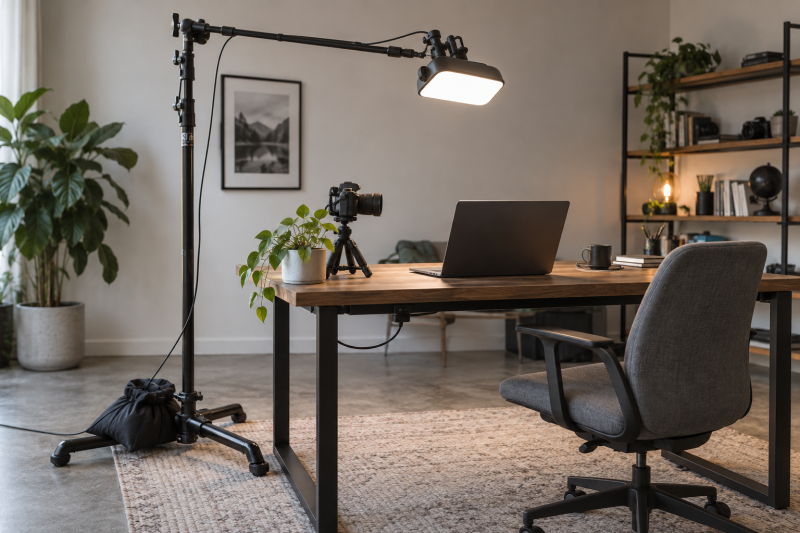
An overhead light is useful for desk tutorials when the fixture must stay out of the shot and the table must stay clear. A C-stand can place a light or flag over the work area, but the arm, grip head, load position and base are more important than a headline maximum height. The wrong rig can tip or drop equipment onto a desk, so size a rig conservatively.
The five C-stands below cover lower and taller room setups. Their listings range from a 210 cm kit to 10.8-foot stands. Dimensions, accessories and capacities below are seller-stated. No configuration here has been load-tested. Most important, a center-column load figure is not the safe load at the far end of a horizontal boom.
Before mounting anything overhead, calculate the actual fixture plus modifier weight, follow the maker’s arm configuration guidance, ballast the base and keep people out from under an unsecured rig.Overhead Desk C-Stands Compared
| Image | Product | Details | Check Price |
|---|---|---|---|
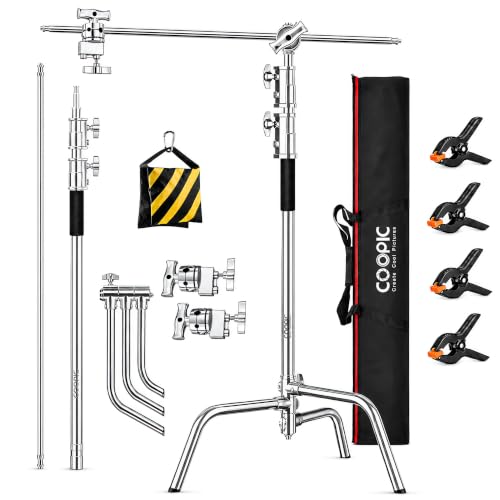 | COOPIC 210 cm C-Stand | Best fit: Lower ceilings and desks Height: 105–210 cm stated Arm: 88 cm stated Included: 2 grip heads, sandbag, case Column load: 15 kg stated | Check Price on Amazon |
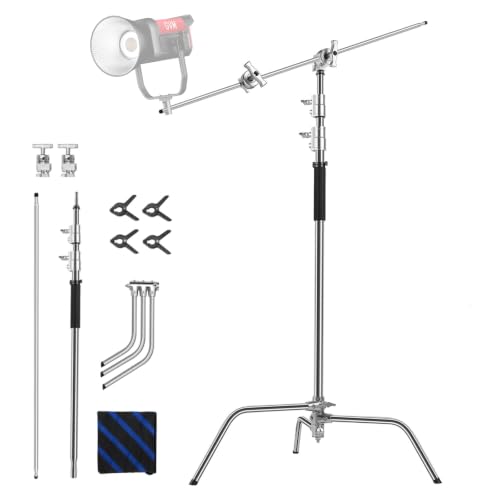 | GVM 8 ft C-Stand | Best fit: Mid-height desk lighting Height: 1–2.4 m stated Base: Folding turtle base Included: Weight bag and 4 clips stated Arm: Included; length not stated | Check Price on Amazon |
 | NEEWER BASICS SC320 Lite | Best fit: Known boom-arm limit Height: 4.7–10.5 ft stated Arm: 4.2 ft stated Boom load: 17.6 lb stated Column load: 44 lb stated | Check Price on Amazon |
 | K&F CONCEPT 10.8 ft C-Stand | Best fit: Taller grip setup Height: 149–330 cm stated Arm: Crossbar included Adapters: 2 listed Column load: Up to 20 kg stated | Check Price on Amazon |
 | Soonpho 10.8 ft C-Stand | Best fit: Long-reach overhead position Height: 150–330 cm stated Arm: 128 cm stated Boom load: 8 kg stated Column load: 20 kg stated | Check Price on Amazon |
1. COOPIC 210 cm C-Stand — Best for Lower Ceilings
COOPIC lists a center-column height range of 105 to 210 cm and an 88 cm extension arm. The smaller reach may be easier to fit beside a desk in a lower-ceiling room than a full 10-foot stand. The listing describes a removable turtle base, two grip heads, a sandbag and a carrying case. With those accessories it is a usable grip kit for a modest light or flag, subject to the exact fixture and mounting hardware.
The seller states support up to 15 kg, but its bullets do not establish that figure for a fully extended horizontal arm. Treat it as a general stand claim, not a safe boom load. A shorter arm can still create a strong tipping moment if the fixture is far from the column. Fill and place the included sandbag as instructed, keep the arm over the strongest base-leg direction and do not put the desk or operator beneath an untested setup.
A shorter C-stand is easier to fit in a small room, but overhead safety still depends on arm load and ballast.Our Take Choose COOPIC when a 210 cm maximum and shorter arm meet the shot. Get the maker’s load guidance for your exact configuration before trusting the headline capacity overhead.
- Lower maximum height suits many rooms.
- 88 cm arm and two grip heads listed.
- Sandbag and case in the stated kit.
- 15 kg claim is not a rated extended-boom limit.
- Shorter reach may not cover a wide desk.
2. GVM 8 ft C-Stand — Best Mid-Height Kit
GVM’s listing gives a height range from 1 to 2.4 meters and describes a stainless-steel column with a folding turtle-style base. Its package list includes the main pole, a crossbar, the base, a weight bag and four clips. For a desk setup, the middle height may be enough to raise a light above the camera frame without a much taller column filling the room.
The exact bullets used here do not state a trustworthy boom-arm load rating or arm length. Do not infer either from the 8-foot maximum height. The included weight bag needs appropriate fill, and the leg spread needs floor space around the desk. A clip count is useful for flags or small accessories but says nothing about load security. Check the current listing and maker guidance for the specific light mount before buying it for overhead use.
Our Take Consider GVM for a medium-height studio corner where the accessory bundle fits your light. If a published boom limit is mandatory, compare the NEEWER BASICS option.
- 1-to-2.4-meter stated height.
- Folding C-style base described.
- Weight bag and four clips listed.
- No clear boom-arm load stated in cited bullets.
- Arm length is not established here.
3. NEEWER BASICS SC320 Lite — Best for a Stated Boom Limit
The NEEWER BASICS listing separates two capacities, 17.6 lb (8 kg) for the boom arm and 44 lb (20 kg) for the center column. That distinction is more useful than a single headline load when the light will extend over a desk. The seller states an arm length up to 4.2 feet and column height from 4.7 to 10.5 feet. It includes two grip heads and describes a spring-loaded column and metal turtle base.
Do not interpret the 17.6-pound figure as safe at every angle, extension or environment. Confirm how the maker defines that capacity and include the weight of the light, modifier, adapter and any cables pulling on the arm. Keep the load over a suitable base leg and ballast the stand according to the instructions. The tall minimum position may still be too high for a small tabletop flag, and a 4.2-foot arm needs clear space away from shelves and people.
Our Take Pick NEEWER BASICS when a published arm limit helps you plan a controlled overhead setup. Still follow the exact configuration instructions and use proper ballast.
- Separate 8 kg boom and 20 kg column claims.
- Up-to-4.2-foot arm described.
- Two grip heads included.
- Tall minimum height for a tight desk.
- Capacity still depends on configuration.
4. K&F CONCEPT 10.8 ft C-Stand — Best Tall Adapter Kit
K&F CONCEPT lists a stainless-steel stand adjustable from 149 to 330 cm, plus a crossbar and two adapters. The seller says the adapter heads have multiple hole sizes for rods or accessory shafts, while the bar ends carry 1/4-inch and 3/8-inch threads. The attachment range may help a creator who changes lights, flags or reflectors at a fixed desk rather than always using one fixture.
The listing states support up to 20 kg but does not clearly isolate the safe load at the far end of the arm. Do not put a 20 kg light on the boom based on the overall stand claim. Verify the exact thread and grip fit for your equipment, the maker’s recommended arm angle and ballast placement. Its 330 cm maximum is useful only with adequate ceiling height and a safe floor area for the base.
Our Take Choose K&F CONCEPT for a taller grip setup with multiple adapter options. Use a stand with a clear boom rating when the arm-load limit is the deciding spec.
- Up to 330 cm seller-stated height.
- Crossbar and two adapters listed.
- Thread options for different accessories.
- 20 kg figure is not an arm-specific limit.
- Requires generous ceiling and floor clearance.
5. Soonpho 10.8 ft C-Stand — Best for Long-Reach Positioning
Soonpho states a column range from 150 to 330 cm and a 128 cm holding arm. The seller describes stainless-steel construction, a folding three-leg C-style base and spring buffering in the column. An arm length that is actually published lets you measure whether the stand can sit beyond the desk edge while the light reaches the intended area.
Its 20 kg load claim applies to the center column, while another seller bullet states 8 kg (17.6 lb) for the boom arm. Do not substitute the larger column number for the arm limit. Count every attached part and follow maker guidance before rigging a light over people or valuable equipment. Check the floor footprint, cable path and ceiling at the chosen height. A long arm increases tipping force even when the light itself is compact.
Use the published 128 cm reach for layout planning, not as permission to hang a heavy fixture at its tip.Our Take Consider Soonpho when its published arm reach solves a desk-layout problem. The seller separates an 8 kg arm claim from the 20 kg column claim; follow the exact configuration guidance before loading either.
- 128 cm seller-stated holding arm.
- Separate 8 kg arm and 20 kg column claims.
- Folding base and spring-buffered column described.
- Long reach needs careful ballast and space.
- Capacity still depends on the exact configuration.
Buying Guide
1. Separate column capacity from boom capacity
The horizontal arm creates a tipping force that an upright center column does not. A seller may advertise a large stand load, but that figure may apply only to the vertical column. NEEWER BASICS and Soonpho both publish separate boom-arm and column figures. Treat unspecified arm limits as unknown rather than copying the largest number in a title.
Add up the fixture, modifier, grip hardware and cable pull before comparing any claim. Even a lightweight LED panel can sit far from the column and make the base unstable. Follow the exact maker configuration and use suitable ballast. A filled sandbag is not a universal substitute for a proper load rating. If the arrangement will be above a person, get qualified grip advice instead of improvising from a roundup.
2. Measure the room and base-leg path
A C-stand needs floor area outside the camera frame, not just ceiling height. Mark where the stand’s longest leg, desk chair and walking path will be. Position the boom over the strongest leg direction as the maker directs, and keep the stand on level flooring. A stand set beside the desk can hold a light overhead while leaving the table clear, but it should not clutter the floor.
Check the ceiling, shelves and arm sweep at the planned height. A 330 cm maximum is irrelevant in a low room. A shorter 210 cm kit may cover a compact tabletop scene with less unused metal in the way. If your setup is only a close face light rather than a true overhead source, a desk ring-light guide or flat key-light guide may help you find a simpler mount.
3. Check the grip kit and cable routing
A C-stand with an included grip head and arm is more useful than a bare pole, but the exact thread, spigot and hole sizes must match the light or flag hardware. K&F lists multiple adapter holes, and NEEWER BASICS includes two grip heads. Confirm the package on the current offer and check that locks are tight before attaching equipment. Never use a loosely fitting adapter overhead.
Route power and control cables with slack so they cannot pull the fixture or snag on the desk chair. Inspect the setup from the camera angle and from the worker’s seat. The light should be out of frame without hanging directly above a vulnerable position unless the rig has been properly secured. Fold the base and store the arm separately when the room returns to normal desk use.
Frequently Asked Questions
Is a 20 kg C-stand safe for a 20 kg light on the arm?
The answer is no, because a 20 kg center-column or overall claim does not establish a 20 kg capacity at the boom tip. The arm changes the forces on the grip head and base, especially as it extends. The Soonpho listing gives 20 kg for its center column and a separate 8 kg boom-arm claim.
Use the manufacturer’s arm rating for your exact configuration and keep a safety margin. Include the weight of the modifier, adapter and cable strain. If the load will sit above people or costly gear and the maker does not give clear guidance, choose a safer rigging approach with a qualified person.
Does a turtle base remove the need for a sandbag?
A turtle-style base does not remove the need for a sandbag. The base has low, spreading legs and can fold for storage, but it does not cancel the tipping force of an extended arm. Ballast requirements depend on the attached load, arm direction, flooring and maker instructions. An empty weight bag provides no meaningful ballast.
Place ballast as instructed without blocking a walkway or chair. After rigging, check that the base does not rock and that locks hold when the arm is moved to its working position. Do not use a hand-push test as a substitute for the maker’s load guidance.
Why choose a shorter C-stand for desk video?
A lower maximum height can be easier to handle under a household ceiling and may keep unused sections out of the shot. COOPIC’s listing states 210 cm and GVM’s states 2.4 m; both may be sufficient for an overhead light above a seated desk or product tabletop. A taller stand is not automatically safer or more useful.
Choose by the required light position, not the largest number. Leave room for the grip head, fixture and any modifier below the ceiling. Then confirm the arm reach and base location with the actual desk dimensions.
Can I attach a camera to one of these boom arms?
Attach a camera only if the specific maker-approved hardware and load configuration support the camera. A threaded tip alone does not prove the rig is safe for an expensive body over a work surface. A camera with a lens can weigh more than expected, and its center of mass may be far from the mounting point.
For a small tabletop overhead view, a purpose-built camera desk mount may be simpler. For heavier cameras or human subjects below, use appropriately rated equipment and professional grip practice rather than treating a lighting stand as a universal camera crane.
Bottom Line
Choose by room height, arm reach and documented load limits. COOPIC and GVM suit lower or mid-height rooms. NEEWER BASICS and Soonpho both publish separate boom and column figures. K&F offers a taller adapter kit but no clear arm-specific rating in the cited bullets. Proper rigging is more important than a taller stand or a higher headline number.