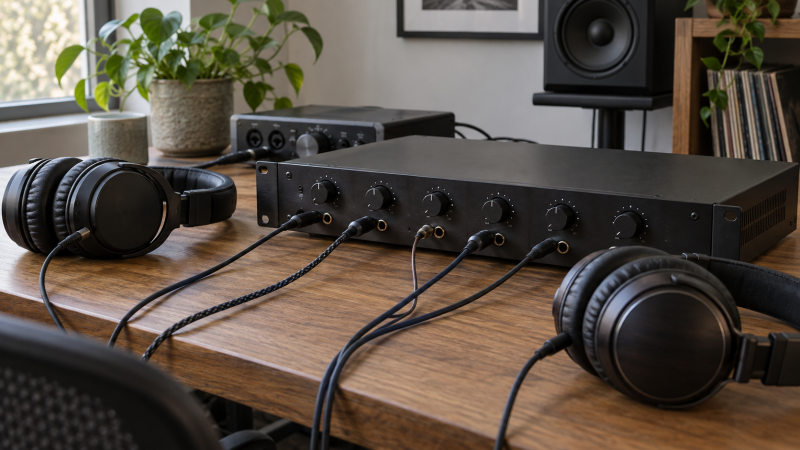
Six headphone sockets do not necessarily mean six different mixes. Before buying a distributor, count the distinct feeds your musicians need, then trace how each feed gets from your interface or mixer to a headphone output. The answer depends on inputs and routing, not the number of jacks on the front panel.
Count the different sounds people need to hear, then check that your interface can send them and your headphone amplifier can distribute them.Start with a listener-and-feed list
Write down every listener and what they need that others do not. A singer may need more of their own vocal and less guitar. A drummer may want more click. An engineer may need an unaffected control-room mix. Two listeners who can use the same balance count as one feed, even if they need separate volume knobs. Two listeners who need different balances count as two feeds unless the headphone system can create those differences from additional inputs.
Keep volume control separate from mix control. A four-way amp that copies one stereo input to four volume knobs makes four listening positions but still starts with one mix. Mackie describes its HM-4 as a compact four-output distributor with a single input. A distributor with one input can be the right answer for a small group sharing a cue mix, but it does not supply four independent source mixes.
For a quick rehearsal, ask each musician to describe their ideal balance in one sentence. If everyone says “the same mix, just louder or quieter,” the simplest distributor may suffice. If each wants “more me” or separate click, keep going. Which outputs, cables, and routing you need upstream depends on that difference.
Check what your interface or mixer can send
Open the interface’s routing software or the mixer’s manual and count independently routable output pairs you can dedicate to monitoring. Do not count the same stereo signal twice merely because it appears on two physical connectors. If outputs 1 to 2 drive the speakers and outputs 3 to 4 can carry a separate cue, you have one separate stereo cue available without repurposing the speaker feed. A mono cue may use one output, but do not assume a headphone amp accepts or distributes it correctly without checking its input wiring.
Check whether those outputs are independently assignable in the recording software you use. Some interfaces can mirror the main mix at additional jacks, while others expose separate software buses. A distributor cannot invent an independent mix that never leaves the interface. PreSonus’s explanation of monitor mixes distinguishes a stereo studio headphone mix from a mono stage monitor send and warns against treating a mixer output as a headphone socket.
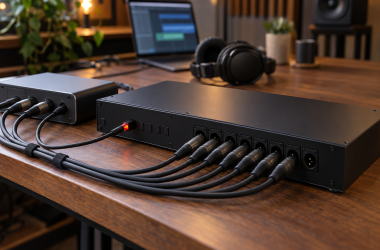
Budget the cable path too. A stereo line-level cue normally needs its left and right channels routed to the correct amplifier inputs. Confirm connector type and balanced/unbalanced wiring at both ends rather than assuming that any quarter-inch cable will preserve a stereo feed. Keep amplifier output intended for headphones distinct from line outputs intended to feed other equipment.
See what the distributor can change locally
Some amplifiers offer one main mix plus an auxiliary input on each channel. Such an amplifier lets a listener blend a shared base mix with a dedicated “more me” feed without needing a separate full mix from the interface. Mackie’s HM-400 page lists an aux input and main/aux balance control per channel. It also lists twelve headphone outputs across four channels. Those twelve sockets are not twelve separately adjustable main/aux mixes. The channel controls are the more useful count for this decision.
In other designs, each station has a choice between two shared buses, plus an individual external feed. PreSonus’s HP60 description lists two stereo main input pairs, a Mix A/B control for each of six channels, and one external stereo input per channel. That arrangement can create different listener balances, but you must still supply the source signals. The controls do not create isolated recordings or extra interface outputs.
ART’s HeadAmp6 Pro page describes an independent auxiliary input and a main/aux balance control per channel. Its two headphone sockets per channel can serve more listeners, but listeners sharing one channel’s controls do not each get their own balance. The distinction is independently controlled channels versus total sockets.
For buying options and exact model tradeoffs, use our headphone distribution amplifier guide. This counting exercise is the first filter. Eliminate any unit whose inputs and per-channel controls cannot cover your listener list.
Make a routing map before ordering
Draw a simple line from each source bus to a physical interface or mixer output, then to an amplifier input and listener station. Label the shared stereo mix, click, and any personal instrument or vocal feeds. If the same feed must reach several people, mark where it is split. If a performer needs a dedicated cue, write down which output carries it. If a box is empty, an output or amp input is missing, and you find out before you buy.
For example, a singer and guitarist may share a backing mix but each want their own instrument louder. One shared stereo bus plus two separate aux sends can suit an amp with one aux input per channel. If the interface only has one independent stereo pair and no additional sends, the amp’s aux controls cannot supply the missing upstream signals. You would need a different routing plan, a personal mixer, or more independently routed outputs. Treat the singer and guitarist case as a planning example, not a claim that every named device supports the exact arrangement.
Test the plan at realistic listening levels and check how talkback, mute, mono switches and click routing behave. Confirm whether two headphone jacks on one channel share its level and balance control. If a second amplifier is daisy-chained, check that its feed carries the intended mix, not merely a copy of the engineer’s monitors. Do not assume a cable splitter creates separate cues.
Frequently asked questions
How many mixes do I need for four musicians?
There is no fixed number. Four musicians who accept the same balance need one feed and four independently controllable listening levels. Four musicians who require different balances need a way to create four outcomes, whether through separate routed mixes or a shared base mix blended with aux signals at each station.
Ask what each person needs to change while tracking. Count a different mix only when the listening balance needs to differ. Then verify both the source outputs and amplifier controls that make each difference possible.
Does a separate volume knob make a mix independent?
No. Volume changes the level of whatever signal reaches that socket. A separate mix requires an independently routed source, a blend of multiple inputs, or another documented per-channel mixing mechanism.
The device’s spec sheet may count “outputs,” “channels,” and “inputs” differently. Inspect the routing diagram or manual and name what each control adjusts before equating any of those counts.
Can I send one click track to only one player?
Yes, if your upstream routing can send click to a separate output and the monitoring chain can deliver that feed only to the intended listener, or blend it into that listener’s channel. The exact setup depends on your interface, recording software and amplifier inputs.
Before a take, mute and unmute the click and listen at each headphone station. By listening at each station, you find a click that was accidentally sent to the shared main bus, and you check the signal path itself rather than a software label.
Bottom line
Count listener-specific balances, not headphone sockets. Confirm the interface can produce the feeds, the amplifier can route or blend them into the required stations, and the cables carry the right signals. Then compare models in the linked buying guide against that map.