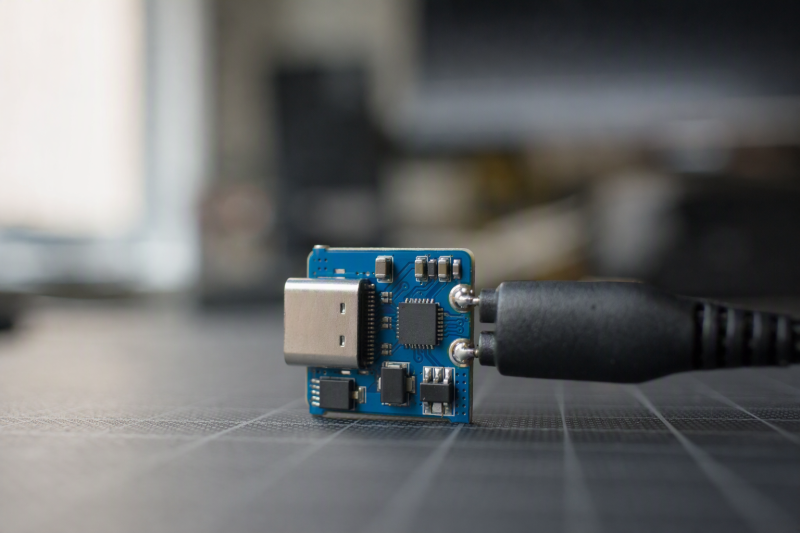
If you need a fixed, predictable DC voltage pulled out of a USB-C Power Delivery source for a maker project, a bench test, or a repair, a PD trigger board is the part that does it. These are small electronic modules, not finished consumer chargers. Each board takes a USB-C PD or QC charger as its input and negotiates a fixed output voltage that a DIP switch or the board’s fixed wiring selects, so you can feed clean 9V, 12V, 15V, or 20V into whatever you are building instead of hacking apart a charger cable.
We reviewed eight active, in-stock USB-C PD trigger and decoy boards, all sourced from their Amazon listings. Every board here establishes the same core identity: a USB-C PD input, a documented fixed or selectable voltage output, and a form factor meant to be wired into a project rather than plugged straight into a device. Where listings differ on pack size, amperage rating, housing, or interface type, we call it out directly, and where a listing is silent on a spec, we say so instead of guessing.
Quick Picks: Best USB-C PD Trigger Boards
- Best DIP-switch voltage selector: Seloky USB-C PD Trigger Board
- Best five-mode voltage selector: Fyntave PD/QC Decoy Trigger Board
- Best housed board for household projects: DWEII Type-C PD3.0 Trigger Board
- Best for notebook power-supply polling: ACEIRMC Type-C PD Decoy Trigger Board
- Best value multi-pack: LIKIER USB-C PD Trigger Board
- Best female-interface board for custom cables: Treedix USB-C PD3.0 Trigger Board
- Best for stocking multiple builds: AITRIP USB-C PD Trigger Board
- Best housed board with a QC trigger case: JUZITAO Type-C PD3.0 Trigger Board
| Image | Product | Details | Check Price |
|---|---|---|---|
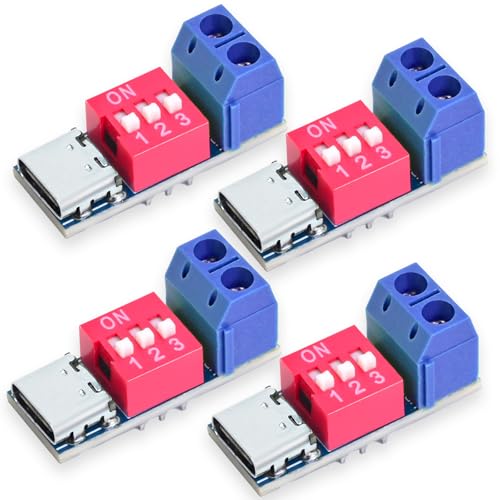 | Seloky USB-C PD Trigger Board Module (4-Pack) | Voltage selection: DIP switch; 5V to 20V Pack size: 4 boards Current rating: Not stated | Check Price on Amazon |
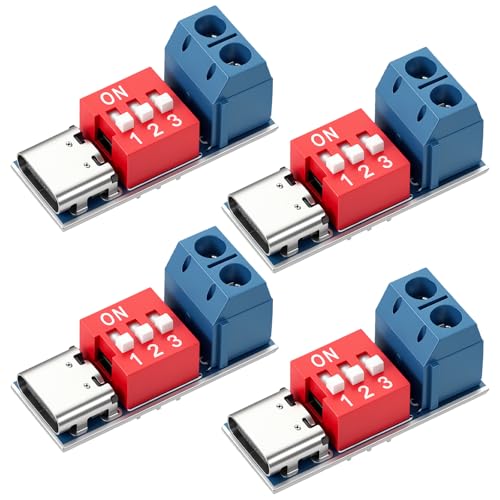 | Fyntave PD/QC Decoy Trigger Board (4-Pack) | Voltage selection: 5 fixed modes; 5V to 20V Pack size: 4 boards Current rating: Not stated | Check Price on Amazon |
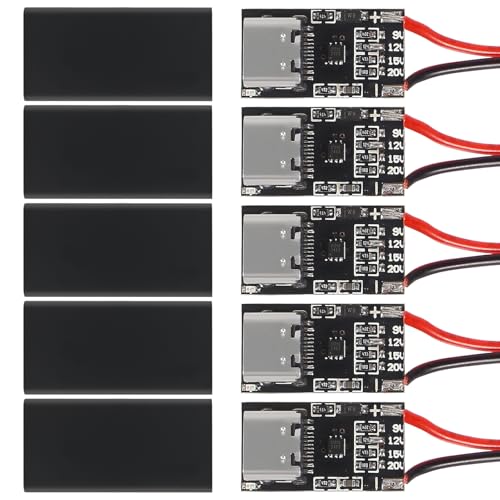 | DWEII Type-C PD3.0 QC Trigger Board (5-Pack) | Voltage steps: 5V / 9V / 12V / 15V / 20V Current rating: 5A Pack size: 5 boards | Check Price on Amazon |
 | ACEIRMC Type-C PD Decoy Trigger Board (4-Pack) | Voltage steps: 5V / 9V / 12V / 15V / 20V Voltage selection: DIP switch Pack size: 4 boards | Check Price on Amazon |
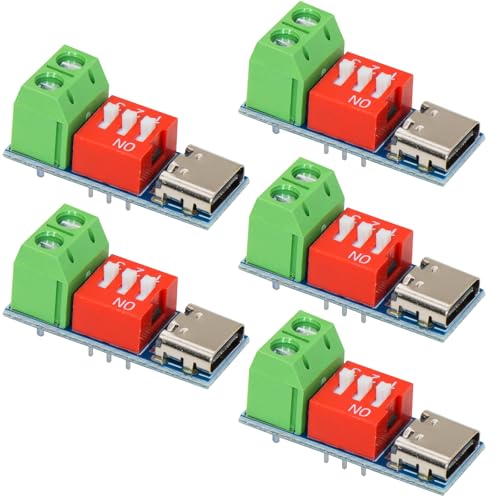 | LIKIER USB-C PD Trigger Board Module (5-Pack) | Voltage steps: 5V / 9V / 12V / 20V Pack size: 5 boards Current rating: Not stated | Check Price on Amazon |
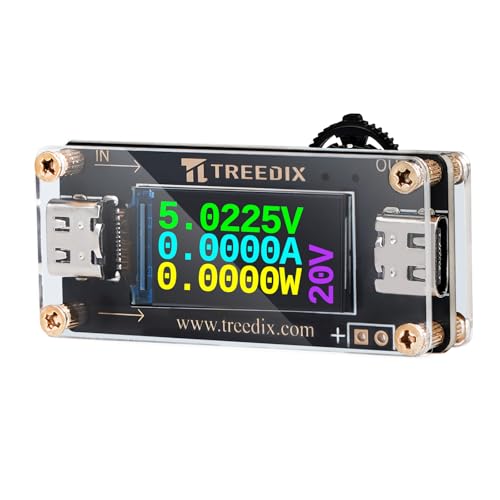 | Treedix USB-C QC PD3.0 Trigger Board Module | Voltage steps: 5V / 9V / 12V / 15V / 20V Current rating: 5A Interface: USB-C female | Check Price on Amazon |
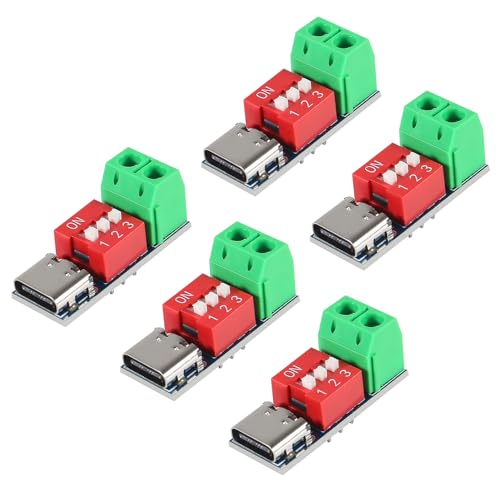 | AITRIP USB-C PD Trigger Board Module (5-Pack) | Voltage steps: 5V / 9V / 12V / 15V / 20V Pack size: 5 boards Current rating: Not stated | Check Price on Amazon |
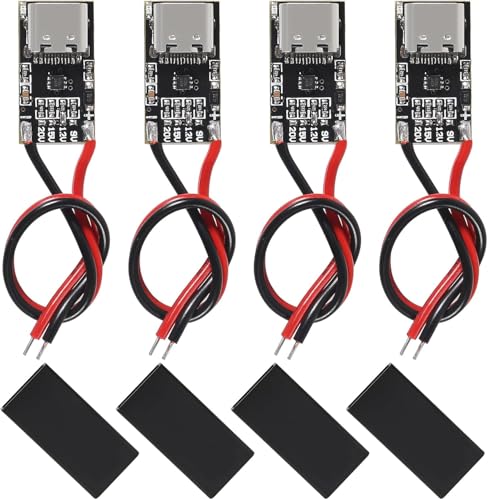 | JUZITAO Type-C PD3.0 QC Trigger Board (4-Pack) | Voltage steps: 5V / 9V / 12V / 15V / 20V Current rating: 5A Pack size: 4 boards | Check Price on Amazon |
Key Takeaway: All eight boards here document a USB-C PD input with a fixed or DIP-switch-selectable output, but they split on real, checkable differences: whether the listing states an amperage rating, whether the board ships in a housing, and whether it wires directly to a cable or exposes a female USB-C port. Match those three details to your project before you match anything else.
1. Seloky USB-C PD Trigger Board (4-Pack) — Best DIP-Switch Voltage Selector
Seloky’s listing identifies this as a USB-C PD trigger board module with a PD/QC decoy role, sold as a four-pack. The listing’s features state a DIP switch adjusts the output from 5V to 20V, and the title calls out a 12V output specifically as a highlighted use case. The listing does not state a current (amperage) rating, so pair it with your project’s own current draw estimate rather than assuming a specific ceiling.
Our Take This is a straightforward DIP-switch board for a builder who wants one part number that can be set to whatever voltage the current project needs, then reset for the next one. The four-pack means you can leave several boards configured at different voltages instead of re-flipping switches between projects.
- Seloky documents a DIP switch covering the full 5V to 20V PD range on one board
- Ships as a four-pack, so multiple projects can each keep their own preset voltage
- Listing highlights a 12V output specifically, useful for common DIY motor and relay projects
- The listing does not state an amperage rating
- No housing is mentioned, so the board ships as a bare PCB
2. Fyntave PD/QC Decoy Trigger Board (4-Pack) — Best Five-Mode Voltage Selector
Fyntave’s listing identifies this as a set of PD/QC decoy boards with a USB-C interface. The features state five fixed voltage modes selectable across the 5V to 20V range, though the listing does not spell out each individual voltage step the way some competing boards do. Fyntave also states aluminum construction, while no current rating is stated on the listing.
Our Take Fyntave combines five selectable voltage modes, a four-pack quantity, and stated aluminum construction. Compare that physical design with Seloky’s listed DIP-switch arrangement, then choose the board whose selection method and construction fit the planned build.
- Fyntave documents five selectable fixed-voltage modes across the 5V to 20V PD range
- Four-pack quantity supports multiple simultaneous project configurations
- USB-C interface confirmed directly in the listing’s feature text
- The listing does not list each individual voltage step by number
- No amperage rating is documented
3. DWEII Type-C PD3.0 Trigger Board (5-Pack) — Best Housed Board for Household Projects
DWEII’s title is one of the most explicit in this set: a Type-C PD3.0 QC trigger board with fixed output steps at 5V, 9V, 12V, 15V, and 20V, a 5A current rating, and housing included. The listing markets it for household electronics use, and it is one of only two boards in this roundup, alongside the JUZITAO board below, whose listing explicitly states a protective housing ships with the module rather than a bare PCB.
Our Take DWEII pairs the full five-step voltage set with a stated 5A rating and a housing in the same listing, which is a more complete spec sheet than several of the bare-board options here. If you want a board you can actually leave sitting on a desk rather than one that needs its own enclosure, this is the more finished-feeling option of the set.
- DWEII states the full 5V, 9V, 12V, 15V, and 20V fixed-voltage step set
- Documents a 5A current rating directly in the title
- Ships with housing, unlike most bare-board options in this set
- Five-pack quantity for stocking multiple projects at once
- Offer status shows in-stock but scarce at the time of this listing snapshot
- Fixed voltage steps mean no in-between custom output
4. ACEIRMC Type-C PD Decoy Trigger Board (4-Pack) — Best for Notebook Power-Supply Polling
ACEIRMC’s title describes this board with an unusual pair of terms not used by the other seven listings here: “Polling Detector.” Combined with a notebook power-supply framing, the listing positions this board for checking what voltage modes a laptop-style USB-C PD source actually offers, in addition to its stated role as a decoy trigger board with 5V, 9V, 12V, 15V, and 20V fixed-voltage output selected by a DIP switch.
Our Take The “polling detector” language in ACEIRMC’s own title suggests this board is aimed at diagnosing what a given USB-C PD charger or laptop power brick supports, not just pulling a fixed voltage for a build. If your project is figuring out what a mystery PD source can deliver before you commit to it, this listing’s framing fits that job more directly than the others.
- The listing does not state a current (amperage) rating
- No housing is mentioned in the listing
5. LIKIER USB-C PD Trigger Board (5-Pack) — Best Value Multi-Pack
LIKIER’s listing identifies a USB-C PD trigger board and PD/QC decoy set, with the title stating conversion to 5V, 9V, 12V, or 20V output. Unlike the DWEII, ACEIRMC, Treedix, and JUZITAO listings, LIKIER’s title does not include a 15V step, so treat that voltage as undocumented for this specific board rather than assuming it is simply omitted from the title.
Our Take A five-pack at this voltage range is a reasonable pick when your projects only ever need 5V, 9V, 12V, or 20V and you would rather have five boards on hand than chase down replacements mid-project. If 15V specifically is a requirement, confirm it against the current listing before ordering, since LIKIER’s own title does not list it.
- LIKIER documents 5V, 9V, 12V, and 20V fixed output modes
- Five-pack quantity for stocking multiple simultaneous projects
- USB Type-C input confirmed in the title
- The title does not list a 15V step, unlike several other boards in this set
- No amperage rating or housing documented
6. Treedix USB-C PD3.0 Trigger Board — Best Female-Interface Board for Custom Cables
Treedix’s title stands apart from the rest of this set in two specific, documented ways. First, it describes a Type-C female interface rather than a board wired directly into a fixed cable, meaning you supply your own USB-C cable to connect it to a power source. Second, its title states the broadest explicit protocol compatibility list here: PD2.0, PD3.0, QC2.0, QC3.0, and BC1.2. The listing also states a 5A current rating and the full 5V, 9V, 12V, 15V, and 20V fixed voltage steps.
Our Take A female USB-C port instead of a captive cable is a real, checkable design choice, and it matters for a build where you need to route the cable a specific way, swap cable lengths, or mount the board somewhere a fixed pigtail would not reach cleanly. Combined with the widest documented protocol list in this comparison, Treedix’s board is the one to reach for when the project needs flexibility in how it physically connects, not just which voltage it outputs.
- Treedix documents a Type-C female interface, so any USB-C cable can connect it rather than a fixed captive lead
- States the broadest protocol compatibility list here: PD2.0, PD3.0, QC2.0, QC3.0, and BC1.2
- Documents a 5A rating and the full 5V through 20V voltage step set
- The title does not state a pack quantity the way most other boards here do
- A female-interface board needs a separate USB-C cable to function, an extra part some builders will already have and others will not
7. AITRIP USB-C PD Trigger Board (5-Pack) — Best for Stocking Multiple Builds
AITRIP’s listing identifies a five-pack of USB-C PD trigger and decoy boards. Its feature text states the full 5V, 9V, 12V, 15V, and 20V fixed-output set, USB Type-C PD support, and ABS material. No amperage rating is documented on the listing.
Our Take AITRIP is the five-pack choice when a project needs any of the five documented fixed-voltage steps, including 15V, and spare boards are useful. Its ABS construction is stated, but the missing amperage rating still requires a separate check when project current draw is a hard requirement.
- AITRIP documents 5V, 9V, 12V, 15V, and 20V fixed output modes
- Five-pack quantity keeps spare boards on hand for multiple builds
- USB Type-C PD support and ABS material are stated in the feature text
- No amperage rating is documented
- The listing does not establish a particular protective case around the board
8. JUZITAO Type-C PD3.0 Trigger Board (4-Pack) — Best Housed Board with a QC Trigger Case
JUZITAO’s title closely mirrors DWEII’s: a Type-C PD3.0 QC trigger board with the full 5V, 9V, 12V, 15V, and 20V fixed-voltage step set, a stated 5A rating, and housing described specifically as a QC trigger housing. Like DWEII, the listing markets it for household electronics use, and it is the second of the two housed boards in this comparison.
Our Take JUZITAO covers the same documented ground as DWEII, full voltage set, 5A rating, and housing, in a four-pack instead of a five-pack. Between the two housed boards, the choice is mostly pack size and price, since neither listing states a spec the other lacks.
- JUZITAO documents the full 5V, 9V, 12V, 15V, and 20V fixed-voltage step set
- States a 5A current rating directly in the title
- Ships with a QC trigger housing, matching DWEII as one of two housed boards here
- Four-pack quantity, one fewer board than the DWEII five-pack for a similar spec set
- Fixed voltage steps mean no in-between custom output
Buying Guide: How to Choose a USB-C PD Trigger Board
A USB-C PD trigger board is a small component, not a finished product you plug in and forget. Getting the right one for a project means checking a handful of specific, listing-documented details against what your build actually needs, rather than assuming all eight boards above are interchangeable.
Match the Fixed-Voltage Set to Your Project’s Power Requirement
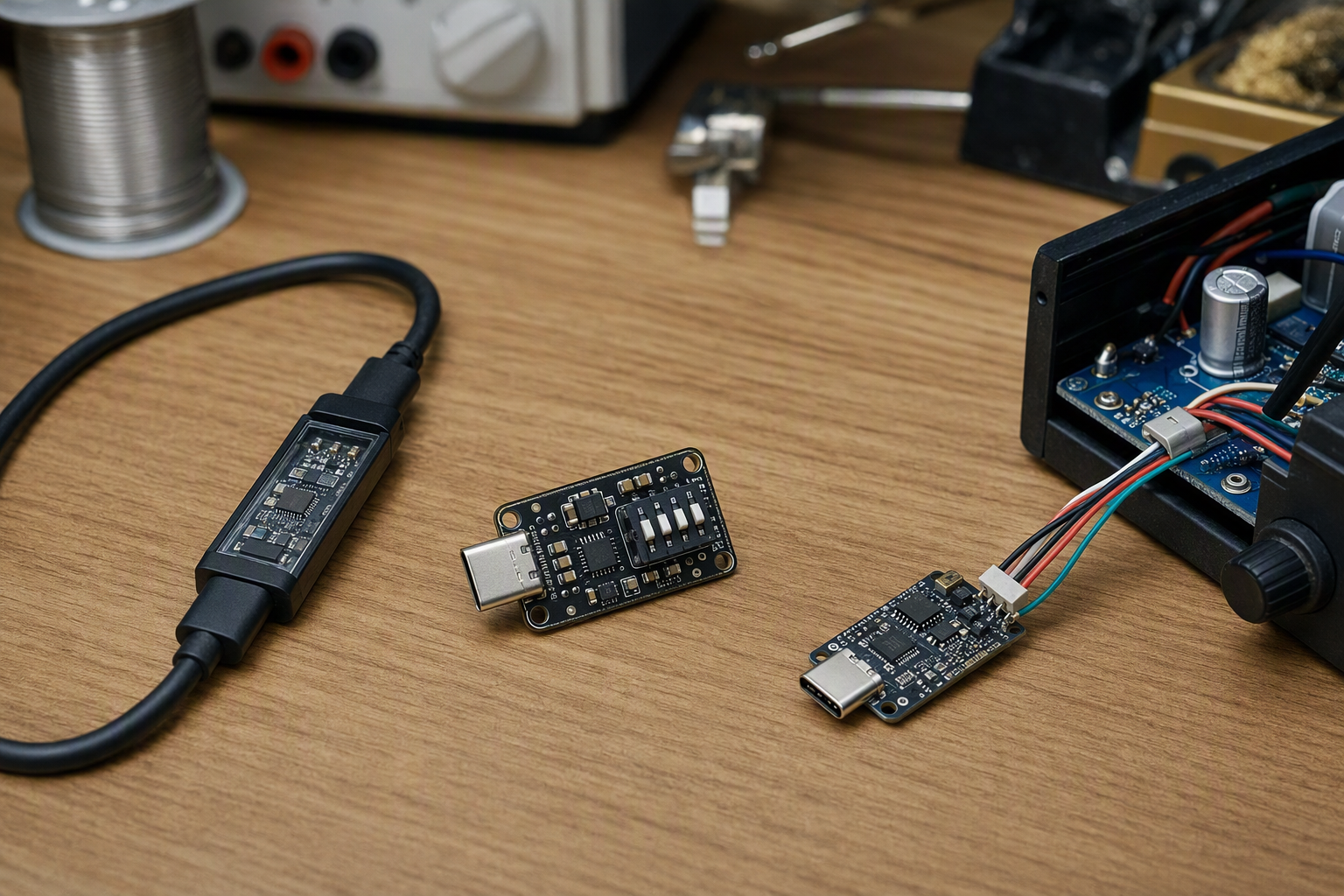
The single most important spec on any trigger board is which voltage steps it actually outputs. DWEII, ACEIRMC, Treedix, AITRIP, and JUZITAO state the full five-step set of 5V, 9V, 12V, 15V, and 20V directly in their listings. LIKIER states four steps, 5V, 9V, 12V, and 20V, with no 15V mentioned in its title or feature text. Seloky and Fyntave describe a DIP-switch range of 5V to 20V without listing every individual step by number.
If your project specifically needs a 15V rail, a board that does not list it in its own listing is not a safe assumption to build around. Check the current listing for the exact board you are ordering before committing a design to a particular voltage, since even boards that look nearly identical in a comparison table can differ on this one detail. A gap in a title is not proof the board cannot do it, but it is also not proof that it can, so treat an unlisted voltage step as unconfirmed rather than simply missing from our summary.
DIP-Switch Selection vs Fixed Multi-Mode Output
Several boards here, including Seloky and ACEIRMC, describe a DIP switch as the mechanism that sets the output voltage, letting you flip a physical switch to change modes on the same board. Others describe the same multi-voltage capability without singling out a DIP switch by name, such as Fyntave‘s “five fixed voltage modes” language, which may use a different physical selection method the listing does not spell out.
The practical difference for a builder is how often you expect to reconfigure the same physical board. A DIP-switch board is convenient when one board serves several projects over time, since you can reset it in seconds instead of buying a second unit. If you are setting up a permanent installation that will always run at one voltage, the selection mechanism matters less, and a lower-cost board without a documented switch mechanism can do the same job just as well once it is configured and left alone.
Housed Boards vs Bare PCB Modules
Two boards in this set, DWEII and JUZITAO, explicitly state that their listings include a protective housing around the trigger circuitry. Fyntave separately states aluminum construction, and AITRIP states ABS material, but those descriptions are not the same as an explicit protective-case claim. Confirm the physical protection needed before leaving a board exposed in a project.
A housed board is the safer default for a project where the board will sit exposed on a desk, inside an enclosure with other components, or anywhere a bare PCB edge could short against something metal. A bare board is not automatically a problem, since most maker projects mount the PCB inside their own enclosure anyway, but it does mean you are responsible for that mechanical protection yourself rather than getting it out of the box.
Built-In Cable vs Female USB-C Port
Every board in this comparison except one, Treedix, appears to connect via whatever fixed lead or connector its own listing describes without calling out a female USB-C port specifically. Treedix‘s listing is explicit that its interface is a Type-C female port, meaning you supply your own USB-C cable rather than relying on a lead built into the board.
This distinction matters for physical layout more than for electrical performance. A female-interface board gives you control over cable length and routing, which helps when the trigger board needs to sit somewhere a fixed pigtail cannot comfortably reach, or when you want to swap a damaged cable without replacing the whole board. A board with a built-in lead is simpler to wire in a hurry, since there is one fewer part to source, but it ties the board’s physical position to whatever length that lead happens to be.
Pack Size, Redundancy, and Per-Board Cost
Pack sizes across this comparison run from single units up to five-packs. DWEII, LIKIER, and AITRIP ship as five-packs. Seloky, Fyntave, ACEIRMC, and JUZITAO ship as four-packs. Treedix‘s title does not state a pack quantity, which most often indicates a single-unit listing, though you should confirm the exact quantity on the current listing before ordering if you need more than one.
Buying a multi-pack makes sense when you are outfitting several projects at once, or when you want spares on hand in case a board fails during testing. A single board makes more sense when you only have one build in mind and do not want unused inventory sitting in a parts drawer. Compare the per-board cost across pack sizes rather than the sticker price alone, since a five-pack and a four-pack at a similar total price can have meaningfully different per-unit economics.
Frequently Asked Questions
What is a USB-C PD trigger board and how does it work?
A USB-C PD trigger board is a small electronic module that plugs into a USB-C Power Delivery source, such as a PD-capable wall charger or power bank, and negotiates a specific fixed output voltage from that source. Instead of the variable, negotiated voltage a normal USB-C device receives, the trigger board tells the charger it wants a fixed rail, commonly one of the standard PD steps like 9V, 12V, 15V, or 20V, and the charger responds by supplying that voltage on the board’s output terminals.
Builders use these boards to tap the fixed-voltage output for projects that need clean DC power but were not designed with USB-C PD negotiation logic of their own, things like small motors, LED strips, relay boards, or bench test setups. All eight boards in this comparison, from Seloky and Fyntave‘s DIP-switch designs to Treedix‘s female-interface board, perform this same core function. They differ on which voltage steps they document, whether they state a current rating, and physical details like housing and connector type, as covered in the buying guide above.
Can I use a PD trigger board to power a Raspberry Pi or other single-board computer?
The listings in this comparison describe general-purpose fixed-voltage output modules, not boards designed or certified specifically for any particular single-board computer. None of the eight product listings here name a Raspberry Pi, Arduino, or similar board by model, so treat compatibility with a specific device as something you confirm separately rather than something these listings establish.
What the listings do document is the fixed-voltage output each board can produce, which is the number you would need to match against whatever your target device’s power input actually requires. A few things to check before wiring a trigger board into any single-board computer or other electronics project:
- Confirm the device’s required input voltage against the exact voltage step the board is set to output, since a mismatch can damage sensitive electronics.
- Check whether the board states a current rating, as only DWEII, Treedix, and JUZITAO document a 5A figure in this comparison. The others do not state an amperage ceiling.
- Verify the physical connector or output terminals match how you plan to wire the board into your project, since some boards here use a female USB-C port and others describe a fixed lead.
We are not making a specific wiring or safety recommendation beyond what each listing documents, since none of the eight packets we reviewed include manufacturer wiring diagrams or independent safety certification data.
Do these boards work with any USB-C PD charger?
Each listing in this comparison documents PD or PD/QC decoy functionality, meaning the board is built to negotiate with a Power Delivery source specifically, not just any USB-C port. Treedix‘s listing goes furthest in stating explicit protocol compatibility, naming PD2.0, PD3.0, QC2.0, QC3.0, and BC1.2 directly. The other seven listings describe PD and, in most cases, QC decoy functionality without listing every protocol version by name.
In practice, a trigger board can only output a voltage step that the connected charger actually supports and is willing to negotiate. A charger that only offers 5V and 9V, for example, will not hand a trigger board a 20V rail no matter how the board’s switch is set, because the negotiation happens between the board and the charger’s own PD controller. If your build depends on a specific higher voltage step like 20V, confirm your charger supports that step independently of which trigger board you buy, since the trigger board can only request what the charger is capable of delivering.
Is a DIP-switch board safer or more reliable than a fixed-output board?
None of the eight listings in this comparison state independent safety certification, testing, or reliability data beyond their own product descriptions, so we are not able to make a comparative safety claim between the DIP-switch boards and the others based on the evidence available here. What we can document is the mechanical difference: a DIP-switch board, like Seloky or ACEIRMC, lets you change the output voltage after the board is already wired in, while a board without a documented switch mechanism may require re-wiring or reconfiguration to change modes.
That mechanical flexibility is a convenience feature, not a safety feature on its own. Whether a given board is appropriate for your project depends on matching its documented voltage and current specs to your build’s actual requirements, and on your own judgment about wiring and enclosure practices, which is outside what any of these eight Amazon listings claim to certify.
What’s the difference between a PD trigger board and a decoy board?
In the listings we reviewed, “trigger board” and “decoy board” are used largely interchangeably by the sellers themselves. Seloky, Fyntave, LIKIER, and AITRIP all use “decoy” language directly in their titles alongside “trigger board,” and ACEIRMC‘s title uses “decoy trigger” as a single combined term. The underlying function each listing describes is the same: negotiating a fixed voltage from a PD source rather than accepting whatever variable voltage a standard USB-C connection would otherwise provide.
The term “decoy” in this context refers to the board impersonating a device that requests a specific fixed voltage from the charger’s negotiation logic, tricking the charger into locking to that rail. It is not a separate product category from a trigger board. When comparing listings, focus on the documented voltage steps, amperage rating, and physical interface rather than whether the seller’s title uses “trigger,” “decoy,” or both, since all eight boards here perform the same core negotiation function regardless of which term appears in the title.
How many amps can these boards actually deliver?
Current (amperage) rating is one of the least consistently documented specs across this comparison. Only three of the eight listings state a specific figure:
- DWEII states a 5A rating directly in its title.
- Treedix states a 5A rating directly in its title.
- JUZITAO states a 5A rating directly in its title.
The remaining five boards, Seloky, Fyntave, ACEIRMC, LIKIER, and AITRIP, do not state an amperage figure anywhere in the title or feature text we reviewed. That is a documented gap rather than evidence those boards are limited to a lower current, so if your project’s current draw is a hard requirement, prioritize one of the three boards with a stated 5A rating, or check the current listing for the specific board you are considering before assuming a figure that was never published.
A Note on Our Sourcing for This Guide
Every spec in this article comes from each product’s own Amazon listing, gathered through Amazon’s product data API. None of the eight listings in this comparison were cross-checked against a manufacturer’s own website, because these are unbranded or small-brand electronics modules without an independent manufacturer page to verify against. That means every voltage, amperage, housing, and interface claim above reflects what the seller states on Amazon, not an independent lab measurement or a manufacturer datasheet.
Where a listing was silent on a spec, such as an amperage rating or a housing, we said so directly rather than assuming the board lacks that feature. Offer availability, pricing, and exact stock status change constantly on Amazon, so confirm the current listing for any board before ordering, particularly for a project where a specific voltage step or current rating is a hard requirement rather than a nice-to-have.